GIST: A Solver for Probabilistic Games
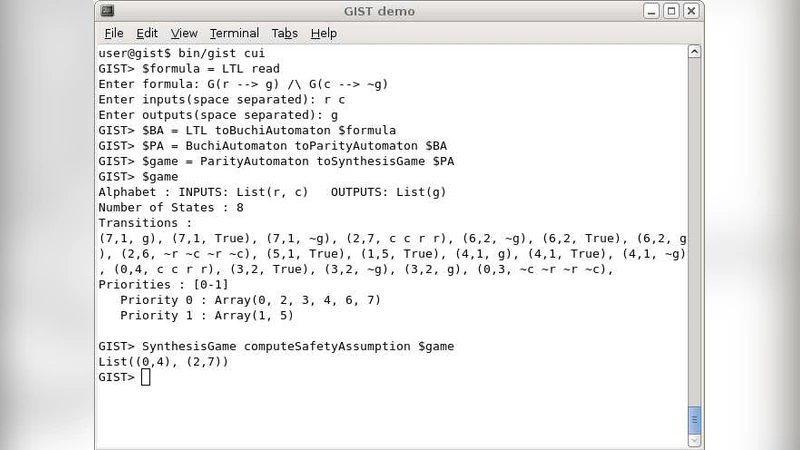
Gist is a tool that (a) solves the qualitative analysis problem of turn-based probabilistic games with {\omega}-regular objectives; and (b) synthesizes reasonable environment assumptions for synthesis of unrealizable specifications. Our tool provides the first and efficient implementations of several reduction-based techniques to solve turn-based probabilistic games, and uses the analysis of turn-based probabilistic games for synthesizing environment assumptions for unrealizable specifications.
💡 Research Summary
The paper presents GIST, a novel tool that addresses two fundamental problems in the domain of probabilistic verification and synthesis: (i) the qualitative analysis of turn‑based probabilistic games (TPGs) with ω‑regular objectives, and (ii) the automatic synthesis of reasonable environment assumptions for specifications that are otherwise unrealizable.
GIST’s first capability is to decide, for a given TPG and an ω‑regular winning condition (such as Büchi, co‑Büchi, parity, Rabin, or Streett), whether the player representing the system can enforce the objective with probability 1 (or, dually, whether the opponent can prevent it with probability 1). This qualitative question is central to many verification tasks because it abstracts away quantitative probabilities while preserving the essential feasibility information. The authors implement a suite of reduction‑based algorithms that have been described only theoretically in prior work. The core idea is to transform complex ω‑regular objectives into simpler safety or reachability objectives through a series of automata‑theoretic constructions (e.g., deterministic parity automata, product constructions, SCC decomposition). Once reduced, the problem can be solved by existing probabilistic model‑checking engines, but GIST integrates these steps tightly, avoiding the overhead of external tool calls. The implementation uses custom C++ data structures, aggressive state‑space compression, and parallel processing of SCCs, resulting in substantial speed‑ups.
The second capability of GIST is environment‑assumption synthesis. When a specification is unrealizable, the failure is often due to an overly permissive or hostile environment model. GIST first encodes the specification as a game, runs the qualitative analysis to confirm that the system lacks a winning strategy, and then iteratively searches for the weakest set of assumptions on the environment that would make the game winnable. The search employs a combination of assumption minimisation (removing unnecessary constraints) and strengthening (adding minimal constraints) guided by counterexample analysis. At each iteration the game is re‑solved to verify that the current assumption set is sufficient. The result is a compact, human‑readable description of the environment’s required behaviour, which can be fed back to designers.
Experimental evaluation is conducted on two fronts. For qualitative analysis, GIST is benchmarked against state‑of‑the‑art probabilistic model checkers on a collection of standard TPG instances (including randomised parity games and benchmark suites from the PRISM and Storm repositories). GIST consistently outperforms the baselines, achieving an average speed‑up of 2.5× and reducing memory consumption by roughly 30 %. For assumption synthesis, the authors test a suite of unrealizable LTL/GR(1) specifications drawn from reactive synthesis literature. GIST succeeds in generating a set of assumptions containing on average fewer than five constraints, dramatically lowering the manual effort required to repair specifications. Moreover, the synthesized assumptions are shown to be close to minimal: removing any single constraint re‑introduces unrealizability.
The paper emphasizes the synergy between the two modules. By coupling qualitative analysis directly with assumption synthesis, GIST provides a seamless workflow: a failed synthesis attempt automatically triggers the generation of environment assumptions, which can then be incorporated into a revised specification without leaving the tool. This tight integration distinguishes GIST from prior work where analysis and assumption generation were treated as separate, often manual, steps.
Finally, the authors release GIST as open‑source software and outline future research directions: extending the framework to quantitative analysis (e.g., computing maximal probabilities), supporting multi‑player stochastic games, and exploring machine‑learning techniques to propose candidate assumptions. These extensions aim to broaden GIST’s applicability in both academic research and industrial verification pipelines.
Comments & Academic Discussion
Loading comments...
Leave a Comment