The Indirect Search for Dark Matter with IceCube
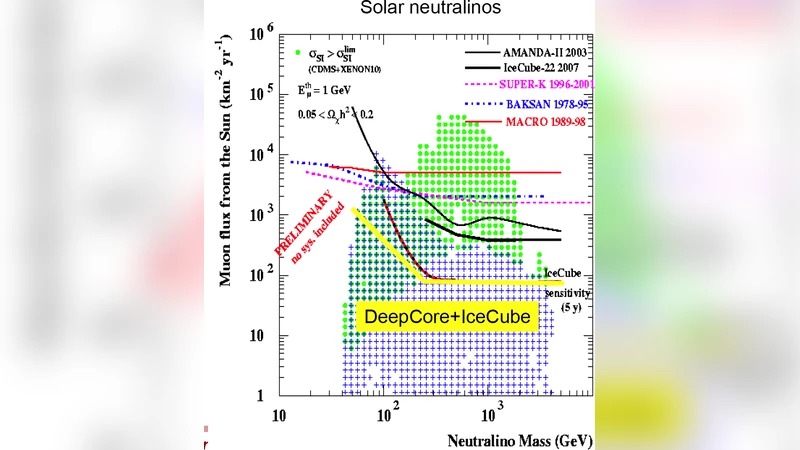
We revisit the prospects for IceCube and similar kilometer-scale telescopes to detect neutrinos produced by the annihilation of weakly interacting massive dark matter particles (WIMPs) in the Sun. We emphasize that the astrophysics of the problem is understood; models can be observed or, alternatively, ruled out. In searching for a WIMP with spin-independent interactions with ordinary matter, IceCube is only competitive with direct detection experiments if the WIMP mass is sufficiently large. For spin-dependent interactions IceCube already has improved the best limits on spin-dependent WIMP cross sections by two orders of magnitude. This is largely due to the fact that models with significant spin-dependent couplings to protons are the least constrained and, at the same time, the most promising because of the efficient capture of WIMPs in the Sun. We identify models where dark matter particles are beyond the reach of any planned direct detection experiments while being within reach of neutrino telescopes. In summary, we find that, even when contemplating recent direct detection results, neutrino telescopes have the opportunity to play an important as well as complementary role in the search for particle dark matter.
💡 Research Summary
The paper revisits the potential of kilometer‑scale neutrino telescopes such as IceCube to detect neutrinos generated by the annihilation of weakly interacting massive particles (WIMPs) captured in the Sun. After a concise introduction that contrasts indirect neutrino searches with direct detection experiments, the authors lay out the astrophysical framework governing WIMP capture. Capture is driven by elastic scattering off solar nuclei; because the Sun is composed primarily of hydrogen, spin‑dependent (SD) interactions with protons dominate the capture rate for models where the WIMP couples to nuclear spin. In contrast, spin‑independent (SI) interactions rely on heavier nuclei and are therefore less efficient in the Sun, making indirect detection less competitive for SI‑dominant models unless the WIMP mass is very large.
The authors then discuss the equilibrium condition between capture and annihilation. When equilibrium is reached, the annihilation rate—and thus the neutrino flux—is directly proportional to the capture rate, rendering the prediction largely independent of the uncertain annihilation cross‑section. The annihilation products (b‑quarks, τ‑leptons, gauge bosons, etc.) decay into high‑energy neutrinos that travel unimpeded to Earth.
IceCube’s detection principle is explained: Cherenkov light from muons produced by charged‑current νμ interactions is recorded by an array of optical modules embedded in Antarctic ice. By selecting upward‑going muon tracks from the direction of the Sun and applying stringent background rejection, IceCube can isolate a potential dark‑matter signal. Using existing data, including the DeepCore sub‑array that lowers the energy threshold, the authors derive limits on the SD WIMP‑proton scattering cross‑section that improve upon the best direct‑detection bounds by roughly two orders of magnitude. For SI interactions, IceCube becomes competitive only for WIMP masses above several hundred GeV, where the higher‑energy neutrino spectrum improves signal‑to‑background discrimination.
A systematic scan of supersymmetric (MSSM), Kaluza‑Klein, and other non‑standard models is presented. Many viable scenarios feature dominant SD couplings and lie below the reach of current or near‑future direct‑detection experiments, yet they produce neutrino fluxes well within IceCube’s sensitivity. The paper highlights that forthcoming upgrades—IceCube‑Gen2 and additional dense instrumentation—will extend the reach to multi‑TeV WIMP masses, probing parameter space that is essentially inaccessible to any planned direct‑detection technology.
In the concluding discussion, the authors emphasize the complementary nature of neutrino telescopes. While direct searches excel at constraining SI interactions and low‑mass WIMPs, IceCube uniquely probes SD‑dominant models and high‑mass regimes through solar capture. The astrophysics of capture and annihilation is sufficiently understood to allow robust exclusion of models, and the existing IceCube data already set the most stringent limits on SD WIMP‑proton scattering. Consequently, neutrino telescopes remain a vital component of the global dark‑matter search strategy, capable of discovering or ruling out classes of WIMP candidates that would otherwise evade detection.
Comments & Academic Discussion
Loading comments...
Leave a Comment