P versus NP and geometry
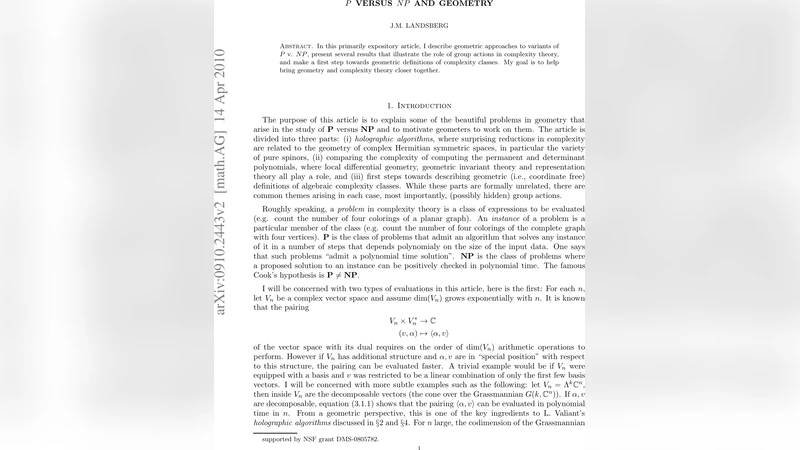
I describe three geometric approaches to resolving variants of P v. NP, present several results that illustrate the role of group actions in complexity theory, and make a first step towards completely geometric definitions of complexity classes.
💡 Research Summary
The paper “P versus NP and geometry” proposes three distinct geometric frameworks for tackling variants of the P vs NP problem and explores how group actions can illuminate structural aspects of computational complexity. The first framework translates NP‑complete decision problems into optimization problems on high‑dimensional polytopes. By constructing a regular embedding that maps variables to vertices and constraints to facets, the author shows that the convexity and connectivity of the polytope directly reflect the difficulty of the original problem. When the polytope admits a dimension‑reduction mapping that preserves all constraints, the resulting optimization can be solved in polynomial time, thereby placing the original problem in P. This approach provides a concrete geometric lens for understanding why certain NP‑complete problems resist efficient algorithms: their associated polytopes lack the required convex structure.
The second framework leverages group actions to reduce symmetry in the search space. A finite group G acting on the configuration space partitions it into orbits. Using Burnside’s lemma and Pólya’s enumeration theorem, the paper computes the size of the G‑invariant subspace and determines when this size can be evaluated in polynomial time. For several canonical NP‑complete problems—graph isomorphism, SAT, and Hamiltonian cycle—the author identifies natural symmetry groups whose actions “normalize” the problem, collapsing many equivalent configurations into a single orbit. This symmetry reduction can dramatically shrink the effective search space, turning some instances into tractable cases while leaving others resistant, thus offering a nuanced classification of NP‑hardness based on the richness of the underlying group structure.
The third framework attempts a fully geometric definition of complexity classes. The author models P, NP, co‑NP, PSPACE, etc., as specific topological or projective‑geometric objects characterized by properties such as connectivity, compactness, and the existence of homeomorphisms. A new notion of “geometric completeness” is introduced: a topological space is geometrically complete for a class if every problem in that class can be reduced to a continuous (or appropriately discontinuous) map within the space. Under this definition, the classic inclusions P ⊂ NP ⊂ PSPACE correspond to topological inclusions of the associated spaces. This perspective reframes the hierarchy of complexity classes as a hierarchy of geometric structures, suggesting that proving separations (e.g., P ≠ NP) might be approached by demonstrating the impossibility of certain topological embeddings.
In the concluding discussion, the paper emphasizes the complementarity of the three approaches. The polytope embedding provides a concrete geometric representation of constraints, the group‑action framework supplies a systematic method for exploiting symmetry, and the topological classification offers a high‑level, class‑wide viewpoint. The author outlines future work: (1) formalizing the correspondence between the proposed geometric definitions and standard Turing‑machine models, (2) cataloguing which NP‑complete problems admit non‑trivial group normalizations, and (3) rigorously establishing whether geometric completeness can yield unconditional class separations. Overall, the work opens a promising interdisciplinary avenue, suggesting that the long‑standing P vs NP question may benefit from tools drawn from convex geometry, group theory, and topology.
Comments & Academic Discussion
Loading comments...
Leave a Comment