Dark Matter Disc Enhanced Neutrino Fluxes from the Sun and Earth
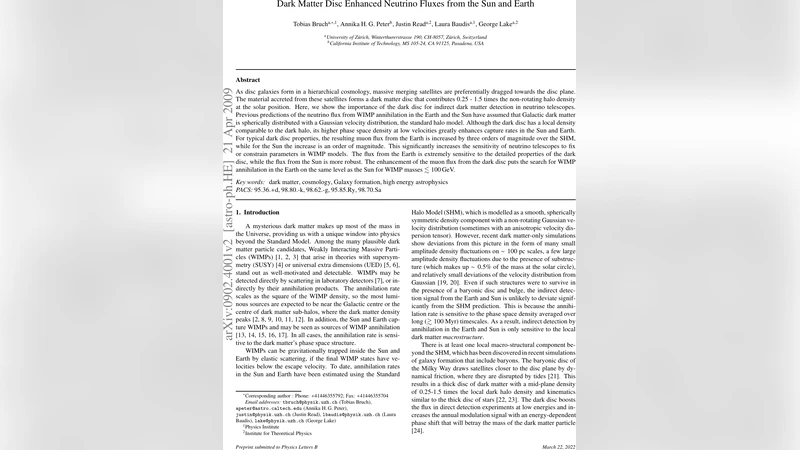
As disc galaxies form in a hierarchical cosmology, massive merging satellites are preferentially dragged towards the disc plane. The material accreted from these satellites forms a dark matter disc that contributes 0.25 - 1.5 times the non-rotating halo density at the solar position. Here, we show the importance of the dark disc for indirect dark matter detection in neutrino telescopes. Previous predictions of the neutrino flux from WIMP annihilation in the Earth and the Sun have assumed that Galactic dark matter is spherically distributed with a Gaussian velocity distribution, the standard halo model. Although the dark disc has a local density comparable to the dark halo, its higher phase space density at low velocities greatly enhances capture rates in the Sun and Earth. For typical dark disc properties, the resulting muon flux from the Earth is increased by three orders of magnitude over the SHM, while for the Sun the increase is an order of magnitude. This significantly increases the sensitivity of neutrino telescopes to fix or constrain parameters in WIMP models. The flux from the Earth is extremely sensitive to the detailed properties of the dark disc, while the flux from the Sun is more robust. The enhancement of the muon flux from the dark disc puts the search for WIMP annihilation in the Earth on the same level as the Sun for WIMP masses < 100 GeV.
💡 Research Summary
The paper investigates how a dark matter disc, a structure predicted to form as massive satellite galaxies are dragged into the plane of a galactic disc during hierarchical assembly, influences indirect dark‑matter searches using neutrino telescopes. Traditional calculations of neutrino flux from WIMP (Weakly Interacting Massive Particle) annihilation in the Sun and Earth assume a spherically symmetric halo with a Gaussian velocity distribution – the Standard Halo Model (SHM). In contrast, the dark disc contributes a local density comparable to that of the non‑rotating halo (0.25–1.5 times the halo density at the solar radius) but possesses a markedly higher phase‑space density at low velocities. Because WIMP capture in a celestial body is most efficient for particles moving slower than the escape velocity, the disc’s surplus of low‑speed WIMPs dramatically boosts capture rates.
Using realistic disc parameters (mean rotation ≈150 km s⁻¹, velocity dispersion 50–100 km s⁻¹), the authors compute capture rates for both the Earth and the Sun. For the Earth, the capture enhancement reaches roughly three orders of magnitude relative to the SHM, while for the Sun the increase is about an order of magnitude. This translates into muon fluxes from WIMP annihilation that are 10³ times larger for the Earth and ten times larger for the Sun. Consequently, neutrino telescopes become sensitive to WIMP–nucleon cross sections far below current limits, even for cross sections as low as 10⁻⁴⁶ cm².
A key implication is that, for WIMP masses below ~100 GeV, the Earth’s neutrino signal becomes comparable to that of the Sun, overturning the conventional view that solar searches dominate indirect detection. The Earth‑based signal is highly dependent on the precise properties of the dark disc (density, velocity dispersion, lag speed), offering a potential probe of the disc’s characteristics through observed muon rates. In contrast, the solar signal is more robust because the Sun’s deep gravitational well and high core temperature already ensure efficient capture; the disc merely adds a modest factor.
The authors discuss experimental relevance, noting that current and upcoming neutrino observatories such as IceCube, KM3NeT, and ANTARES possess the sensitivity required to test these predictions. Detection of an enhanced muon flux from the Earth would not only strengthen constraints on WIMP models but also provide indirect evidence for the existence and dynamical properties of a dark matter disc in the Milky Way. The paper concludes by advocating a combined analysis of solar and terrestrial neutrino data to disentangle halo and disc contributions, thereby refining both particle‑physics parameters and our understanding of Galactic dark‑matter structure.
Comments & Academic Discussion
Loading comments...
Leave a Comment