A new twist on excited dark matter: implications for INTEGRAL, PAMELA/ATIC/PPB-BETS, DAMA
We show that the 511 keV gamma ray excess observed by INTEGRAL/SPI can be more robustly explained by exciting dark matter (DM) at the center of the galaxy, if there is a peculiar spectrum of DM states chi_0, chi_1 and chi_2, with masses M_0 ~ 500 GeV, M_1 <~ M_0 + 2 m_e, and M_2 = M_1 + delta M >~ M_0 + 2 m_e. The small mass splitting delta M should be <~ 100 keV. In addition, we require at least two new gauge bosons (preferably three), with masses ~100 MeV. With this spectrum, chi_1 is stable, but can be excited to chi_2 by low-velocity DM scatterings near the galactic center, which are Sommerfeld-enhanced by two of the 100 MeV gauge boson exchanges. The excited state chi_2 decays to chi_0 and nonrelativistic e+e-, mediated by the third gauge boson, which mixes with the photon and Z. Although such a small 100 keV splitting has been independently proposed for explaining the DAMA annual modulation through the inelastic DM mechanism, the need for stability of chi_1 (and hence seqestering it from the Standard Model) implies that our scenario cannot account for the DAMA signal. It can however address the PAMELA/ATIC positron excess via DM annihilation in the galaxy, and it offers the possibility of a sharper feature in the ATIC spectrum relative to previously proposed models. The data are consistent with three new gauge bosons, whose couplings fit naturally into a broken SU(2) gauge theory where the DM is a triplet of the SU(2). We propose a simple model in which the SU(2) is broken by new Higgs triplet and 5-plet VEV’s, giving rise to the right spectrum of DM, and mixing of one of the new gauge bosons with the photon and Z boson. A coupling of the DM to a heavy Z’ may also be necessary to get the right relic density and PAMELA/ATIC signals.
💡 Research Summary
The paper proposes a unified framework that simultaneously accounts for three seemingly unrelated astrophysical anomalies – the 511 keV gamma‑ray line observed by INTEGRAL/SPI, the excess of high‑energy positrons reported by PAMELA and ATIC/PPB‑BETS, and a possible sharp feature in the ATIC spectrum – by invoking a “twisted” version of excited dark matter (XDM). The authors introduce a dark sector consisting of three nearly degenerate states, χ₀, χ₁ and χ₂, with a common mass scale around 500 GeV. χ₀ is the true ground state, χ₁ lies just above it (its mass exceeds M₀ by at most 2 mₑ), and χ₂ is heavier than χ₁ by a tiny splitting δM ≲ 100 keV. This hierarchy is crucial: χ₁ is effectively stable because it does not mix with Standard Model (SM) particles, while χ₂ can decay to χ₀ plus a non‑relativistic e⁺e⁻ pair.
The dynamics are mediated by three new gauge bosons, each with a mass of order 100 MeV. Two of them (V₁ and V₂) are responsible for a Sommerfeld‑enhanced scattering process χ₁ χ₁ → χ₂ χ₂ that occurs preferentially in the high‑density, low‑velocity environment of the Galactic Center. The third boson (V₃) mixes weakly with the photon and Z boson (mixing parameter ε ≈ 10⁻³) and provides the decay channel χ₂ → χ₀ e⁺e⁻. Because the e⁺e⁻ are produced with kinetic energies well below the electron mass, they quickly annihilate into 511 keV photons, reproducing the intensity and morphology of the INTEGRAL signal without invoking any exotic astrophysical sources.
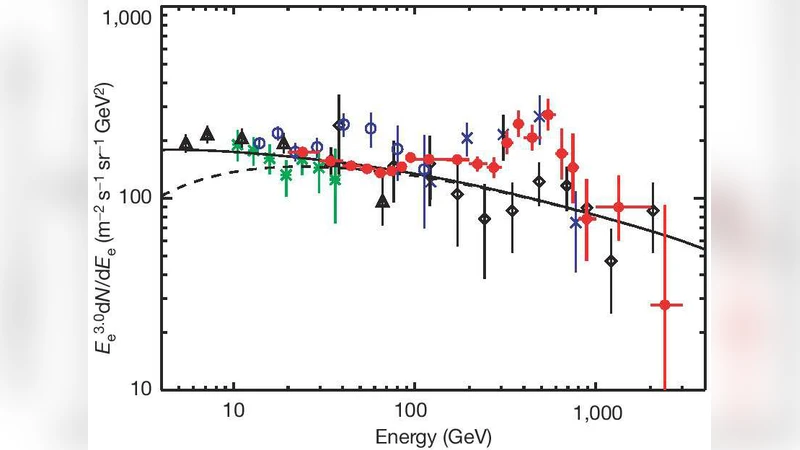
In parallel, the ground‑state annihilation χ₀ χ₀ → e⁺e⁻ proceeds via the same light mediators. The Sommerfeld enhancement, amplified by the 100 MeV boson exchange, raises the annihilation cross‑section to the level required to explain the PAMELA positron fraction rise and the ATIC/PPB‑BETS excess in the 300–800 GeV range. Moreover, the decay of χ₂ produces e⁺e⁻ with a very narrow energy distribution, offering a natural explanation for the sharper “bump” hinted at in the ATIC data, a feature that is difficult to obtain in conventional single‑state dark‑matter models.
To embed these ingredients in a renormalizable theory, the authors construct a broken SU(2) gauge group under which the dark matter forms a triplet. The SU(2) is broken by the vacuum expectation values of a Higgs triplet and a Higgs 5‑plet, giving distinct masses to V₁, V₂ and V₃. V₃’s kinetic mixing with the SM hypercharge gauge boson generates the required coupling to electrons while keeping other SM interactions suppressed. The relic abundance of χ₀ can be achieved either through the same light‑mediator annihilations or by introducing an additional heavy Z′ boson (mass ∼ TeV) that couples to the dark triplet; the Z′ helps to set the correct thermal freeze‑out cross‑section and can also contribute to the high‑energy positron signal.
A notable limitation of the model is its incompatibility with the DAMA/LIBRA annual‑modulation claim. Inelastic dark‑matter explanations of DAMA require a ∼ 100 keV splitting between two states that both couple to nuclei. Here, χ₁ is deliberately decoupled from the SM to guarantee its cosmological stability, so nuclear scattering is essentially absent. Consequently, the proposed framework cannot simultaneously accommodate the DAMA signal, a point the authors acknowledge.
The paper concludes with several experimental avenues for testing the scenario. Fixed‑target and low‑energy e⁺e⁻ experiments (e.g., NA64, DarkLight) can search for the 100 MeV gauge bosons via missing‑energy signatures or displaced decays. Improved mapping of the 511 keV line’s spatial distribution by future gamma‑ray missions could probe the predicted concentration of χ₁ χ₁ excitations near the Galactic Center. Direct‑detection experiments with sensitivity to sub‑keV recoil energies could place limits on any residual χ₁–nucleus interactions, while collider searches for a heavy Z′ or the Higgs multiplets would test the UV completion. If any of these signatures are observed, they would provide compelling evidence for a multi‑state dark sector with light mediators, dramatically reshaping our understanding of dark matter’s particle nature.
Comments & Academic Discussion
Loading comments...
Leave a Comment