Myopic Coding in Multiterminal Networks
This paper investigates the interplay between cooperation and achievable rates in multi-terminal networks. Cooperation refers to the process of nodes working together to relay data toward the destination. There is an inherent tradeoff between achieva…
Authors: Lawrence Ong, Mehul Motani
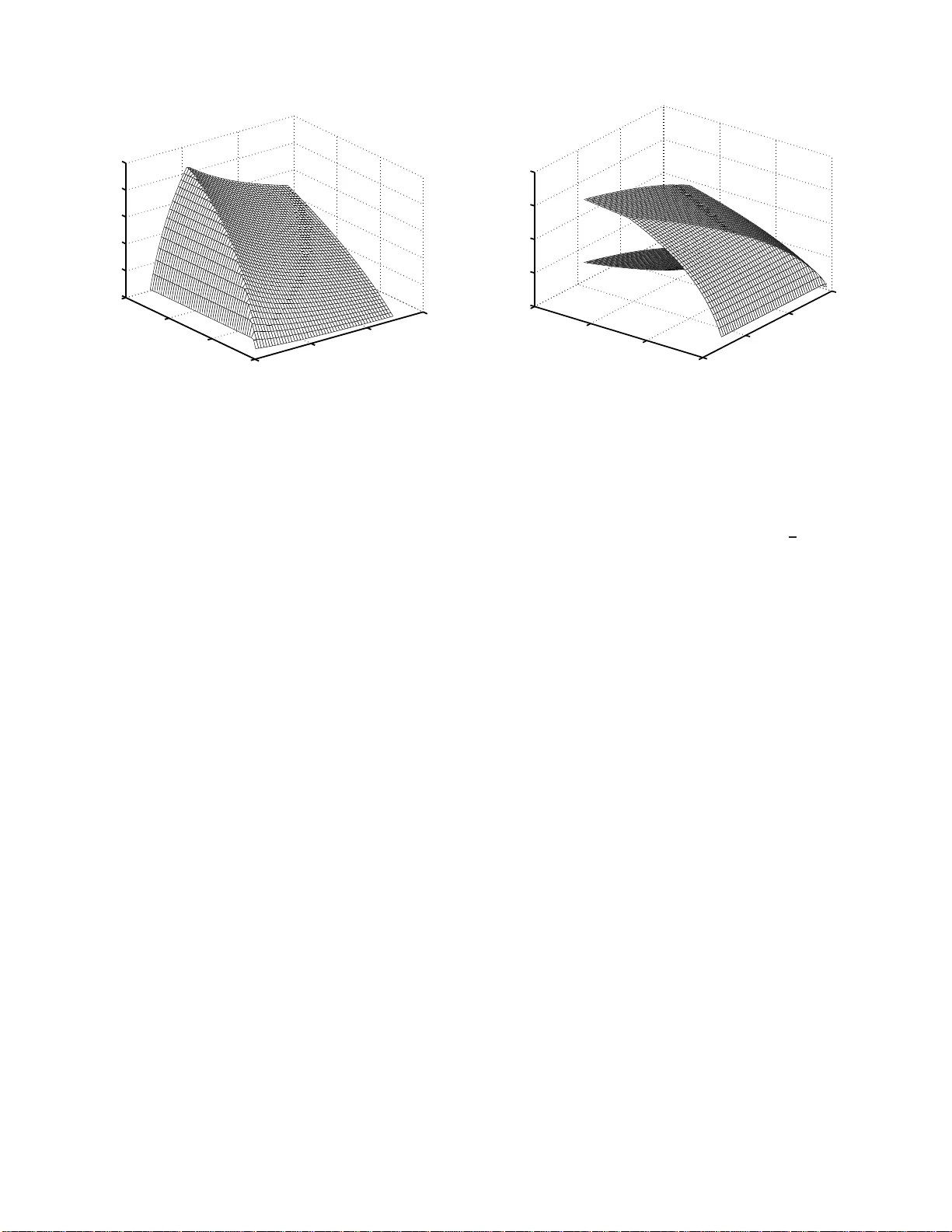
1 My opic Coding in Multitermi nal Netw orks Lawrence Ong, Stud ent Member , IEEE and M ehul Mot ani, Member , IEEE Electrical and Computer Engineering Department, National University of Singapore, Singapore 119260. Email: lawrence.ong@cantab .net, motani@nus.edu.s g Abstract This paper in vestigates the interplay between cooperatio n and achievable rates in multi-ter minal network s. Cooperation r efers to the p rocess o f n odes w orking tog ether to relay data toward the d estination. T here is an inherent tradeoff between achiev able inform ation transmission rates and the level of c ooperatio n, which is d etermined by how many node s are i n volved and how the nodes encod e/decod e the data. W e illustrate t his trade-off by stud ying informa tion-theo retic decode- forward ba sed codin g strategies fo r data transmission in multi-term inal networks. Decode-f orward strategies a re usually discussed in the context of o mniscient c oding , in which all nodes in the network fully coop erate with each o ther, both in encodin g an d decoding . In this pap er , we in vestigate myo pic coding , in which each n ode coopera tes with on ly a few neighbo ring node s. W e show that a chiev a ble r ates of myopic decode- forward can be as large as that of omniscient decode-for ward in the lo w SNR regime. W e also s how that when each n ode has only a few co operatin g n eighbo rs, ad ding o ne node i nto the coope ration inc reases the tran smission rate significantly . Furtherm ore, we show th at myo pic decode-fo rward can achieve n on-zer o r ates as the network size grows without b ound . Index T erms Achiev a ble rates, deco de-fo rward, multiple-r elay channel, multi-termin al network, myopic c oding. I . I N T RO D U C T I O N A. W ir e less Networks W ireless networks have been recei ving much attention recently by both res earchers an d ind ustry . The ma in advantage o f wireless technology to users is the s eamless acce ss to the network w henever and wherever they are; to service providers, ea sier deployment, as no ca ble laying is required. Examples of wireless networks include cellular mobile networks, W i-Fi networks, and se nsor networks. A large a mount o f research has bee n carried out rec ently on various as pects of wireless networks, including power saving [1], [2], routing [3], [4], [5], transport capa city [6], [7], and c onnec ti vity [8]. In this p aper , we foc us on transmiss ion rates in mu lti-termi nal wireless ne tworks. Analyzing transmiss ion rates in multi-terminal networks is no t e asy . Consider the s ingle-r elay channel [9 ], [10], a ch annel consisting of one sou rce, one relay , and one destination. Even for this simple three-terminal network, the ca pacity is not known exce pt for a few special ca ses, e.g., the degraded relay chan nel [9]. This hints at the dif ficulty of an alyzing multi-terminal networks. W e attempt to in vestigate an excerpt o f the multi-terminal ne twork by looking at data trans mission from a single source to a single destination, from multiple source s to a single destination, an d from a single source to multiple des tinations, with the help of relay(s). Ap propriate models for these types o f ne tworks are the mu ltiple-r elay channel [11], [12] (an extension of the single-relay channe l), the multiple-access relay chan nel [13], [14 ], a nd the br oadcas t relay channel [15] resp ectiv ely . The reason for using relays, w hich have no d ata of their own to send, in the network is as follows. D irect trans mission from the so urce to a far -situate d de stination may re quire high transmission power (due to the path loss of electromagnetic wav e propagation). Since wireless networks ope rate over a share d me dium, this can c reate direct interference to othe r users. T rans mitting da ta via intermediate relays, us ing multiple-hop routing or coop erati ve relaying , can help to decreas e the trans mit power and red uce multi-user interferenc e. A portion of the results in this paper has been presented at the 39th Conference on Information Sciences and Systems, John Hopkins Univ ersity , Baltimore, MD, 16-18 March, 2005, and the IEEE International S ymposium on Information Theory , Adelaide Conv ention Centre, Adelaide, Australia, 4-9 September , 2005. 2 B. P oint-to-P oint Co ding A c ommon app roach to data transmission is to abstract the wireless n etwork into a communication graph, with an ed ge co nnecting two nodes if they c an co mmunicate. Data communication ha ppens by identifying a route, which is a se quenc e of nodes that c onnec t the source to the destination. Each node se nds data to the next node in the route an d decod es data from the previous node in the route. T ransmissions of o ther node s a re treated a s no ise. W e call this c oding strategy point-to-point co ding in a multi-terminal network. T his way of transmitting data from the source to the destination is commonly ca lled multi-hop routing in the communications an d networking literature. The terms c oding a nd cod ing strategy a re used interchang eably in this p aper . C. Omniscient Cod ing Point-to-point coding ignores the inh erent broadcas t na ture of the wireless c hannel, i.e., that a node can hear transmissions me ant for o ther node s, and thu s it can a ct as a relay for them. Clearly , the b est thing to d o is for all nodes to coo perate, helping the source to send its d ata to the de stination. This requires every node to b e aware of the presenc e o f other nodes and to have knowledge of the process ing they do. W e refer to coding strategies that utilize the global view an d complete co operation as omn iscient coding . In the literature, omniscient co ding strategies we re in vestigated for multi-terminal networks, e .g., the mu ltiple-access relay chan nel, the broadc ast relay chan nel [16], [17], a nd the multiple-relay c hannel [7], [12], [18]. While the rates achievable by omn iscient c oding s trategies are higher than those achiev able by point-to-point coding s trategies in thes e chan nels, there are a n umber of practical dif ficulties in implementing complete coop eration, e.g., (i) des igning code s based o n omnisc ient coding is more dif ficult as it in volves the optimization of the whole n etwork, (ii) the failure of o ne node a f fects the decoding of all other n odes, and (iii) all node s ne ed to be sy nchronize d (for so me coding strategies). D. Myopic Cod ing In v iew of these p ractical issu es, we in vestigate myop ic cod ing , coding s trategies with constrained commun ica- tions, e .g., nod e have a loca l view of the network, an d limited coo peration. Myopic coding p ositions itself be tween point-to-point coding a nd omnis cient cod ing. In myopic c oding, communications of the nodes are c onstrained in such a way tha t a node communica tes with more than two node s (as oppo sed to point-to-point coding ) but not with all the no des (as op posed to omn iscient co ding) in the network. Myopic coding incorporates loc al cooperation. It allows co operation among neighboring node s to increase the transmission rate compa red to point-to-point c oding. On the other ha nd, it partially so lves the practical difficulties e ncountered in omniscient c oding. In this pape r , we illustrate myop ic coding by using d ecode -forward b ased coding s trategies. W e derive achievable rates of myop ic coding strategies for the multiple-relay ch annel, the multiple-access relay channe l, a nd the broadc ast c hannel. W e c ompare the performance of myop ic c oding to that of omnisc ient cod ing in these c hanne ls and show the trade-off betwee n ac hiev a ble rates a nd c omplexity . E. Contributions The p rimary aim of this work is to understa nd h ow to c ommunicate data from source s to d estinations through a network of wireless relays. This work is a step in the direction of design ing efficient protocols a nd a lgorithms for wireless networks. W e as k the following qu estions which we will partially an swer in the rest of this paper: • What rate regions are achiev able in multi-terminal c hannels (such as the mu ltiple-relay cha nnel, multiple-acce ss relay cha nnel, a nd the b roadcas t relay c hannel) in whic h every nod e has only a localized or myopic view o f the network? • What is the v alue of cooperation? In other words, what is the impa ct on the performance, in terms of transmission rates, when communications among the nod es a re constrained compared to the cas e whe n they are uncon strained? Answering these questions leads to the main co ntrib utions of this pap er , which a re: • W e c onstruct rando m codes for myop ic decod e-forward , i.e., decode-forward coding s trategies [12] with myopic outlook, for the disc rete memoryless mu ltiple-relay channe l and d eri ve a chiev able rate s of the strategies. • W e compute achievable rates of myopic deco de-forward and omniscient decode-forward for the Gaussian multiple-relay chann el. 3 • Comparing the my opic version an d the omniscient version of d ecode -forward, we s how that including a few nodes into the coo peration increas es the trans mission rate signific antly , often mak ing it close to that u nder full cooperation. In othe r words, s ometimes more c ooperation yields diminishing returns . • W e s how that in the mu ltiple-relay chann el, myopic deco de-forward can achieve non-ze ro rates as the network size grows to infinity . • W e d eri ve achievable rate regions of myop ic de code-forward for the multiple-acce ss relay c hanne l and the broadcas t relay ch annel. On Ga ussian channe ls, we show that u nder ce rtain conditions, the pe rformance of myopic coding ca n be close to that of omniscient coding. F . P aper Outline The rest of the paper is organized as follo ws. In Section II, we defi ne myopic coding and give examples of two my opic coding strategies. W e p resent the advantages of myopic coding compa red to omn iscient coding. In Section III, we in vestigate myop ic coding in the multiple-relay c hannel. W e first defin e the chan nel model and then deriv e achiev able rates of two-hop myopic de code-forward. W e then co mpare a chiev able rates of one-ho p myop ic decode -forward, two-hop myopic decode-forward, and omniscient decode-forward for the multiple-relay cha nnel. W e s how that, in the fiv e-node and the six-nod e Ga ussian mu ltiple-relay chann els, w hen the nodes transmit at low signal-to-noise ratio (SNR), ac hiev ab le rates of the two-hop c oding are clos e to those of the o mniscient coding . In Section III-F , we extend the ana lysis to the general k -hop myopic d ecode -forward for the T -node multiple-relay channe l, whe re k c an be any positive integer from 1 to T − 1 and T is the numb er of node s (includ ing the s ource, the relays, and the destination) in the cha nnel. In Section III-H, we in vestigate myopic cod ing in a large network, meaning that the number of no des g rows to infinity . W e s how that even with a restricted view , in wh ich a no de treats the transmiss ions o f the nodes beyond its v iew as n oise, ach iev ab le rates are s till bou nded away from zero. In Sections IV and V, we in vestigate myo pic decod e-forward for two o ther cha nnels, name ly the multiple-acce ss relay ch annel and the broad cast re lay cha nnel. W e show tha t under ce rtain cond itions, achiev able rate s of myopic decode -forward can be as lar ge a s that of omniscient dec ode-forward. W e c onclude the pap er in Section VI. I I . M Y O P I C C O D I N G A. What is Myopic Cod ing? Recall that we categorize a coding strategy as omniscient if all no des have a globa l view of the network a nd can coope rate co mpletely . Now , we define myop ic coding. This is an informal de finition which will be ma de more precise later in the pape r . Informal Defi nition 1 : A myopic X co ding strategy is a con strained version of the corresp onding omniscien t X coding s trategy . The co nstraint in myop ic coding is su ch that every node c ooperates with only a few other nodes. This c ooperation c an be in the form of transmitting to another node, processing (e.g., decod ing, a mplifying, quantizing) or c anceling the transmissions from anothe r no de. W e note that a myopic coding s trategy is d efined with resp ect to an o mniscient co ding strategy . Thou gh there is no fixed way of c onstraining an omniscient coding strategy , the idea is to limit the proces sing at the no des by limiti ng the numbe r of ne ighbors a nod e co mmunicates and co operates with. Myopic co ding aims to a chieve practical a dvantages, e.g., lo wer comp utational complexity , robustness to topology c hange s, and fewer storage/buf fer requirements. T o illustrate myo pic coding , we now briefly discu ss two myopic coding strategies for the multiple-relay chann el, namely myopic d ecode -forward a nd myopic a mplify-forw ard. B. Myopic Dec ode-F orw ar d for the Multiple-Relay Channe l Let us con sider the decode -forward co ding strategy for the multiple-relay channe l by Xie and Kumar [12], in which every message is fully deco ded at and forwarded by the relay s. It is a lso kn own as the de code-and -forward strategy . In this strategy , block Markov encoding (irregular block Markov en coding 1 [9] an d regular block Markov encoding 1 [19]) ca n be u sed. In the Gau ssian chan nel, a nod e splits its total trans mission power between s ending new 1 W e use the terminology in [18]. Note t hat the terms were not used in the original paper but subseque ntly used in later papers. 4 Fig. 1: Omnisc ient dec ode-forward for the fi ve-node Gaussian multiple-relay ch annel. Fig. 2: T wo-hop myop ic decod e-forward for the five- node Gau ssian multiple-relay chan nel. information and repe ating wha t the relays in fr ont (downstream, i.e., to ward the destination) send. For de coding, succe ssive de coding 1 [9] ca n be used for irre gular Markov enc oding; backward dec oding [20 ] or sliding window decoding 1 [21] can be used for re gular block M arkov encoding. In the Gaussian channel, a node decodes signals fr om all the nod es be hind (upstream, i.e., tow a rd the source ). At the s ame time, it cance ls interfering transmissions from all the nod es in front. Since all the nod es fully coo perate, we term this c oding strategy omniscient d ecode-forw ar d . Now , we use a n example to illustrate how e ach node cooperates wit h all other nodes in omniscien t decode-forward. Consider a five-node Gauss ian multiple-relay cha nnel (the formal defin ition ca n be found in Se ction III-C ). Using omniscient decod e-forward, a node transmits to all the node s in front. Fig. 1 de picts the trans missions of the n odes. Let all U i , i = 1 , 2 , 3 , 4 , be indepe ndent random variables. When node 4 trans mits U 4 to n ode 5 , node 3 splits its power , transmitting new information ( U 3 ) to node 4 and helping n ode 4 to trans mit another copy of w hat nod e 4 transmits ( U 4 ) to n ode 5. Similarly , node s 1– 3 split their power to transmit n ew information a nd old information (the same information of what the nodes in front trans mit). In decoding , a node deco des the transmissions from all nod es behind. For example, node 5 decode s a ll transmissions from nodes 1–4. In addition, a node canc els all transmissions from the nod es in front whe n it dec odes. For example, when nod e 2 dec odes U 1 from node 1, it cance ls U 3 and U 4 from nod e 3, U 4 from nod e 4, as we ll as U 2 , U 3 , and U 4 from node 1. Now , we co nsider a myopic version of the omnisc ient dec ode-forward in wh ich nodes are limited in how much information they can store a nd proces s. W e define k - hop myopic deco de-forward for the multiple-relay chann el as follo ws. Definition 1: k -hop myopic dec ode-forward for the multiple-relay channe l is a co nstrained version of o mniscient decode -forward, and the con straints are as follo ws. • In encoding , a node must transmit me ssage s that it has deco ded from at mos t the past k blocks of received signal. • In deco ding, a node can de code one mess age using only k blocks of received sign al. • A n ode ca n store a d ecode d messa ge in its memory over at most k blocks. At the fi rst glan ce, the ab ove c onstraints for myop ic dec ode-forward do no t s eem to includ e the view of a node or how ma ny other no des a nod e ca n communicate with. Howev er , the se are embe dded in the defin ition itself. The constraints automatically restrict the n umber of nodes a no de can co operate with. Furthermore, the restrictions stem from prac tical advantages of having fewer p rocessing a nd storage req uirements a t the node s, which are the moti vati ons be hind myo pic coding. Now , let us co nsider two-hop myopic de code-forwa r d . The enco ding and the dec oding process es at the n odes in the five-node multiple-relay chan nel are as follows (refer to Fig. 2) • Node 1 transmits U 1 and U 2 , node 2 transmits U 2 and U 3 , etc. • Node 5 dec odes U 3 and U 4 , node 4 decod es U 2 and U 3 , etc. • During decoding , nod e 2 canc els U 2 and U 3 , node 3 ca ncels U 3 and U 4 , etc. W e note that this encoding techniqu e is dif fe rent from [7, Fig. 1], in which the sou rce and the relay transmit independ ent signals (hen ce n o coh erent co mbining is pos sible) w hile the relays and the destination decode trans- missions from all nodes beh ind. T he decoding technique in [7] is only poss ible u nder o mniscient coding as a node decode s eac h me ssage using the received signals from all upstream nodes , po ssibly over a large numbe r of blocks . In myopic dec ode-forward for the mu ltiple-relay chann el, we use the c oncept o f regular block Markov encoding and sliding window dec oding. However , the encoding and the deco ding tec hniques dif fer from that found in the 5 literature as the nodes have limited v iews. It is noted that myo pic coding captures point-to-point coding and omniscient c oding as special cases . In particular , k -hop myopic d ecode -forward for the multiple-relay c hannel where k = 1 is point-to-point coding and k = T − 1 ( T is the nu mber of no des in the c hannel) omniscien t decode -forward. The rea der is reminde d that the term “hop ” us ed here do es not c arry the same mea ning as it do es in multi-hop routing. The term hop is best u nderstood by loo king at the sequ ence in which the messages are de coded, e.g. , if the mes sages are decod ed by no de i followed by nod e j , then node j is no de i ’ s next hop. W e s ay that a set of node s V are in the view of nod e i if nod e i proces ses (e.g., dec odes, amplifies, o r q uantizes) or canc els the transmissions from a ll the no des in V . C. Myopic Amplify-F orwa r d for the Mu ltiple-Relay Ch annel Next, let u s c onsider the amplify-forw ard strategy for the multiple-relay c hannel by Y ukse l a nd Erkip [22]. W e will use the on e-source, two-relay , one-des tination ne twork as an example. Cons ider the “ S + R 1 ( S ) + R 2 ( S, R 1 ) ” scheme [22, T able I]. In this scheme , the transmission s are s plit into three blocks . In block 1, the s ource transmits to both relays an d the destination (henc e the n otation S ). In bloc k 2, relay 1 normalizes its rece iv e d sign al from the source in block 1 and forwards the normalized re ceiv ed signal to relay 2 and the des tination (hence the nota tion R 1 ( S ) ). Rela y 2 comb ines the s ignals that it has rec eiv ed in blocks 1 a nd 2, no rmalizes to its own power value, and trans mits the combine d signal in block 3 (he nce the no tation R 2 ( S, R 1 ) ). The d estination then decod es using the three blocks of rec eiv ed signal (henc e the notation S + R 1 ( S ) + R 2 ( S, R 1 ) ). W e term this coding strategy omniscient amplify-forward, as ea ch node coo perates with all othe r nodes . Now , let us consider a myopic version of the amplify-forward strategy . It ha s been noted in [22] that relay 2 can choos e to listen to on ly re lay 1 (which transmits in block 2) and forwards only this rece i ved signal to the destination (the no tation used is R 2 ( R 1 ) ). Instead of decoding over three bloc ks, the destination c an choose to decode on ly from relay 2 (which transmits in block 3). W e see tha t in this sch eme, a node listens to only one node and forwards to another n ode. Hence, we term this s trategy on e-hop myopic amplify-forward. One can similarly construct two-hop myopic amp lify-forw ard, and so o n. D. Practical Advantages of My opic Coding In this section, we discuss a few practical advantages of myopic coding c ompared to omniscient coding. These include simpler code design, increas ed robustness , reduced computation and memory requirements, and local syn chronization. Though the analyses of myopic coding in this pap er are b ased on information-theoretic achiev able rates (in S hannon ’ s se nse), the practical ad vantages he re are relev ant to code des igns bas ed on thes e strategies (myopic o r o mniscient, de code-forward or amplify-forw a rd, etc.). That researchers are interested in practical implementations of information-theoretic cooperative strategies is ap parent in the recen t work that has been p roposed in this direction. The re are various codes des igned base d on o mniscient decode-forward for the single-relay c hannel [23], [24], [25], [26] and the multiple-relay chan nel [27], [28], [29]. One ma y de sign my opic versions of these co des to reap the p ractical ad vantages d iscusse d in this section. Looking closely at the L DPC code s using parity forw arding (ba sed on omniscient deco de-forward) for the multiple-relay chann el [27], we se e tha t the c omplexity of design ing cod es grows with the nu mber of relays. This means that constructing codes in which all nodes cooperate c an be more dif ficult compared to designing codes in which nodes only cooperate with neighboring nodes. This technique of u tilizing local knowledge (or limited cooperation) is prevalent in other wireless n etwork problems, e.g., clus ter- based routing [30 ], whe reby no des are split into clus ters, and routes a re optimized loc ally . Myopic co ding sc hemes are more robust to topology c hange s than the correspo nding omniscien t cod ing sch emes. For example, cons ider c ancellation of the interference from d ownstream node s. In omn iscient coding , a nod e nee ds to h av e the knowledge o r an estimate o f wha t every downstream node transmits in order to ca ncel it. Any error in the cance llation (due to topology chang es or n ode failures not kn own to the decode r) will affect the decoding and thus the rate. In my opic c oding, n odes o nly canc el the interferen ce from a few ne ighboring nodes. This me ans tha t topology cha nges or node failures beyo nd a n ode’ s v iew are less likely to af fect its deco ding. In App endix I , we giv e another example to show how node failures affect more n odes in myop ic coding than in omniscien t c oding. 6 Fig. 3: T he T -node multiple-relay chann el. In a ddition, the e ncoding and d ecoding comp utations at eac h node unde r myopic coding can be less . Since a node only needs to transmit to and decode from a fe w nodes , the node enco des fewer data for its transmissions and dec odes fewer d ata from the received s ignals. Furthermore, since the node s ne ed to buf fer fewer data for encod ing, interference cancellation, an d dec oding, less memory is requ ired for buf fering and c odeboo k storag e. Conside r the fiv e -node Gaus sian multiple-relay channel. Using omniscient decode -forward, n ode 1 encodes a mes sage four times over fou r blocks, using dif feren t power splits. Node 5 buf fers fou r blocks o f its rec eiv ed sign al to deco de o ne mes sage. T he buf fer grows as the number of nodes in the network increa ses. On the other hand, using myop ic decod e-forward, the nod es buf fer fewer blocks of received signal, an d the buf fer s ize for eac h node is ind epende nt of the number of n odes in the network. Myopic coding mitigates the need for synch ronization of the entire network. Und er omniscient decode -forward, all the nodes might ne ed to be s ynchron ized. On the other hand, un der my opic coding, a node only nee ds to synchron ize with a few ne ighboring n odes. Hence , sy nchronization c an be do ne locally . In brief, my opic c oding ca n inc rease the robustness and s calability of the network. In the next s ection, we ana lyze the performanc e of myopic cod ing in the multiple-relay c hanne l using the deco de-forward coding s trategy . I I I . M YO P I C C O D I N G I N T H E M U LT I P L E R E L A Y C H A N N E L In this se ction, we construct random c odes for myopic dec ode-forward for the multiple-relay cha nnel and compare the performanc e of these myo pic coding strategies to the c orresponding omnisc ient cod ing strategy . A. Channe l Mo del Fig. 3 d epicts the T -node multiple-relay cha nnel, with no de 1 being the so urce a nd node T the des tination. Nod es 2 to T − 1 are purely relays. Message W is generated at nod e 1 and is to be s ent to no de T . A multiple-relay channe l can b e completely de scribed by the cha nnel d istrib ution p ∗ ( y 2 , y 3 , . . . , y T | x 1 , x 2 , . . . , x T − 1 ) (1) on Y 2 × Y 3 × · · · × Y T , for each ( x 1 , x 2 , . . . , x T − 1 ) ∈ X 1 × X 2 × · · · × X T − 1 . In this paper , we on ly cons ider memoryless and time inv ariant c hanne ls [18], w hich means p ( y 2 i , . . . , y T i | x i 1 , . . . , x i T − 1 , y i − 1 2 , . . . , y i − 1 T ) = p ∗ ( y 2 i , . . . , y T i | x 1 i , . . . , x ( T − 1) i ) , (2) for all i . W e use the following notation: x i denotes an input from node i into the c hannel; x ij denotes the j -th input from node i into the channe l; y ij denotes the j -th output from the chann el to n ode i ; and x i t = x t 1 , x t 2 , . . . , x ti . W e de note the T -nod e multiple-relay cha nnel by the tuple X 1 × · · · × X T − 1 , p ∗ ( y 2 , . . . , y T | x 1 , . . . , x T − 1 ) , Y 2 × · · · × Y T . (3) 7 B. Notation an d Definitions In the multiple-relay cha nnel, the information s ource at node 1 emits rando m letters W , e ach taking on values from a fin ite set of s ize M , that is w ∈ { 1 , ..., M } , W . W e co nsider each n us es of the channe l as a block. Definition 2: An ( M , n ) c ode of a T -node multiple-relay c hanne l comprises : • An encod ing function a t node 1 , f 1 : W → X n 1 , which ma ps a sou rce letter to a c odeword o f length n . • n encoding functions at node t, t = 2 , 3 , . . . , T − 1 , f ti : Y i − 1 t → X t , i = 1 , 2 , . . . , n , s uch that x ti = f ti ( y t 1 , y t 2 , . . . , y t ( i − 1) ) , which map p ast received signals to the signal to b e transmitted into the ch annel. • A dec oding function at the d estination, g T : Y n T → W , su ch that ˆ w = g T ( y n T ) , wh ich map s rece iv e d s ignals of length n to a sourc e letter estimate. Definition 3: As suming that the source letter W is uniformly d istrib u ted over { 1 , ..., M } , the av erage error probability is d efined a s P e = Pr { ˆ W 6 = W } . (4) W e denote the estimated i -th source letter a t the d estination a s ˆ W i . Definition 4: Th e rate R ≤ 1 n log M (5) is ach iev able if, for any ǫ > 0 , there is at lea st one ( M , n ) c ode such tha t P e < ǫ . The following de finition and lemma are taken from [31, p. 384] and [31, p. 386] respe ctiv e ly . Definition 5: Co nsider a finite collection o f random variables ( X 1 , X 2 , . . . , X k ) with some fixed joint distributi on p ( x 1 , x 2 , . . . , x k ) . Let S d enote a n arbitrarily ordered su bset of the se random variables, and co nsider n independe nt copies of S . Pr { S = s } = n Y i =1 Pr { S i = s i } . (6) The set A n ǫ of ǫ -typical n -sequen ces ( x 1 , x 2 , . . . , x k ) is de fined as A n ǫ ( X 1 , X 2 , . . . , X k ) = ( x 1 , x 2 , . . . , x k ) : − 1 n log p ( s ) − H ( S ) < ǫ, ∀ S ⊆ { X 1 , X 2 , . . . , X k } . (7) Lemma 1: For any ǫ > 0 a nd for sufficiently lar ge n , |A n ǫ ( S ) | ≤ 2 n ( H ( S )+ ǫ ) Throughou t this pap er , we follo w the notation for no de p ermutation used in [21]. Let T be the set of all relay nodes, T = { 2 , 3 , . . . , T − 1 } . Let π ( · ) be a permutation on T . Define π (1) = 1 , π ( T ) = T a nd π ( i : t ) = { π ( i ) , π ( i + 1) , . . . , π ( t ) } . C. The Gaus sian Multiple-Relay Chan nel In the T -node Gau ssian multiple-relay chan nel, n ode t , t = 2 , . . . , T , rece i ves Y t = X i =1 ,...,T − 1 i 6 = t p λ it X i + Z t , (8) where X i , input to the ch annel form no de i , is a ran dom variable with fixed average power E [ X 2 i ] = P i . Y t is the receiv ed signa l a t no de t . Z t , the rece i ver noise at no de t , is an indepen dent zero-mea n Gau ssian random variable with variance N t . λ it is the ch annel gain from no de i to node t . λ it depend s on the antenn a gain, the carrier frequency o f the transmission, and the distan ce b etween the transmitter and the rec eiv er . W e consider Gaussian mult iple-relay channe ls with fixed a verage t ransmit po wer at the source and at all relays. W e note that using o mniscient dec ode-forward, having a maximum average power constraint on every node is eq uiv alent to having a fixed av e rage transmit power constraint on the node , as the overall rate is a non -decreasing fun ction of the av erage transmit power at any node, kee ping the transmit power of othe r node s co nstant. This is beca use a node d ecodes the transmiss ions from all upstream no des a nd can cels the transmission s from all downstream nod es. So, the trans missions of all nod es are either used in deco ding o r c anceled but a re never treated as noise . Howe ver , under myopic coding, lowering the transmit power at ce rtain nodes may h elp to reduce the interference at other nodes and increase the overall rate. Henc e the maximum ra te achievable by myopic decod e-forward with maximum av erage power con straints on the node s is lower bo unded b y that with fixed average p ower cons traints. 8 W e us e the standa rd path loss mod el for signal propag ation. Th e chan nel ga in is given by λ it = κd − η it , (9) where η is the path loss expon ent, a nd η ≥ 2 with equa lity for free s pace trans mission. κ is a po siti ve cons tant as far as the an alyses in this pa per are c oncerne d. Hence , the rece iv e d power at nod e t from node i is given by P it = λ it P i = κd − η it P i . (10) For the channel where all transmitters have the same power constraint, i.e., P i = P , an d all rec eiv ers have the same noise power , i.e., N t = N , we define the s ignal-to-noise ra tio (SNR) to be P N . D. Achievable Rates In this se ction, we in vestigate achiev a ble r ates of two myopic deco de-forward coding str ategies and the omniscien t decode -forward coding strategy . 1) Omnisc ient coding : First, we conside r a chiev a ble rates of omniscien t decod e-forward. Xie and Kumar [12] proposed a dec ode-forward c oding strategy for the multiple-relay c hannel. They showed that the following rate is achiev able, which is higher than that in [7]. R ≤ max π ( · ) max p ( · ) min 1 ≤ t ≤ T − 1 I ( X π (1: t ) ; Y π ( t +1) | X π ( t +1; T − 1) ) (11a) = R omniscient . (11b) The first maximization a llows us to arrange the order in which da ta flow through the relay no des. The s econd maximization is over all p ossible distrib utions p ( x 1 , x 2 , . . . , x T − 1 ) on X 1 × · · · × X T − 1 . The minimization is over all relays and the destination, where full d ecoding of the mes sages must be do ne. Since all the information must pass through each relay , the relay that d ecode s at the lowest rate be comes the bottleneck of the overall transmission. W e note in the mutual information term that n ode π ( t + 1) receiv es the transmiss ion from a ll nodes behind, X π (1: t ) . Since it knows what the n odes in front transmit (by the flow of data), it can ca ncel out their trans missions, a s see n in the conditioned term X π ( t +1; T − 1) . Now , we in vestigate ac hiev ab le rates of myopic decode-forward cod ing strategies. W e note that using decode - forward, all relays mus t fully dec ode the messag es. W e ass ume that the relays de code the mess ages s equen tially . 2) One-Hop Myopic Coding (P o int-to-P o int Coding): In one-hop myo pic dec ode-forward, a relay no de trans mits what it ha s decod ed from one b lock o f rece iv e d s ignal. This me ans a no de transmits to on ly the node in the next hop. In decod ing, a node decode s one messa ge u sing on e block o f rece iv e d signal. This means a node de codes from only one node behind. A node keeps its decode d mess age for o ne block, a nd it us es the last decod ed messag e to c ancel the effect of its own transmiss ion. Using random c oding [32], n ode π ( t ) can reliably d ecode d ata up to the rate R π ( t ) = I ( X π ( t − 1) ; Y π ( t ) | X π ( t ) ) , (12) for s ome p ( x 1 ) p ( x 2 ) · · · p ( x T − 1 ) , t ∈ { 2 , . . . , T } , and X π ( T ) = 0 . Since all information mus t pass through all nodes in orde r to reac h the destination, the overall rate is constrained by R ≤ min t ∈{ 2 ,...,T } R π ( t ) . (13) Noting that the messag es can flow through the relays in any orde r [21] and the node s transmit indepen dent sign als, we have the following res ult. Theorem 1: Let X 1 × · · · × X T − 1 , p ∗ ( y 2 , . . . , y T | x 1 , . . . , x T − 1 ) , Y 2 × · · · × Y T be a memoryles s multiple-relay c hanne l. Under one-hop myopic dec ode-forward or point-to-point cod ing, the rate R is achievable, where R ≤ max π ( · ) max p ( · ) min t ∈{ 2 ,...,T } I ( X π ( t − 1) ; Y π ( t ) | X π ( t ) ) = R 1-hop . (14) The outer ma ximization is over all poss ible node permutations and the inner maximization is taken over all joint distrib utions of the form p ( x 1 , . . . , x T − 1 , y 2 , . . . , y T ) = p ( x 1 ) p ( x 2 ) · · · p ( x T − 1 ) × p ∗ ( y 2 , . . . , y T | x 1 , . . . , x T − 1 ) . 9 3) T wo -Hop Myopic Coding: Instead of jus t trans mitting to only its immediate neigh bor , a node might want to help the neighb oring node to transmit to the neighbo r’ s n eighbor . Unde r two-hop my opic deco de-forward, a node can transmit messages that it has deco ded in the past two bloc ks of received signals. That mean s in bloc k i , a node transmits data that it has decode d in b locks i − 1 and i − 2 . In decod ing, it deco des one messag e using only two blocks of receiv ed sign al. T wo-hop myopic d ecode -forward achieves rates up to that given in the followi ng theorem. Theorem 2: Let X 1 × · · · × X T − 1 , p ∗ ( y 2 , . . . , y T | x 1 , . . . , x T − 1 ) , Y 2 × · · · × Y T be a T -node memoryless mu ltiple-relay ch annel. Using two-hop myopic deco de-forward, the rate R is a chiev able, where R ≤ max π ( · ) max p ( · ) min t ∈{ 2 ,...,T } I ( U π ( t − 2) , U π ( t − 1) ; Y π ( t ) | U π ( t ) , U π ( t +1) ) (15a) = R 2-hop , (15b) where U π (0) = U π ( T ) = U π ( T +1) = 0 , for π (0) = 0 and π ( T + 1) = T + 1 . The outer maximization is over a ll possible relay p ermutations and the inn er maximization is taken over all joint distrib utions of the form p ( x 1 , x 2 . . . , x T − 1 , u 1 , u 2 . . . , u T − 1 , y 2 , y 3 . . . , y T ) = p ( u π (1) ) p ( u π (2) ) · · · p ( u π ( T − 1) ) p ( x π (1) | u π (1) , u π (2) ) p ( x π (2) | u π (2) , u π (3) ) · · · p ( x π ( T − 1) | u π ( T − 1) ) × p ∗ ( y 2 , . . . , y T | x 1 , . . . , x T − 1 ) . The proof o f Theorem 2 c an be foun d in Appe ndix II. Using a particular probability dis trib u tion function on a c oding strategy , we term the max imum rate a t which a node ca n reliably de code the source messa ges the reception rate . For example, using one-ho p myopic decod e- forward, the recep tion rate at node π ( t ) is R π ( t ) = I ( X π ( t − 1) ; Y π ( t ) | X π ( t ) ) ; using two-hop myopic decod e-forward, the rece ption rate at nod e π ( t ) is R π ( t ) = I ( U π ( t − 2) , U π ( t − 1) ; Y π ( t ) | U π ( t ) , U π ( t +1) ) . E. P er formance C omparison In this section, we compa re achiev a ble rates of the two myop ic coding strategies an d the omnisc ient coding strategy for the Gau ssian multiple-relay chan nel. 1) Chan nel Setup: Con sider a linear five-node chann el, in which nodes are arrange d in a s traight line in the sense tha t for a ny i < j < k , d ik = d ij + d j k . N ode 1 is the s ource, nodes 2, 3, a nd 4 a re the rela ys, a nd n ode 5 is the des tination. Node t , t = 2 , 3 , 4 , 5 , rece i ves the following chann el output, Y t = 4 X i =1 i 6 = t q κd − η it X i + Z t . (17) In all analyses in this sec tion, we use the follo wing parameters: N 2 = N 3 = N 4 = N 5 = N = 1 W , κ = 1 , and η = 2 . Now , cons ider a point-to-point link. The rate a t wh ich information can be transmitted throu gh a Gaussia n ch annel (per cha nnel us e) from no de i to nod e t is giv en by [31] R ≤ 1 2 log 1 + P it N t . (18) Throughou t this pa per , logarithm b ase 2 is us ed and h ence the units of rate a re bits per chann el use . 2) One-Hop My opic Co ding: In one-hop myopic decode-forward, nod e t transmits only to node t + 1 . Let us first cons ider nod e 1. It s ends X 1 to node 2. Node 2 rec eiv es Y 2 = q κd − η 12 X 1 + q κd − η 32 X 3 + q κd − η 42 X 4 + Z 2 . (19) 10 0 0.1 0.2 0.3 0.4 0.5 0.6 0.7 0.8 0.9 0 1 2 3 4 5 6 7 8 9 10 R [bits/channel use] P 1 ,P 2 ,P 3 ,P 4 [W] κ =1, η =2, N i =1W, d i-1,i =1m, i=2,3,4,5 R 2 R 3 R 4 R 5 R 1-hop Fig. 4: Ac hiev ab le rates of one-hop myopic decod e- forward for the five-node multiple-relay chann el, with equal nod e sp acing. 0 0.2 0.4 0.6 0.8 1 1.2 1.4 0 1 2 3 4 5 6 7 8 9 10 R [bits/channel use], d ij [m] P 1 ,P 2 ,P 3 ,P 4 [W] κ =1, η =2, N i =1W i=2,3,4,5 d 12 d 23 d 34 d 45 R 1-hop Fig. 5: Ac hiev ab le rates of one-hop myopic decod e- forward for the five-node multiple-relay chann el, with the optimal n ode spacing . Node 2 dec odes new messa ges from node 1’ s transmission. From (12), the rece ption rate at nod e 2 is R 2 = I ( X 1 ; Y 2 | X 2 ) (20a) = 1 2 log 2 π e h κd − η 12 P 1 + κd − η 23 P 3 + κd − η 24 P 4 + N 2 i − 1 2 log 2 π e h κd − η 23 P 3 + κd − η 24 P 4 + N 2 i (20b) = 1 2 log " 1 + d − 2 12 P 1 1 + d − 2 23 P 3 + d − 2 24 P 4 # . (20c) Here, we have subs tituted κ = 1 , η = 2 , an d N 2 = 1 W . The reception rates at nodes 3, 4, a nd 5 can be co mputed in similar way . Achiev able rates of one-hop my opic deco de-forward are R ≤ min t ∈{ 2 , 3 , 4 , 5 } R t = R 1-hop . (21) W e n ote that the mes sage flow through the node s in the order { 1 , 2 , 3 , 4 , 5 } gives the highest a chiev able rate in this network. Figs. 4 and 5 show achievable rates of one-hop myopic dec ode-forward for equal node spac ing and the optimal node spacing r espec ti vely . In the latt er , the spacing among the nodes is determined by brute force, with the cons traints that all five no des form a s traight line (node i + 1 is in front of n ode i ) an d d 15 = 4 . When the nodes are equally sp aced, R 1-hop is con strained by reception rates R 2 and R 3 . In o rder to increase R 2 and R 3 , the distance d 12 and d 23 should b e decrea sed. W e see that this is indeed the case . The optimum values for d 12 and d 23 are less than 1 m, as c an be se en in Fig. 5. W e see in Fig. 5 that a s the av erage trans mit p ower increas es, the op timal d 12 and d 23 decreas e wh ile the o ptimal d 34 and d 45 increase. This is becau se R 2 and R 3 are signific antly aff ected whe n P 3 and P 4 increase. Reca ll that in one-ho p myop ic decod e-forward, a no de treats the trans missions of all the node s beyond its view a s noise. For example, node 3 dec odes from no de 2, and treats the transmissions of nodes 1 and 4 as no ise. Sinc e there is no transmitting no de in front o f n ode 4, R 4 and R 5 are less affected by the increase of the transmit power . He nce, to compens ate for the greater noise experienced by n odes 2 and 3 as the transmit power increas es, d 12 and d 23 are reduced to incre ase R 2 and R 3 . 3) T wo -Hop Myopic Coding: In two-hop myopic d ecode-forward, n ode t, t = 1 , 2 , 3 , allocate α t of its power to transmit to node t + 2 a nd (1 − α t ) of its p ower to node t + 1 . Since there is only one node in front of nod e 4, it allocates all its power to trans mit to nod e 5. The transmis sion by eac h no de is listed as follows: • Node 4 se nds X 4 = √ P 4 U 4 . 11 • Node 3 se nds X 3 = √ α 3 P 3 U 4 + p (1 − α 3 ) P 3 U 3 . • Node 2 se nds X 2 = √ α 2 P 2 U 3 + p (1 − α 2 ) P 2 U 2 . • Node 1 se nds X 1 = √ α 1 P 1 U 2 + p (1 − α 1 ) P 1 U 1 . Here, U i , i = 1 , 2 , 3 , 4 are inde penden t G aussian random v a riables, ea ch with u nit v a riance, 0 ≤ α j ≤ 1 for j = 1 , 2 , 3 . From (77), for fixed { α 1 , α 2 , α 3 } , the rec eption rate at no de 2 is R 2 = I ( U 1 ; Y 2 | U 2 , U 3 ) (22a) = 1 2 log 2 π e " κd − η 12 (1 − α 1 ) P 1 + q κd − η 23 α 3 P 3 + q κd − η 24 P 4 2 + N 2 # − 1 2 log 2 π e " q κd − η 23 α 3 P 3 + q κd − η 24 P 4 2 + N 2 # (22b) = 1 2 log 1 + d − 2 12 (1 − α 1 ) P 1 1 + q d − 2 23 α 3 P 3 + q d − 2 24 P 4 2 . ( 22c) Here, we have subs tituted κ = 1 , η = 2 , an d N 2 = 1 W . The reception rates at nodes 3, 4, a nd 5 can be co mputed in a similar way . Minimizing over all recep tion rates an d max imizing over a ll possible p ower splits, the overall achiev able rate is giv e n by R ≤ ma x { α 1 ,α 2 ,α 3 } min t ∈{ 2 , 3 , 4 , 5 } R t = R 2-hop . (23) W e note that the me ssage flow in the node permutation { 1 , 2 , 3 , 4 , 5 } gives the highe st overall rate in this network. Figs. 6 – 9 show ach iev able rates, rec eption rates and power splits for nodes in d if ferent positions. W e note that the nodes are arrange d in a s traight line. When the nodes are equa lly space d, we see that the overall rate is constrained by R 2 and R 3 . Increas ing the transmit power increa ses R 3 more than R 2 . So, to ma ximize min { R 2 , R 3 } , the optimal α 2 increases to increas e R 2 further . When the transmit power increase s be yond 10W , α 2 reaches it maximum and the ov erall r ate is no w restricted by R 2 alone. T o understan d this, we look a t the rate eq uations. For node s 3–5, they deco de the trans missions from 2 1 /2 n odes beh ind, but nod e 2 de codes only from node 1. This makes R 2 the b ottleneck of the overall transmission rate. High R 4 and R 5 sugges ts that the overall rate c an b e improved by rea djusting the pos ition of the no des. One way to improve R 2 is to decreas e d 12 . By d oing this, we reduce the signa l attenu ation from n ode 1 to n ode 2. This indeed inc reases the overall rate, as shown in Fig. 7 . He re d 12 = 0 . 5 m, while keeping the p ositions of n odes 3, 4, a nd 5 unc hange d. Now , we see that the overall rate is constrained b y R 2 , R 3 , R 4 , a nd R 5 , i.e. , no single bottle- neck. W e have seen that the increase in transmit power incre ases the reception rates of different no des by different amount. Henc e whe n the transmit power increas es, the α ’ s adjus t the mselves to maximize min { R 2 , R 3 , R 4 , R 5 } . Now , we stud y the cas es wh en the relay nodes are clus tered at the sourc e or at the destination. Fig. 8 s hows achiev able rates whe n the relay s are clustered at the sou rce. In this arrangeme nt, the overall rate is c onstrained by both R 2 and R 5 when the nodes trans mit at low power , a nd by R 5 alone when the nodes transmit at high power . That R 5 being the bottleneck sh ould not c ome as a surprise as node 5 is po sitioned far away from the re st of the nodes. Howe ver , a t high p ower , the cons traint is at R 2 and n ot at R 5 . T he reason is that nod e 2 receives strong interference from node 4, which is nea r . When the relays are clus tered at the des tination, we expect R 2 to constrain the overall rate. Th is is shown in Fig. 9. The reception rate at node 2 is low as the signal from node 1 is severely attenua ted due to the large d 12 and high interference from no des 4 and 5, which are c lose to no de 2 . It is n oted that wh en the overall rate is con strained by R 2 , the power allocations aff ecting it, wh ich are α 1 and α 3 should be s et to zero. Setting α 1 = 0 , we e nsure that all power from node 1 carries new information to node 2. Setting α 3 = 0 , we maximize the a mount of interference that node 2 can ca ncel in its decod ing. 12 0 0.5 1 1.5 2 2.5 0 5 10 15 20 25 30 R [bits/channel use], α P 1 ,P 2 ,P 3 ,P 4 [W] κ =1, η =2, N i =1W, d i-1,i =1m, i=2,3,4,5 α 1 , α 3 α 2 R 2 R 3 R 4 R 5 R 2-hop Fig. 6 : Achiev able rates of two-hop myopic decod e- forward for the five-node multiple-relay ch annel, with equa l no de spac ing. 0 0.2 0.4 0.6 0.8 1 1.2 1.4 1.6 1.8 2 0 5 10 15 20 25 30 R [bits/channel use], α P 1 ,P 2 ,P 3 ,P 4 [W] κ =1, η =2, N i =1W, d 12 =0.5m, d 23 =1.5m, d 34 =1m, d 45 =1m α 1 α 2 α 3 R 2 ,R 3 ,R 4 ,R 5 ,R 2-hop Fig. 7 : Achiev able rates of two-hop myopic decod e- forward for the five-node multiple-relay ch annel, with no de 2 close r to the source . 0 0.5 1 1.5 2 2.5 0 5 10 15 20 25 30 R [bits/channel use], α P 1 ,P 2 ,P 3 ,P 4 [W] κ =1, η =2, N i =1W, d 12 =0.5m, d 23 =0.5m, d 34 =0.5m, d 45 =2.5m α 1 α 3 α 2 R 2 R 3 R 4 R 5 R 2-hop Fig. 8 : Achiev able rates of two-hop myopic decod e- forward for the five-node multiple-relay ch annel, with the relay s clustered a t the source . 0 0.5 1 1.5 2 2.5 3 3.5 0 5 10 15 20 25 30 R [bits/channel use], α P 1 ,P 2 ,P 3 ,P 4 [W] κ =1, η =2, N i =1W, d 12 =2.5m, d 23 =0.5m, d 34 =0.5m, d 45 =0.5m α 1 , α 3 α 2 R 2 R 3 R 4 R 5 R 2-hop Fig. 9 : Achiev able rates of two-hop myopic decod e- forward for the five-node multiple-relay ch annel, with the relay s clustered a t the destination. 4) Omnisc ient Co ding: In omniscient decode -forward, encoding is as follows. • Node 4 se nds X 4 = √ P 4 U 4 . • Node 3 se nds X 3 = p (1 − α 3 ) P 3 U 3 + √ α 3 P 3 U 4 . • Node 2 se nds X 2 = p (1 − α 2 − β 2 ) P 2 U 2 + √ β 2 P 2 U 3 + √ α 2 P 2 U 4 . • Node 1 se nds X 1 = p (1 − α 1 − β 1 − γ 1 ) P 1 U 1 + √ γ 1 P 1 U 2 + √ β 1 P 1 U 3 + √ α 1 P 1 U 4 . Here, U i , i = 1 , 2 , 3 , 4 are indepen dent Gaus sian random variables with unit variances, 0 ≤ α 1 + β 1 + γ 1 ≤ 1 , 0 ≤ α 2 + β 2 ≤ 1 , 0 ≤ α 3 ≤ 1 , a nd α i , β j , γ 1 ≥ 0 , i = 1 , 2 , 3 , j = 1 , 2 . T o illustrate the power s plits, let us con sider node 1.,It allocates α 1 of its total power to transmit to n ode 5, β 1 of its power to node 4, γ 1 of its power to n ode 3, and the remaining power to node 2 . Fixing so me { α 1 , β 1 , γ 1 , α 2 , β 2 , α 3 } , the rec eption rate at no de 2 is R 2 = I ( X 1 ; Y 2 | X 2 X 3 X 4 ) (24a) = 1 2 log 2 π e h κd − η 12 (1 − α 1 − β 1 − γ 1 ) P 1 + N 2 i − 1 2 log 2 π eN 2 (24b) 13 0 0.2 0.4 0.6 0.8 1 1.2 0 0.5 1 1.5 2 2.5 3 R [bits/channel use], ρ P 1 ,P 2 ,P 3 ,P 4 [W] κ =1, η =2, d 12 =0.5m, d 23 =1.5m, d 34 =d 45 =1m R omniscient R 2-hop R 1-hop ρ 1 ρ 2 Fig. 10: Ach iev ab le rates unde r d if ferent c oding strate- gies in the five-node multiple-relay chann el. 0 0.2 0.4 0.6 0.8 1 1.2 0 0.5 1 1.5 2 2.5 3 R [bits/channel use], ρ P 1 ,P 2 ,P 3 ,P 4 ,P 5 [W] κ =1, η =2, d 12 =0.5m, d 23 =1.5m, d 34 =d 45 =d 56 =1m R omniscient R 2-hop R 1-hop ρ 1 ρ 2 Fig. 11: Ach iev ab le rates unde r d if ferent c oding strate- gies in the six-node multiple-relay chann el. = 1 2 log h 1 + d − 2 12 (1 − α 1 − β 1 − γ 1 ) P 1 i . (24c) Here, we have subs tituted κ = 1 , η = 2 , an d N 2 = 1 W . The reception rates at nodes 3, 4, a nd 5 can be co mputed in a similar way . Omnisc ient decod e-forward achieves rates up to R omnicient = max { α 1 ,β 1 ,γ 1 ,α 2 ,β 2 ,α 3 } min t ∈{ 2 , 3 , 4 , 5 } R t . (25) W e de fine the followi ng efficiency term to benc hmark the p erformance of k -hop myo pic coding. ρ k = R k − hop R omniscient , (26) where k ∈ { 1 , 2 , . . . , T − 1 } . It is the ratio of the maximum ac hiev a ble rate of a k -hop myop ic c oding strategy to that of the correspo nding omnisc ient coding strategy . Figs. 10 and 11 show ach iev ab le rates in the five-node and the six-no de multiple-relay chann el resp ectiv ely , using one-hop, two-hop, and omnis cient decod e-forward. The maximum rate a chiev able by myopic cod ing can never exce ed that by the co rresponding omnisc ient c oding. This is because under myopic coding, every node treats the transmissions of the nodes o utside its view as noise . In addition, a node can o nly transmit limited messa ges. On the other han d, under omnisc ient c oding, a nod e can decode the sign als from a ll the nodes behind and cancel the transmissions of all the nodes in front. A node c an also poss ibly transmit all previously de coded mess ages. In Fig. 1 0, we see a see mingly strange result that the maximum achiev able rate o f two-hop myopic decod e- forward is as high as that of omniscient decode -forward. This can happe n in a five-node chann el und er certain circumstance s. Us ing e ither omniscien t or two-hop myopic d ecode -forward, nod e 3 in the five-node multiple-relay channe l ca n c ommunicate with all other n odes, i.e., it dec odes from n odes 1 and 2, and ca ncels trans missions from node 4. So, when the overall transmission rates is con strained by R 3 , the maximum ac hiev ab le ra te of two-hop myopic d ecode -forward is the s ame a s that of o mniscient d ecode -forward. This explains why ρ 2 = 1 at low SNR in Fig. 1 0. Howe ver , a s the number of relays inc reases, we expect achievable rates of two-hop myopic decode-forward to be strictly less than that of omnisc ient decode -forward. W e s ee that this is indeed the case from Fig. 11, in which ρ 2 is strictly less than 1. Comparing achievable rates of one-hop and two-hop myopic dec ode-forward, the rates improve sign ificantly when one more node is a dded into the node s’ view . Th is sug gests tha t in a large ne twork with many relays, k -hop myopic deco de-forward, where k need s not be la r ge, c ould achieve rates c lose to that of o mniscient deco de-forward. 14 Furthermore, ρ 1 and ρ 2 are high in the low SNR regime. The efficiency drops as the SNR increa ses. T o understand this phe nomenon , we co nsider dif ferent types of noise, i.e., rec eiv er noise a nd interferenc e. The nodes in bo th omniscient and myopic d ecode -forward exp erience the same receiver noise . So, in the low S NR regime where the receiv er no ise is domina nt, myop ic dec ode-forward performs close to omnisc ient dec ode-forward, an d the efficiency is h igher . On the other hand, in the high SNR regime, the interference (which a no de can not ca ncel in myopic decode -forward but can in omniscient deco de-forward) is dominant. So, the e f ficiency o f myopic dec ode-forward drops. F . E xtending to k -Hop Myopic Co ding Now , we generalize two-hop myopic deco de-forward to k -hop my opic decod e-forward whe re k ∈ { 1 , . . . , T − 1 } and have the following theo rem. Theorem 3: Let X 1 × · · · × X T − 1 , p ∗ ( y 2 , . . . , y T | x 1 , . . . , x T − 1 ) , Y 2 × · · · × Y T be a T -node memoryless multiple-relay c hanne l. Under k -hop d ecode -forward, the rate R is a chiev a ble, where R ≤ max π ( · ) max p ( · ) min t ∈{ 2 ,...,T } I ( U π ( t − k ) , . . . , U π ( t − 1) ; Y π ( t ) | U π ( t ) , . . . , U π ( t + k − 1) ) (27a) = R k -hop . (27b) Here, U π ( m ) = 0 , for all m = 2 − k , 3 − k , . . . , 0 , T , T + 1 , . . . , T + k − 1 . The outer maximization is over all relay permutations and the inner maximiza tion is taken over all joint distrib utions o f the form p ( x 1 , x 2 . . . , x T − 1 , u 1 , u 2 . . . , u T − 1 , y 2 , y 3 . . . , y T ) = p ( u π (1) ) p ( u π (2) ) · · · p ( u π ( T − 1) ) × p ( x π ( T − 1) | u π ( T − 1) ) p ( x π ( T − 2) | u π ( T − 2) , u π ( T − 1) ) · · · p ( x π ( T − k ) | u π ( T − k ) , u π ( T − k +1) . . . , u π ( T − 1) ) × p ( x π ( T − k − 1) | u π ( T − k − 1) , u π ( T − k ) . . . , u π ( T − 2) ) · · · p ( x π (1) | u π (1) , u π (2) , . . . , u π ( k ) ) × p ∗ ( y 2 , . . . , y T | x 1 , . . . , x T − 1 ) . The p roof c an be found in Appe ndix III. In the extreme ca se whe re k = T − 1 , we end up w ith omn iscient decode -forward. G. On the Gauss ian Multiple R elay Chann el with F ading In the a nalyses so far , we c ompared the p erformance of my opic coding s trategies in static Gauss ian ch annels, i.e., without fading. Now , we explain how myopic coding is done in the Gauss ian ch annel with phase fading or Rayleigh fading. It has bee n s hown by Krame r e t al. [18, Theo rem 8] tha t u nder phas e fading or Rayleigh fading, the maximum omniscient decode -forward rate c an b e ac hieved by indepe ndent Gaus sian input distributions. In this ca se, X i , i = 1 , . . . , T − 1 , a re indep enden t Gaus sian random variables. Under omnisc ient decod e-forward, no de t d ecode s from all no des i, i < j , an d ca ncels the transmissions of nodes l , l ≥ j . In k -hop myopic decode -forward, the nod es transmit ind epende nt Gauss ian signals a s they would u nder the o mniscient coding. Howe ver , in the decoding, node t decode s the sign als only from k nodes b ehind, i.e., n odes i, i = max { 1 , t − k } , . . . , t − 1 . It can cels the transmiss ions from only k no des in front (including itself), i.e., nodes l , l = t, . . . , min { t + k − 1 , T − 1 } . It treats the rest of the transmissions a s no ise. The followi ng theorem characterize s the performanc e of k -hop myop ic dec ode-forward for the Gau ssian multiple-relay chan nel with p hase fading or Rayleigh fading. Theorem 4: Consider a T -node Gau ssian multiple-relay channe l with phase fading or Ra yleigh fading. Using k -hop decode -forward, the rate in e quation (27) is a chiev able, by se tting X i = U i , x i = u i , ∀ i = 1 , 2 , . . . , T − 1 . The proof for the a bove theorem is s traight forward given that the no des transmit independe nt signals in the fading c hannel. 15 Fig. 12: The power allocation of two-hop myopic de code-forward for the Gaus sian mu ltiple-relay chann el. H. Myopic Cod ing in Large Multiple-Relay Chann els One p otential problem of myopic co ding is wh ether the rate vanishes when the number of nodes in the network grows. This c oncern arises bec ause in myopic dec ode-forward, a no de treats transmissions of n odes beyond its view as pure noise. As the n umber of transmitting nodes grows to infinity an d each decoding node only has a limited view , the noise power might sum to infinity . The no ise might overpower the s ignal power and driv e the transmission rate to zero. In this section, we scrutinize ach iev ab le rates of two-hop myopic decod e-forward in the T -node multiple-relay channe l when T grows to infin ity . The rationale o f studying two-hop my opic coding is that we ca n a lways achieve higher transmission rates using k -hop myopic c oding w ith k > 2 . Theorem 5: Achiev able rates of k -hop myopic decode-forward in the T -node Gaussian multiple-relay c hanne l are bounde d away from zero, for any T ≥ 3 . Now , we prove Theorem 5 . In two-hop myopic decod e-forward for the T -node Gauss ian multiple-relay channe l (we sha ll extend T to infin ity later), the transmission of e ach node is a s follo ws. • Node t, t = 1 , 2 , . . . , T − 2 , s ends X t = √ α t P t U t +1 + p (1 − α t ) P t U t . • Node T − 1 sends X T − 1 = √ P T − 1 U T − 1 . where U i , i = 1 , 2 , . . . , T − 1 , a re inde penden t Gaussian ran dom variables with unit variances and 0 ≤ α i ≤ 1 . The transmissions of the nodes arou nd no de t a re depicted in Fig. 12. Assume tha t a ll the n odes are e qually spa ced a t 1m a part and transmit a t power P . Conside r the received signal power at no de t , we ca n always fin d a non-emp ty s et { ( α 1 , . . . , α T − 2 ) : 0 ≤ α i ≤ 1 , i = 1 , . . . , T − 2 } su ch that P sig ( t ) = q 3 − η α t − 3 κP + q 2 − η (1 − α t − 2 ) κP 2 + q 2 − η α t − 2 κP + q 1 − η (1 − α t − 1 ) κP 2 (29a) = q 3 − η α t − 3 κP + q 2 − η (1 − α t − 2 ) κP 2 + q 2 − η α t − 2 κP + q 1 − η (1 − α t − 1 ) κP 2 (29b) > 0 , (29c) for t ≥ 4 , an d P sig (2) = (1 − α 1 ) κP > 0 (30a) P sig (3) = 2 − η (1 − α 1 ) κP + p 2 − η α 1 κP + q 1 − η (1 − α 2 ) κP 2 > 0 . (30b) Now we co nsider n odes 4 ≤ t ≤ T − 3 , the no ise power is P noise ( t ) = N t < ∞ , and the interference power is 16 giv e n by P int ( t ) = q 3 − η (1 − α t − 3 ) κP + q 4 − η α t − 4 κP 2 + q 4 − η (1 − α t − 4 ) κP + q 5 − η α t − 5 κP 2 + · · · + q ( t − 2) − η (1 − α 2 ) κP + q ( t − 1) − η α 1 κP 2 + ( t − 1) − η (1 − α 1 ) κP + q 1 − η α t +1 κP + q 2 − η (1 − α t +2 ) κP 2 + q 2 − η α t +2 κP + q 3 − η (1 − α t +3 ) κP 2 + · · · + q ( T − t − 3 ) − η α T − 3 κP + q ( T − t − 2 ) − η (1 − α T − 2 ) κP 2 + q ( T − t − 2 ) − η α T − 2 κP + q ( T − t − 1) − η κP 2 , (31a) P int ( t ) κP = 3 − η α t − 3 + 4 − η + 5 − η + · · · + ( t − 1) − η + 2 q 3 − η 4 − η (1 − α t − 3 ) α t − 4 + 2 q 4 − η 5 − η (1 − α t − 4 ) α t − 5 + · · · + 2 q ( t − 2) − η ( t − 1) − η (1 − α 2 ) α 1 + 1 − η α t +1 + 2 − η + 3 − η + · · · + ( T − t − 1 ) − η + 2 q 1 − η 2 − η α t +1 (1 − α t +2 ) + 2 q 2 − η 3 − η α t +2 (1 − α t +3 ) + · · · + 2 q ( T − t − 3 ) − η ( T − t − 2 ) − η α T − 3 (1 − α T − 2 ) . (32a) Simplifying, we g et P int ( t ) κP = 3 − η α t − 3 + t − 1 X j =4 1 j η + 1 − η α t +1 + T − t − 1 X j =2 1 j η + 2 t − 2 X j =3 s (1 − α t − j ) α t − ( j +1) j η ( j + 1) η + 2 T − t − 3 X j =1 s α t + j (1 − α t + j +1 ) j η ( j + 1) η (33a) < t − 1 X j =3 1 j η + T − t − 1 X j =1 1 j η + 2 t − 2 X j =3 1 j η + 2 T − t − 3 X j =1 1 j η (33b) < 6 T X j =1 1 j η < 6 ζ ( η ) . (33c) Here ζ ( η ) = P ∞ j =1 1 j η is the Riemann zeta function. It h as bee n ca lculated that ζ (2) = π 2 6 , ζ (3) = 1 . 2020 57 ... etc. It is easily seen that the Rie mann zeta function is a d ecreasing function of η . Since, η ≥ 2 , P int ( t ) < π 2 κP for 4 ≤ t ≤ T − 3 . W e can a lso show that P int ( t ) / ( κP ) for t = 2 , 3 , T − 2 , T − 1 , T are bounde d. He nce, we c an always find a non-empty se t { ( α 1 , . . . , α T − 2 ) } suc h that the rec eption rate at every no de t , ∀ t ∈ { 2 , 3 , . . . , T } , is R t = 1 2 log 1 + P sig ( t ) P int ( t ) + N t > 0 , (34) which is bo unded away from ze ro. This me ans the max imum a chiev able rate R 2-hop = max { α 1 ,...,α T − 2 } min t ∈{ 2 , 3 ,...,T } R t > 0 (35) is boun ded away from zero. When more nodes a re include d in the view of myopic coding, P sig increases an d P int decreas es. In ge neral, assuming that the nodes are roug hly e qually s pace d, achievable rates of myop ic de code-forward a re bounde d away from zero even when the network size grows to infinity . In the next two sec tions, w e study achievable rates of myopic a nd omniscient cod ing s trategies for the multiple- acces s relay c hanne l and the b roadcas t relay c hanne l. 17 Fig. 13: Omnisc ient decod e-forward for the four-node multiple-access relay c hanne l. Fig. 14: One-hop myo pic decod e-forward for the four- node multiple-acce ss re lay chann el. I V . M YO P I C C O D I N G I N T H E M U L T I P L E - A C C E S S R E L A Y C H A N N E L A. Channe l Mo del The multiple-acces s relay chan nel has multiple sources , one relay , a nd one d estination. In the T -nod e multiple- acces s relay c hannel, node s 1 to T − 2 are the sou rces, node T − 1 is the relay , and n ode T is the destination. The rates ( R 1 , . . . , R T − 2 ) for node s 1 , . . . , T − 2 res pectiv ely a re said to be a chiev able if each node can transmit messag es to the des tination at their res pectiv e rates with d iminishing error proba bility . They follow close ly the definition that we adopt for the multiple-relay c hanne l. The sources do not receive feedb ack from the ch annel. T he multiple-access relay c hanne l can be co mpletely desc ribed by its ch annel distrib ution of the following form. p ∗ ( y T − 1 , y T | x 1 , . . . , x T − 1 ) . (36) B. Achievable Rates In this pap er , we consider the four-node multiple-acces s relay channel, where nodes 1 and 2 are the sou rces, node 3 is the relay , an d node 4 is the d estination. W e as sume that data from n ode 1 and node 2 are inde pende nt. W e in vestigate dec ode-forward based c oding s trategies for the multiple-access relay channe l, in wh ich the relay must dec ode all me ssage s from both source s. 1) Omnisc ient Coding: In omniscient d ecode -forward for the four-node multiple-acces s relay chan nel, n odes 1 and 2 transmit to both n odes 3 and 4 . This is de picted in Fig. 1 3. Using offset enc oding [14] and sliding w indow decoding , omnisc ient dec ode-forward ach iev es the following rate region [18]. R 1 ≤ I ( X 1 ; Y 3 | U 1 , U 2 , X 2 , X 3 ) (37a) R 1 ≤ I ( X 1 , X 3 ; Y 4 | U 2 , X 2 ) (37b) R 2 ≤ I ( X 2 ; Y 3 | U 1 , U 2 , X 1 , X 3 ) (37c) R 2 ≤ I ( X 2 , X 3 , Y 4 | U 1 , X 1 ) (37d) R 1 + R 2 ≤ I ( X 1 , X 2 ; Y 3 | U 1 , U 2 , X 3 ) (37e) R 1 + R 2 ≤ I ( X 1 , X 2 , X 3 ; Y 4 ) , (37f) where the mu tual information terms a re taken over p ( u 1 , u 2 , x 1 , x 2 , x 3 , y 3 , y 4 ) = p ( u 1 , x 1 ) p ( u 2 , x 2 ) p ( x 3 | u 1 , u 2 ) p ∗ ( y 3 , y 4 | x 1 , x 2 , x 3 ) . (38) W e note tha t in this four-node multiple-access relay ch annel, two-hop myopic dec ode-forward is e quiv alen t to omniscient dec ode-forward. 2) One-Hop Myo pic Coding: In one-hop myo pic deco de-forward for the four-node multiple-access relay cha nnel, nodes 1 and 2 trans mit to n ode 3, b ut not to node 4 . In this scenario, we hav e the channe l mod el as de picted in Fig. 14. W e can v iew this as a multiple-acc ess ch annel (from nodes 1 –2 to node 3) cas caded with a point-to-point channe l (from no de 3 to node 4). Mod ifying the res ults of the multiple-acces s chan nel in [33], the following rate 18 region is achievable by o ne-hop myopic dec ode-forward. R 1 ≤ I ( X 1 ; Y 3 | X 2 , X 3 ) (39a) R 2 ≤ I ( X 2 ; Y 3 | X 1 , X 3 ) (39b) R 1 + R 2 ≤ I ( X 1 , X 2 ; Y 3 | X 3 ) (39c) R 1 + R 2 ≤ I ( X 3 ; Y 4 ) , (39d) where the mutual information terms a re de ri ved unde r the joint distributions p ( x 1 , x 2 , x 3 , y 3 , y 4 ) = p ( x 1 ) p ( x 2 ) p ( x 3 ) p ∗ ( y 3 , y 4 | x 1 , x 2 , x 3 ) . C. P erfor mance Co mparison 1) Chan nel Setup: N ow , we in vestigate achievable rates of one-hop myopic decode-forward and omn iscient decode -forward for the four-node Gaus sian multiple-access relay chann el. No des 1, 2, and 3 s end X 1 , X 2 , and X 3 respectively . Node 3 receives Y 3 = q κd − η 13 X 1 + q κd − η 23 X 2 + Z 3 (40) and node 4 receives Y 4 = q κd − η 14 X 1 + q κd − η 24 X 2 + q κd − η 34 X 3 + Z 4 (41) where Z 3 and Z 4 are indepe ndent zero-mea n w hite Gauss ian noise with variances N 3 and N 4 respectively . X 1 , X 2 , and X 3 are zero-mean Gauss ian rand om variables with fixed average transmit power E [ X 2 i ] = P i , i = 1 , 2 , 3 . In our ana lysis, we use the following parameters. d 12 = d 23 = d 13 = 1 m, N 3 = N 4 = 1 W , κ = 1 , η = 2 , d 13 = d 23 , and d 14 = d 24 . W e let R ′ 3 be the rec eption ra te (su m rate) at node 3, and R ′ 4 the reception rate (sum rate) at node 4. 2) One-Hop Myopic Coding: From (39c), the re ception rate (su m rate) a t node 3 is R ′ 3 = 1 2 log 2 π eE [ Y 2 3 ] − 1 2 log 2 π eE [ Z 2 3 ] (42a) = 1 2 log 2 π e κd − η 13 P 1 + κd − η 23 P 2 + N 3 − 1 2 log 2 π eN 3 (42b) = 1 2 log(1 + P 1 + P 2 ) . (42c) Here, we have s ubstituted κ = 1 , d 13 = d 23 = 1 m, η = 2 , a nd N 3 = 1 W . From (39d), the reception rate at nod e 4 is R ′ 4 = 1 2 log 2 π e κd − η 14 P 1 + κd − η 24 P 2 + κd − η 34 P 3 + N 4 − 1 2 log 2 π e κd − η 14 P 1 + κd − η 24 P 2 + N 4 (43a) = 1 2 log 1 + P 3 /d 2 34 1 + P 1 /d 2 14 + P 2 /d 2 24 ! (43b) where (43b) is obtained after su bstituting κ = 1 , η = 2 , N 4 = 1 W , and d 2 14 = d 2 24 = √ 3 2 + d 34 2 + 1 4 . Since eac h mes sage must be completely deco ded by node s 3 and 4, the follo wing rates are achievable R ′ = R 1 + R 2 ≤ min { R ′ 3 , R ′ 4 } = R 1-hop . (44) Fig. 15 shows how the ma ximum ac hiev a ble sum rate R 1-hop varies with d 34 when P 1 = P 2 = P 3 = 10 W . Wh en the destination is near the relay , R ′ 4 is higher than R ′ 3 , which is a co nstant at I ( X 1 X 2 ; Y 3 | X 3 ) = 2 . 196 bits/cha nnel use. Hence, R 1-hop is c onstrained by R ′ 3 . When d 34 increases , R 1-hop is c onstrained b y R ′ 4 , which decrea ses as d 34 increases . Intuiti vely , w hen the rate is cons trained by R ′ 4 , nodes 1 and 2 can reduce their transmit power to redu ce the interference from node s 1 and 2 at no de 4 . Fig. 16 shows achiev able rate s whe n we vary P 1 = P 2 while kee ping d 34 and P 3 constant. When P 1 = P 2 ≤ 2 . 196 W , R 1-hop is c onstrained by R ′ 3 . Increasing P 1 and P 2 increases R 1-hop . Howe ver , when P 1 and P 2 are large, the interference at node 4 increases and R 1-hop is n ow cons trained by R ′ 4 . In this cas e, increasing P 1 and P 2 decreas es R 1-hop . W e s ee that the re is an optimal point P 1 = P 2 = 2 . 196 W for which R 1-hop is maximized for fixed d 34 and P 3 . 19 0 2 4 6 8 10 0 0.5 1 1.5 2 2.5 d 34 [m] R’ [bits/channel use] κ =1, η =2, N=1W, P 1 =P 2 =P 3 =10W R 1−hop α 1 =0 α 1 =0.25 α 1 =0.5 α 1 =0.75 α 1 =0.9 R omniscient Fig. 15: Achiev a ble sum rates of one-hop my opic decode -forward and omniscient dec ode-forward for the four -node multiple-acce ss relay cha nnel. 0 5 10 15 20 0 0.2 0.4 0.6 0.8 1 1.2 1.4 P 1 ,P 2 [W] R’ [bits/channel use] κ =1, η =2, N=1W, d 34 =1m, P 3 =10W 2.196 R 1−hop Fig. 16: Achiev a ble sum rates of one-hop my opic decode -forward for the fou r -node multiple-acces s relay channe l. 3) Omnisc ient Co ding: In omniscient decode -forward, nodes 1, 2 and 3 transmit the follo wing [16]. X 1 = p P 1 ( √ α 1 U 1 + √ 1 − α 1 V 1 ) (45a) X 2 = p P 2 ( √ α 2 U 2 + √ 1 − α 2 V 2 ) (45b) X 3 = p P 3 ( p β 1 U 1 + p β 2 U 2 ) (45c) where U k and V k , k = 1 , 2 , a re inde penden t, zero-mean Gaussian rando m variables with un it variance, 0 ≤ α 1 , α 2 ≤ 1 , β 1 , β 2 ≥ 0 , an d β 1 + β 2 = 1 . From (37e), the reception rate (sum rate) at node 3 is R ′ 3 = H ( Y 3 | U 1 , U 2 , X 3 ) − H ( Y 3 | U 1 , U 2 , X 1 , X 2 , X 3 ) (46a) = 1 2 log 2 π e P 1 κd − η 13 (1 − α 1 ) + P 2 κd − η 23 (1 − α 2 ) + N 3 − 1 2 log 2 π eN 3 (46b) = 1 2 log 1 + P 1 (1 − α 1 ) + P 2 (1 − α 2 ) . (46c) Here, (46c) is obtained by substituting κ = 1 , d 13 = d 23 = 1 m, N 3 = 1 W . From (37f), the reception rate at no de 4 is R ′ 4 = H ( Y 4 ) − H ( Y 4 | X 1 , X 2 , X 3 ) (47a) = 1 2 log 2 π e " P 1 d 2 14 + P 2 d 2 24 + P 3 d 2 34 + 2 k q P 1 P 3 ( d 14 d 34 ) − η α 1 β 1 + 2 k q P 2 P 3 ( d 24 d 34 ) − η α 2 β 2 + N 4 # + 1 2 log 2 π eN 4 (47b) = 1 2 log " 1 + P 1 d 2 14 + P 2 d 2 24 + P 3 d 2 34 + 2 √ α 1 β 1 P 1 P 3 d 14 d 34 + 2 √ α 2 β 2 P 2 P 3 d 24 d 34 # . (47c) Here, we h ave s ubstituted κ = 1 , η = 2 , N 4 = 1 W . d 2 14 = d 2 24 = √ 3 2 + d 34 2 + 1 4 . The following rates are ac hiev ab le R ′ = R 1 + R 2 ≤ min { R ′ 3 , R ′ 4 } = R omniscient = R 2-hop , (48) for some 0 ≤ α 1 , α 2 ≤ 1 an d β 1 + β 2 = 1 . 20 0 2 4 6 0 2 4 6 0 0.2 0.4 0.6 0.8 1 P 1 ,P 2 [W] κ =1, η =2, N=1W, d 34 =1m P 3 [W] R’ [bits/channel use] Fig. 17: R ′ vs. P 1 , P 2 and P 3 for one-hop myo pic decode -forward for the four-node multiple-acces s relay channe l. 0 2 4 6 0 2 4 6 0 0.5 1 1.5 2 P 3 [W] κ =1, η =2, N=1W, d 12 =d 23 =d 13 =d 34 =1m, α 1 = α 2 =0 P 1 ,P 2 [W] R’ [bits/channel use] R omniscient R 1−hop Fig. 18: Compa rison of achiev a ble sum rates of one -hop myopic dec ode-forward and omniscient deco de-forward for the four-node multiple-access relay chann el. T o co mpare achiev able rates of one -hop myopic de code-forward with that of o mniscient dec ode-forward, we have c alculated R ′ for P 1 = P 2 = P 3 = 10 W . Beca use of symme try , we se t α 1 = α 2 and β 1 = β 2 = 1 2 . Fig. 15 shows ach iev able rates for varying d 34 and α 1 ( = α 2 ). W e see that when d 34 is small, i.e., the destination is close to the relay , the op timal α 1 is 0. This is intuiti ve be cause as d 34 is small, the overall rate is c onstrained by R ′ 3 . T he relay-to-destination link is almost noise free . The reception rate at node 3, R ′ 3 , is maximized at α 1 = 0 when nodes 1 and 2 allocate all signal power for new information (rather than helping the relay to transmit old information). When d 34 is small, the maximum ach iev ab le sum rate of one -hop my opic deco de-forward is the same as that of omniscient d ecode -forward. As the con straint is on R ′ 3 , whethe r nod e 4 decode s ad ditional signals from nod es 1 and 2 does not have any ef fect on the overall a chiev able rate. Howev er , as d 34 increases , the rate c onstraint s hifts to R ′ 4 . R ′ 4 of o ne-hop myop ic dec ode-forward is lower than that of omniscien t de code-forward becau se n ode 4 doe s not dec ode transmiss ions from nod es 1 and 2 in the former . Also, when the maximum ac hiev ab le s um rate is con strained by R ′ 4 , the rate ca n be inc reased w ith a larger α 1 . This is beca use α 1 controls the portion of power for direct transmission from nodes 1 and 2 to nod e 4. Using a higher α 1 , the rate on the c onstrained link (1 , 2 , 3) → 4 improves and so does the overall rate. When the relay is close to the de stination, a s maller α 1 is preferred. When the re lay is far away from the destination, higher ach iev able rates are p ossible using a larger α 1 . W e no te tha t no matter how far the relay is from the destination, the o ptimal α 1 is always strictly less than 1. Setting α 1 = 1 mea ns the sou rce do es n ot sen d new information a nd merely repea ts what the relay send s and he nce new information is never transmitted. Figures 17 a nd 18 d epict ach iev able sum rates o f one-ho p myopic deco de-forward and omniscient de code-forward (with α 1 = α 2 = 0 in the omniscien t c oding) for diff erent transmiss ion power . d 34 is set to 1m. It is noted tha t for small d 34 , the optimal α 1 and α 2 are 0. So , we s et α 1 = α 2 = 0 for the omnisc ient c oding strategy . In Fig. 17, we s ee that inc reasing P 3 always increases achiev a ble rates of both myopic decode-forward and omniscient decod e-forward. This is becau se transmiss ions from nod e 3 are never treated a s noise. However , in one - hop myopic de code-forward, increa sing P 1 and P 2 decreas es R ′ 4 and R ′ , as node 4 treats the se trans missions a s noise. O n the other hand, increasing the transmit power at any nod e alw ays increases achievable rates in omn iscient decode -forward, as all transmiss ions a re either c ancele d off or de coded . From Fig. 18, we see t hat when the sources transmit at lo w power and the relay tr ansmits at high power , achie vable sum rates o f one -hop myopic de code-forward a re as high as that of omniscient d ecode -forward. The reason for this is similar to that expla in in Section III-E.4. Whe n the s ource-relay link is the bottleneck of the overall transmission, achiev able rates of myopic dec ode-forward are the same as that of the correspo nding omnisc ient decode -forward. 21 Fig. 19: Omnisc ient decod e-forward for the four-node broadcas t relay cha nnel. Fig. 20: One-hop myo pic decod e-forward for the four- node broad cast relay chann el. V . M YO P I C C O D I N G I N T H E B RO A D C A S T R E L A Y C H A N N E L A. Channe l Mo del The broadcas t relay channel has on e sou rce, on e relay , and multiple d estinations. In a T -node broa dcast relay channe l, n odes 1 is the sou rce (which does not receiv e feedbac k from the channe l), no de 2 the relay , an d nodes 3 − − T the destinations. The common ra te R 0 (information that is common to all destinations) a nd the pri vate rates ( R 3 , . . . , R T ) for nodes 3 , . . . , T res pectiv ely are sa id to be achiev able if the s ource can transmit information to the destinations at thes e rates with diminishing error proba bility . The broadc ast relay cha nnel c an b e co mpletely de scribed by its channe l distribution o f the following form. p ∗ ( y 2 , . . . , y T | x 1 , x 2 ) . (49) B. Achievable Rates In this paper , we consider the four-node b roadcast relay ch annel, whe re nod es 1 is the source, node 2 is the relay , a nd node s 3 and 4 are the des tinations. Node 1 is conne cted to a mes sage generator that gen erates messag es W 3 and W 4 to be se nt to node s 3 and 4 res pectively; a nd c ommon me ssage W 0 to be se nt to both destinations . W e a ssume that W 3 and W 4 are inde penden t. Again, we use d ecode -forward-based coding s trategies, in which the relay fully de codes all mess ages from the sou rce. 1) Omnisc ient Coding: In omniscien t decode -forward for the four-node broadc ast relay ch annel, node 1 transmits to n odes 2, 3, and 4, while node 2 transmits to nodes 3 a nd 4 . This is depicted in Fig. 1 9. Krame r e t. at [17] giv e s achievable rates for the cas e where there are indepen dent individual mes sages for nod es 3 and 4 as well as common mes sage s for both receiv ers. In this paper , we co nsider the case where there is no priv ate messa ge. Under this cond ition, the follo wing commo n rates [17, e q. (28)] are achievable by omn iscient deco de-forward. R 0 ≤ min[ I ( X 1 ; Y 2 | X 2 ) , I ( X 1 , X 2 ; Y 3 ) , I ( X 1 , X 2 ; Y 4 )] = R omniscient . (50) Similar to the multiple-access relay chan nel, omn iscient decod e-forward is equiv a lent to two-hop decode-forward for the four-node broadca st relay chan nel. 2) One-Hop Myopic Coding: In on e-hop my opic de code-forward for the four-node broadcas t ch annel, nod e 1 transmits to o nly node 2, and n ode 2 transmits to nodes 3 and 4. This is depicted in Fig. 20. This is equivalent to a sing le point-to-point chann el c asca ded with a b roadcas t chan nel. The follo wing rates are a chiev able b y one -hop myopic dec ode-forward. R 0 ≤ min[ I ( U 0 ; Y 3 ) , I ( U 0 ; Y 4 )] (51a) R 0 + R 3 ≤ I ( U 0 ; Y 3 ) + I ( U 3 ; Y 3 | U 0 ) = I ( U 0 , U 3 ; Y 3 ) (51b) R 0 + R 4 ≤ I ( U 0 ; Y 4 ) + I ( U 4 ; Y 4 | U 0 ) = I ( U 0 , U 4 ; Y 4 ) (51c) R 0 + R 3 + R 4 ≤ min[ I ( U 0 ; Y 3 ) , I ( U 0 ; Y 4 )] + I ( U 3 ; Y 3 | U 0 ) + I ( U 4 ; Y 4 | U 0 ) − I ( U 3 ; U 4 | U 0 ) (51d) R 0 + R 3 + R 4 ≤ I ( X 1 ; Y 2 | X 2 ) , (51e) for some p ( u 0 , u 3 , u 4 , x 1 , x 2 ) = p ( x 1 ) p ( u 0 , u 3 , u 4 , x 2 ) . The rates are be obtained by casca ding a point-to-point channe l (from n ode 1 to node 2) to a broa dcast ch annel (from nod e 2 to no des 3 an d 4). Equ ation (51e) giv es the rate c onstraints on the point-to-point chan nel; (51a)–(51d) g i ves the rate constraints on the broa dcast ch annel with common information [34 , p. 391]. Here, U 0 carries information to b e decod ed b y both n odes 3 a nd 4. U 3 and U 4 22 carry priv a te information to node s 3 and 4 resp ectiv ely . W e s et priv a te messag es to zero, that is R 3 = R 4 = 0 . W e choose U 0 = X 2 , U 3 = U 4 = 0 . He nce, the rate at which c ommon messag es can be sent to both receivers is R 0 ≤ min[ I ( X 1 ; Y 2 | X 2 ) , I ( X 2 ; Y 3 ) , I ( X 2 ; Y 4 )] = R 1-hop . (52) W e s ee that (52) differs from (50) in the las t two terms. In the former , there is no coo peration between nod e 1 and node 2. In the latter , co operation under the omniscient co ding is reflected in the term ( X 1 , X 2 ) . C. P erfor mance Co mparison 1) Chan nel Setup: W e compare achiev able rates of one-hop myop ic decode-forward an d omniscien t de code- forward for the four -node Gaussian broad cast relay chann el. Nodes 2, 3 , and 4 receive the following sign al respectively . Y 2 = q κd − η 12 X 1 + Z 2 (53a) Y 3 = q κd − η 13 X 1 + q κd − η 23 X 2 + Z 3 (53b) Y 4 = q κd − η 14 X 1 + q κd − η 24 X 2 + Z 4 (53c) (53d) where E [ X 2 1 ] = P 1 , E [ X 2 2 ] = P 2 , and Z 2 , Z 3 , and Z 4 are white Gaussia n noise with vari ances N 2 , N 3 , a nd N 4 respectively . In the ana lysis in this section, we use the follo wing parame ters: d 23 = d 24 = d 34 = 1 m, d 13 = d 14 , N 2 = N 3 = N 4 = 1 W , κ = 1 , an d η = 2 . 2) One-Hop Myopic Coding: In one-hop myopic d ecode-forward, the recep tion rate at node 2 is R ′ 2 = 1 2 log 2 π e [ κd − η 12 P 1 + N 2 ] − 1 2 log 2 π eN 2 (54a) = 1 2 log 1 + P 1 d 2 12 . (54b) Due to sy mmetry , the recep tion rates at both no de 3 and n ode 4 are R ′ 3 = R ′ 4 = 1 2 log 2 π e [ κd − η 23 P 2 + κd − η 13 P 1 + N 3 ] − 1 2 log 2 π e [ κd − η 13 P 1 + N 3 ] (55a) = 1 2 log " 1 + P 2 /d 2 23 1 + P 1 /d 2 13 # (55b) = 1 2 log 1 + P 2 1 + P 1 1 / 4+( √ 3 / 2+ d 12 ) 2 . (55c) Hence, achievable co mmon rates are up to R 0 ≤ min { R ′ 2 , R ′ 3 , R ′ 4 } ( 56a) = 1 2 log 1 + min P 1 d 2 12 , P 2 1 + P 1 1 / 4+( √ 3 / 2+ d 12 ) 2 (56b) = R 1-hop . (56c) 3) Omnisc ient coding : In the c ase whe re only co mmon messa ges are to be sent, the cha nnel can b e simplified to two iden tical relay chan nels du e to symmetry . Similar to the relay ch annel, node s 1 a nd 2 transmit the followi ng respectively . X 1 = p P 1 ( √ αU 2 + √ 1 − αU 1 ) (57a) X 2 = p P 2 U 2 (57b) where U 2 and U 1 are indepen dent z ero-mean Gaussian rando m variables with unit variance. 23 0 1 2 3 4 5 0 0.5 1 1.5 2 2.5 3 d 12 [m] κ =1, η =2, N=1W R 0 [bits/chanel use] R 1−hop R omniscient P 1 =P 2 =10W } P 1 =P 2 =1W R 1−hop R omniscient } Fig. 21: R 0 vs. d 12 for one -hop my opic d ecode -forward and omniscient decode-forward f or the four -node broad- cast relay cha nnel. 0 1 2 3 4 5 0 1 2 3 4 5 0 0.2 0.4 0.6 0.8 1 1.2 P 1 [W] κ =1, η =2, N=1W, d 12 =1.2m P 2 [W] R 0 [bits/channel use] R omniscient R 1−hop Fig. 22: Compa rison of achiev a ble sum rates of one -hop myopic dec ode-forward and omniscient deco de-forward for the four-node broadca st relay chan nel. The recep tion rate at no de 2 is R ′ 2 = I ( X 1 ; Y 2 | X 2 ) (58a) = 1 2 log 2 π e [ κd − η 12 αP 1 + N 2 ] − 1 2 log 2 π eN 3 (58b) = 1 2 log 1 + (1 − α ) P 1 d 2 12 (58c) and the rece ption rate at node 3 (and node 4 du e to sy mmetry) is R ′ 3 = R ′ 4 = I ( X 1 , X 2 ; Y 3 ) (59a) = 1 2 log 2 π e " κd − η 13 (1 − α ) P 1 + q κd − η 13 αP 1 + q κd − η 23 P 2 2 + N 3 # − 1 2 log 2 π eN 3 (59b) = 1 2 log " 1 + P 1 1 / 4 + ( √ 3 / 2 + d 12 ) 2 + P 2 + 2 s αP 1 P 2 1 / 4 + ( √ 3 / 2 + d 12 ) 2 # . (59c) Hence, achievable co mmon rates are up to R 0 ≤ min { R ′ 2 , R ′ 3 , R ′ 4 } (60a) = 1 2 log 1 + min ( (1 − α ) P 1 d 2 12 , P 1 d 2 13 + P 2 + 2 s αP 1 P 2 d 2 13 )! (60b) = R omniscient , (60c) for some 0 ≤ α ≤ 1 , where d 2 13 = 1 / 4 + ( √ 3 / 2 + d 12 ) 2 . In F ig. 2 1, the maximum ac hiev a ble common rate is c onstrained b y R ′ 3 (and R ′ 4 ) when d 12 is s mall, and by R ′ 2 when d 12 gets lar ge. From the rate express ions, we se e that R ′ 2 of the myop ic coding and the o mniscient c oding ha s the same express ion (by s etting α = 0 in the latter). When the max imum achievable common rate is constrained by R ′ 2 , the op timal α is 0, to ma ke the first term in (60) largest possible. When d 12 is lar ge, R ′ 2 is the bottleneck, and achiev able rates und er both coding strategies are the same . This is be cause using either the myopic coding or the omniscient coding, n ode 2 o nly d ecodes from nod e 1. Comparing the transmit power o f 1 W and 10W , when nodes transmit at lower power (or lo wer SNR) R ′ 2 constrains the overall rate for a lar g er range of d 12 . So, a chiev a ble 24 rates of one-hop myo pic deco de-forward are a s high a s that of omnisc ient d ecode -forward for lar ger range of d 12 in the lo w SNR regime. Fig. 2 2 depicts achiev a ble rates o f one -hop myopic de code-forward and that of omniscient decode-forward for dif ferent P 1 and P 2 . Achievable rates o f the myopic coding are as high as that of the omniscient cod ing whe n P 1 is low and P 2 is high. This is exac tly the criteria for R 0 to be c onstrained by R ′ 2 , or in other words, whe n the source-relay link is the bo ttleneck. V I . C O N C L U S I O N W e deri ved ach iev able rates of myopic decode-forward coding strategies for the multipl e-relay cha nnel, the multiple-access relay cha nnel, and the b roadcas t relay cha nnel. Myopic coding h as pra ctical advantages of being more robust to network topology cha nges, less proce ssing, an d fewer storag e requ irements at ea ch n ode. W e showed that in the low S NR regime, achiev able rates of two-hop myopic deco de-forward a re a s large as that of omniscien t deco de-forward in a five-node multiple-relay c hanne l, and c lose to tha t of the omn iscient coding in a six-no de c hanne l. Compa ring one-hop my opic deco de-forward and two-hop myo pic de code-forward, we see that adding a nod e into the nod es’ view improves the achiev able rate significan tly . He nce, bes ides being more p ractical, a myop ic coding s trategy potentially (as only non -constructiv e cod ing is being cons idered) performs as good or close to the corresponding omniscien t co ding strategy . This mea ns in a large network, we might do local co ding design without comp romising much on the ach iev able rate . W e a lso a nalyzed two my opic cod ing strategies in the multiple-access relay channe l and the broadca st relay channe l. Using examples of four- node Gauss ian cha nnels, we showed that achievable rates of these myop ic co ding strategies are as goo d as that of the ir correspon ding omniscient coding strategies whe n the source (s) transmit(s) a t low power a nd the relay transmits at high power . The an alysis in this pa per helps us to und erstand c oding in multi-terminal n etworks better . Th is work she ds light on the practical de sign of ef ficient transmission protoco ls in wireless networks, where robustness, co mputational power , a nd storage memo ry are important design conside rations, in a ddition to trans mission rate . A P P E N D I X I A N E X A M P L E T O S H OW T H AT M Y O P I C C O D I N G I S M O R E R O B U S T T o illustrate the robustness of myopic coding, we c onsider decode -forward in the seven-node Ga ussian mu ltiple- relay network in which node 4 fails. This mean s the signal contributed b y node 4 will s top. W e cons ider the follo wing sce narios in myopic a nd omn iscient coding : i) T wo-hop myo pic decod e-forward: a) When the overall trans mission rate is not af fected: Node 2 decodes only from node 1, and canc els the interference only from itself (echo c ancellation) and node 3. So, the failure o f node 4 d oes not affect the decoding at nod e 2. Node 7 will a lso no t be affected as it de codes only from n odes 5 a nd 6. In brief, the failure of nod e t only affects no des t − 1 , t + 1 , an d t + 2 in two-hop my opic deco de-forward. b) When the overall transmiss ion rate is affected: Sup pose that upon node 4’ s failure, the overall transmission rate is lowered du e to the chang e in the rece ption rate of node 5. Ad ditional re-con figuration at the source is re quired. Now , the source will have to transmit at a lower rate. One way of doing this is to u se the existing code, but p ad the lower rate me ssage s with zeros. W ith zero-pad ding, the encod ing a nd deco ding at node s 2 and 7 n eed not be change d as the suppo rted rates at thes e no des are no t affected. ii) Omniscient decod e-forward: Nod es 2 a nd 3, who presume that node 4 is still transmitting and a ttempt to cance l its trans missions, will introduce more noise to the ir de coders. Nodes 5 to 7 , who use node 4 ’ s s ignal contributi on in the de coding, will experience a lower SNR. Hence the suppo rted rates at thes e nodes will b e lowered. Using omniscien t c oding, any topology change in the network (e.g., node failure or relocation) req uires re- configuration of more node s co mpared to using my opic coding . 25 Fig. 23: The enc oding sch eme of two-hop myop ic decode -forward for the multiple-relay c hanne l. A P P E N D I X I I P RO O F O F T H E O R E M 2 In this a ppendix, we de scribe the en coding an d dec oding sche mes, and prove a chiev a ble rates of two-hop myop ic decode -forward for the multiple-relay channe l. W e c onsider B + T − 2 transmission block s, e ach of n uses of the channe l. A seq uence of ind epende nt B indices, w b ∈ { 1 , 2 , . . . , 2 nR } , b = 1 , 2 , . . . , B are sent over n ( B + T − 2) uses of the chan nel. As B → ∞ , the rate R nB /n ( B + T − 2) → R for a ny n . Note: W e use w and z to represe nt the so urce me ssage . The n otation w j denotes the information which the source outputs at the j -th block. This me ans the s ource emits w 1 , w 2 , . . . in blocks 1 , 2 , . . . res pectiv ely . The n otation z t denotes the new information which node t transmits. Since e ach node transmits co dew ords derived from the last two d ecode d mes sages , nod e 2 always transmits ( z 2 , z 3 ) . Thes e different notations are us ed at different instances for better illustration. A. Codeb ook G eneration In this s ection, we se e how the co debook at eac h node is g enerated. • First, fix the probability distribution p ( u 1 , u 2 , . . . , u T − 1 , x 1 , x 2 , . . . , x T − 1 ) = p ( u 1 ) p ( u 2 ) · · · p ( u T − 1 ) p ( x 1 | u 1 , u 2 ) p ( x 2 | u 2 , u 3 ) · · · p ( x T − 1 | u T − 1 ) for each u i ∈ U i . • For eac h t ∈ { 1 , . . . , T − 1 } , ge nerate 2 nR independ ent and identically distribut ed (i.i.d.) n -sequenc es in U n t , each drawn according to p ( u t ) = Q n i =1 p ( u ti ) . Index the m as u t ( z t ) , z t ∈ { 1 , . . . , 2 nR } . • Define x T − 1 ( z T − 1 ) = u T − 1 ( z T − 1 ) . • For eac h t ∈ { 1 , . . . , T − 2 } , define a de terministic function tha t maps ( u t , u t +1 ) to x t : x t ( z t , z t +1 ) = f t u t ( z t ) , u t +1 ( z t +1 ) . ( 61) • Repeat the above steps to generate a new indepen dent codebook [12]. The se two codebook s are used in alternate block o f transmission. The reason for using two inde penden t c odeboo ks will be clear in the e rror probability analysis section. W e s ee that in ea ch transmiss ion block, node t , t ∈ { 1 , . . . , T − 2 } , sends mes sage s of two blocks: z t (new data) and z t +1 (old data). In the same bloc k, node t + 1 se nds messa ges z t +1 and z t +2 . Note that a node c ooperates with the nod e in the next hop by repeating the trans mission z t +1 . W e will see this clearer in the next se ction. B. Encod ing Fig. 23 s hows the en coding proces s for two-hop myop ic decod e-forward. The enc oding s teps are as follo ws: • In the beginning of bloc k 1, the source emits the first source letter w 1 . Note that there is no n ew information after B blocks . W e define w B +1 = w B +2 = · · · = w B + T − 2 = 1 . • In block 1, node 1 transmits x 1 ( w 1 , w 0 ) . Since the rest of the nodes ha ve no t recei ved any information, they send du mmy symbols x i ( w 2 − i , w 1 − i ) , i ∈ { 2 , . . . , T − 1 } . W e define w b = 1 , for b ≤ 0 . In block 1, z 1 = w 1 , z 2 = w 0 , . . . 26 • At the end o f block 1, ass ume that no de 2 c orrectly decod es the first signal w 1 . • In block 2, n ode 2 transmits x 2 ( w 1 , w 0 ) . No de 1 trans mits x 1 ( w 2 , w 1 ) . It helps node 2 to re-transmit w 1 and sends w 2 (new information) a t the same time. In block 2, z 1 = w 2 , z 2 = w 1 , z 3 = w 0 , . . . • Generalizing, in bloc k b ∈ { 1 , . . . , B + T − 2 } , node t , t ∈ { 1 , . . . , T − 1 } , ha s data ( w 1 , w 2 , . . . , w b − t +1 ) . Under two-hop myopic dec ode-forward, it sends x t ( w b − t +1 , w b − t ) . • W e s ee tha t a node sends messa ges that it has de coded in the p ast two bloc ks. This a dheres to the c onstraints of two-hop myopic dec ode-forward. C. Decoding • Under the two-hop myo pic deco de-forward con straints, a node ca n store a decoded messag e no lon ger than two b locks and ca n use two blocks o f received sign al to d ecode o ne mess age. • Node 2 ’ s dec oding is slightly diff erent from the other nodes as it h as o nly one upstream n ode. So it de codes ev ery me ssage using one block of received signal. W e illustrate the decod ing o f messa ge w 4 at node 2. At the end o f block 4, assuming that nod e 2 has already deco ded messag es ( w 1 , w 2 , w 3 ) co rrectly . Howev er , du e to the myopic coding co nstraint, it only has w 2 and w 3 in its memory . This is because w 1 was de coded a t the end of bloc k 1 and would have to be d iscarded at the e nd of block 3. So, it finds the a u nique u 1 ( w 4 ) which is jointly typical with u 3 ( w 2 ) , u 2 ( w 3 ) , and y 2 , 4 (the received signal at n ode 2 in block 4). W e write y 2 , 4 instead of y 24 to av oid the co nfusion with the received s ignal of nod e 24 . An error is dec lared is there if n o such w 4 or more than on e unique w 4 . • Nodes 3 to T decode a mes sage using two blocks of received s ignal. Consider no de 3. At the end of block 4, assu ming that node 3 ha s already de coded w 1 (decoded at the end of b lock 2) a nd w 2 (decoded at the end of b lock 3 ) co rrectly . Assume that it now c orrectly decod es w 3 using s ignals from blocks 3 and 4. At the en d of bloc k 4, it fi nds a set o f u 1 ( w 4 ) which is jointly typica l with u 4 ( w 1 ) , u 3 ( w 2 ) , u 2 ( w 3 ) , and y 3 , 4 . W e call this s et L 1 ( w 4 ) . Sinc e it ca n only keep s mes sages decod ed over two blocks, it keeps w 2 and w 3 and d iscard w 1 . At the end o f bloc k 5, node 3 find s a s et of u 2 ( w 4 ) that is jointly typ ical w ith u 4 ( w 2 ) , u 3 ( w 3 ) , and y 3 , 5 . W e call this se t L 2 ( w 4 ) . It fin ds a unique w 4 that belong to b oth sets, that is ˆ w 4 ∈ L 1 ( w 4 ) ∩ L 2 ( w 4 ) . Here ∩ de notes intersec tion of sets. An error is declared when the intersection contains more tha n one index or the sets do no t interse ct. • W e now generalize the decoding proc ess. Refer to Fig. 24, at the en d of b lock b − 1 , ass uming that no de t ha s c orrectly de coded ( w 1 , . . . , w b − t ) . Under the myo pic coding cons traint, it has in its memory w b − t − 1 and w b − t . It dec odes w b − t +1 . It then finds a set of u t − 2 ( w b − t +2 ) that is jointly typica l with ( u t − 1 ( w b − t +1 ) , u t ( w b − t ) , u t +1 ( w b − t − 1 ) , y t ( b − 1) ) . La bel this se t L 1 ( w b − t +2 ) . It d iscards w b − t − 1 from its me mory . At the end of block b , it find s the set of u t − 1 ( w b − t +2 ) that is jointly typical with ( u t ( w b − t +1 ) , u t +1 ( w b − t ) , y tb ) . Labe l this s et L 2 ( w b − t +2 ) . It d eclare ˆ w b − t +2 if there is one and only one index in L 1 ( w b − t +2 ) ∩ L 2 ( w b − t +2 ) . D. Achievable Rates an d Pr ob ability o f Err or An alysis In the previous se ction, we said that nod e t decodes message w b − t +2 in bloc k b . W e denote the event that no decoding error is made at all node s in the first b block , 1 ≤ b ≤ B + T − 2 , by C ( b ) , { ˆ w t ( k − t +2) = w k − t +2 : ∀ t ∈ [2 , T ] and k ∈ [1 , b ] } (62) where ˆ w t ( b ) is n ode t ’ s e stimate of the messa ge w b . This means in the first b b locks, node 2 will have co rrectly decode d ( w 1 , w 2 , . . . , w b ) , node 3 will have correctly decod ed ( w 0 , w 1 , . . . , w b − 1 ) , and so on. W e s et w k = 1 for k ≤ 0 . They are the dummy signa ls sent by the nodes . W e de note the proba bility that the re is no deco ding e rror u p to block b as P c ( b ) , Pr {C ( b ) } (63) and P c (0) , 1 . The p robability that one or more error oc curs during block b ∈ [1 , B + T − 2] a t some node 27 Fig. 24: Decoding at n ode t of me ssag e w b − t +2 . t ∈ [2 , T ] , given that there is no error in de coding at all n odes in all b locks up to b − 1 , is P e ( b ) , Pr n ˆ w t ( b − t +2) 6 = w b − t +2 : for s ome t ∈ { 2 , . . . , T } C ( b − 1) o ≤ T X t =2 Pr n ˆ w t ( b − t +2) 6 = w b − t +2 |C ( b − 1) o (64a) , T X t =2 P et ( b ) (64b) where P et ( b ) , Pr n ˆ w t ( b − t +2) 6 = w b − t +2 |C ( b − 1) o , which is the probability tha t node t wrongly decode s the late st letter w b − t +2 in block b , g i ven that it has correctly decod ed the past letters. Now , we ne ed to c ompute the error probab ility P et ( b ) . As mentione d in the deco ding section, the de coding of a messag e spans over two bloc ks. For exa mple, let u s loo k a t the dec oding of messa ge w b − t +2 at node t , as dep icted in Fig. 24 . The me ssage to be deco ded is boxed a nd the message s that no de t ha s correctly de coded are ma rked with X . In block b − 1 , no de t find a set of w b − t +2 for which u t − 2 ( w b − t +2 ) , u t − 1 ( w b − t +1 ) , u t ( w b − t ) , u t +1 ( w b − t − 1 ) , y t ( b − 1) ∈ A n ǫ ( U t − 2 , U t − 1 , U t , U t +1 , Y t ) , A 1 . (65) In block b , node t fi nds a se t of w b − t +2 for which ( u t − 1 ( w b − t +2 ) , u t ( w b − t +1 ) , u t +1 ( w b − t ) , y tb ) ∈ A n ǫ ( U t − 1 , U t , U t +1 , Y t ) , A 2 . (66) Node t then finds the intersection of the two sets to determine the value of w b − t +2 . Assuming that node t ha s correctly dec oded w b − t − 1 , w b − t , and w b − t +1 , we de fine the following error events: E 1 , u t − 2 ( w b − t +2 ) , u t − 1 ( w b − t +1 ) , u t ( w b − t ) , u t +1 ( w b − t − 1 ) , y t ( b − 1) / ∈ A 1 (67a) E 2 , u t − 2 ( v ) , u t − 1 ( w b − t +1 ) , u t ( w b − t ) , u t +1 ( w b − t − 1 ) , y t ( b − 1) ∈ A 1 (67b) E 3 , u t − 1 ( w b − t +2 ) , u t ( w b − t +1 ) , u t +1 ( w b − t ) , y tb / ∈ A 2 (67c) E 4 , u t − 1 ( v ) , u t ( w b − t +1 ) , u t +1 ( w b − t ) , y tb ∈ A 2 (67d) for some v ∈ n v ∈ [1 , . . . , 2 nR ] : v 6 = w b − t +2 o , and E 5 , E 2 ∩ E 4 . (68) 28 E 5 is the event where v 6 = w b − t +2 is found in the intersection of the decoding se ts and is, therefore, wrongly decode d as the trans mitted messa ge. An error o ccurs during the dec oding in block b at nod e t if events E 1 , E 3 , or E 5 occurs. Now , we can rewrite P et ( b ) = Pr {E 1 ∪ E 3 ∪ E 5 } ≤ Pr {E 1 } + Pr {E 3 } + Pr {E 5 } . (69) The last e quation is due to the u nion boun d of ev ents. From the definition of jointly typ ical se quence s (De finition 5), we know that Pr {E 1 } ≤ ǫ (70a) Pr {E 3 } ≤ ǫ, (70b ) for sufficiently large n . Using Lemma 1, we derive the proba bility of a particular v 6 = w b − t +2 that satisfie s (67b ): Pr ( u t − 2 ( v ) , u t − 1 ( w b − t +1 ) , u t ( w b − t ) , u t +1 ( w b − t − 1 ) , y t ( b − 1) ) ∈ A 1 = X ( u t − 2 , u t − 1 , u t , u t +1 , y t ) ∈A 1 p ( u t − 2 ) p ( u t − 1 , u t , u t +1 , y t ) (71a) ≤ |A 1 | 2 − n ( H ( U t − 2 ) − ǫ ) 2 − n ( H ( U t − 1 ,U t ,U t +1 ,Y t ) − ǫ ) (71b) ≤ 2 n ( H ( U t − 2 ,U t − 1 ,U t ,U t +1 ,Y t )+ ǫ ) 2 − n ( H ( U t − 2 ) − ǫ ) 2 − n ( H ( U t − 1 ,U t ,U t +1 ,Y t ) − ǫ ) (71c) = 2 − n ( H ( U t − 2 ) − H ( U t − 2 | Y t ,U t − 1 ,U t ,U t +1 ) − 3 ǫ ) (71d) ≤ 2 − n ( I ( U t − 2 ; Y t | U t − 1 ,U t ,U t +1 ) − 3 ǫ ) . (71e) The last e quation is bec ause H ( U t − 2 ) ≥ H ( U t − 2 | U t − 1 , U t , U t +1 ) . By a similar me thod, we ca n ca lculate the probability of a particular v ∈ { v ∈ { 1 , . . . , 2 nR } : v 6 = w b − t +2 } satisfies (67d): Pr { ( u t − 1 ( v 2 ) , u t ( w b − t +1 ) , u t +1 ( w b − t ) , y tb ) ∈ A 2 } ≤ 2 − n ( I ( U t − 1 ; Y t | U t ,U t +1 ) − 3 ǫ ) . (72) Combining these two prob abilities, we fin d the proba bility that no de t wrongly dec odes w b − t +2 to any v ∈ { v ∈ { 1 , . . . , 2 nR ] : v 6 = w b − t +2 } to be Pr {E 5 } = X v ∈{ 1 ,.. ., 2 nR } v 6 = w b − t +2 Pr { v s atisfies (68) } (73a) = X v ∈{ 1 ,.. ., 2 nR } v 6 = w b − t +2 Pr { v s atisfies (67b) } Pr { v satisfies (67d) } (73b) ≤ 2 nR − 1 × 2 − n ( I ( U t − 2 ; Y t | U t − 1 ,U t ,U t +1 ) − 3 ǫ ) 2 − n ( I ( U t − 1 ; Y t | U t ,U t +1 ) − 3 ǫ ) (73c) < 2 − n ( I ( U t − 2 ,U t − 1 ; Y t | U t ,U t +1 ) − 6 ǫ − R ) (73d) ≤ ǫ. (73e) Here, (73b) is due to the u se of independ ent codebo oks for each alternating block. The last equation is made possible for s ufficiently lar ge n and if R < I ( U t − 2 , U t − 1 ; Y t | U t , U t +1 ) − 6 ǫ. (74) W ith this rate c onstraint and large n , we se e that the p robability of error is P e ( b ) = T X t =2 P et ( b ) (75a) ≤ T X t =2 [Pr {E 1 } + Pr {E 3 } + Pr {E 5 } ] (75b) ≤ ( T − 1)3 ǫ, (75c) 29 which can b e made arbitrarily small. Henc e, the rate in (74) is ac hiev ab le. Equation (74) is only the rate c onstraint at one no de. In two-hop myopic decode -forward, e ach message mu st be fully d ecode d at ea ch n ode, hence the overall rate is c onstrained by R ≤ min t ∈{ 2 ,...,T } R t , (76) where R t = I ( U t − 2 , U t − 1 ; Y t | U t , U t +1 ) ( 77) and U 0 = U T = U T +1 = 0 . Since the message ca n flow through the relays in a ny order . Hen ce we arri ve at Theorem 2. A P P E N D I X I I I P RO O F O F T H E O R E M 3 Now , we prove Theorem 3. W e s tart by des cribing the codeb ook gen eration. W e send B bloc ks of information over B + T − 2 blocks o f chan nel us e. A. Codeb ook G eneration The code book ge neration for k -ho p myop ic decode -forward for the multiple-relay c hanne l is as follo ws. • Fix the proba bility distrib ution function p ( u 1 , u 2 , . . . , u T − 1 , x 1 , x 2 , . . . , x T − 1 ) = p ( u 1 ) p ( u 2 ) · · · p ( u T − 1 ) p ( x T − 1 | u T − 1 ) × p ( x T − 2 | u T − 2 , u T − 1 ) · · · p ( x T − k | u T − k , u T − k +1 . . . , u T − 1 ) × p ( x T − k − 1 | u T − k − 1 , u T − k . . . , u T − 2 ) · · · p ( x 1 | u 1 , u 2 , . . . , u k ) . (78a) • For eac h t ∈ { 1 , . . . , T − 1 } , ge nerate 2 nR independ ent and identically distribut ed (i.i.d.) n -sequenc es in U n t , each drawn according to p ( u t ) = Q n i =1 p ( u ti ) . Index the m as u t ( z t ) , z t ∈ { 1 , . . . , 2 nR } . • Define x T − 1 ( z T − 1 ) = u T − 1 ( z T − 1 ) . • For eac h t ∈ [ T − k , T − 2] , define a deterministic function that maps ( u t , u t +1 , . . . , u T − 1 ) to x t : x t ( z t , z t +1 , . . . , z T − 1 ) = f t u t ( z t ) , u t +1 ( z t +1 ) , . . . , u T − 1 ( z T − 1 ) . (79) • For eac h t ∈ [1 , T − k − 1] , defin e a deterministic func tion that maps ( u t , u t +1 , . . . , u t + k − 1 ) to x t : x t ( z t , z t +1 , . . . , z t + k − 1 ) = f t u t ( z t ) , u t +1 ( z t +1 ) , . . . , u t + k − 1 ( z t + k − 1 ) . (80) • Repeat the above step s to generate k − 1 new indepe ndent c odebo oks. These k code books are u sed in cycle and reused after k bloc ks of n trans missions. For the sa ke of illustration, we de note the code o f node t , t ∈ { 1 , . . . , T − 1 } by x t ( z t , z t +1 , . . . , z t + k − 1 ) wh ere z j = 1 for j ≥ T . Th ese are d ummy symbols that d o not affect the enco ding p rocess. B. Encod ing W e now describe the enc oding process for k -hop myop ic decode -forward. It is depicted in Fig. 25. • In the beginning of bloc k 1, the source emits the first source letter w 1 . Note that there is no n ew information in blocks b for B + 1 ≤ b ≤ B + T − 2 . W e ass ume tha t w B +1 = w B +2 = · · · = w B + T − 2 = 1 . • In block 1 , node 1 transmits x 1 ( w 1 , w 0 , . . . , w 2 − k ) . Si nce the rest of the node s ha ve not rece i ved a ny informati on, they send dummy symbo ls x i ( w 2 − i , w 1 − i , . . . , w 3 − k − i ) , i ∈ { 2 , . . . , T − 1 } . W e define w b = 1 , for b ≤ 0 . • At the e nd of block b − 1 , b ≥ 2 , we as sume tha t node t has c orrectly de coded message s up to w b − t +1 . Under the k -hop myo pic constraints, a n ode ca n encod e with a t most k previously dec oded messa ges in each block of transmiss ion. S o, in bloc k b , node t e ncode min { k , T − t } previously dec oded mess ages , i.e. , it s ends x t ( w b − t +1 , w b − t , . . . , w b − t − k + 2 ) . W e note that there are on ly T − t n odes in front o f no de t . For the cas e of T − t < k , node t se nds x t ( w b − t +1 , w b − t , . . . , w b − T +2 , 1 , . . . , 1) . This mean s, it sets w i = 1 for i ≥ b − T + 1 , 30 Fig. 25: The encoding sc heme for k -hop myopic de code-forward for the multiple-relay cha nnel. Fig. 2 6: T he decoding s cheme for k -hop myopic dec ode-forward for the multiple-relay chann el. U nderlined symbols are thos e that ha s be en dec oded by node t prior to bloc k b . which is eq uiv alent to se nding dummy symbols. This is becau se a t the e nd of bloc k b − 1 , node T will have already correctly dec oded sign als up to w b − T +1 . As this is the last nod e in the network, all other no des will have had decod ed those signals. Hence n o n ode needs to transmit w i = 1 for i ≥ b − T + 1 ag ain. The dummy symbols are included so that the same transmit notation can b e used for all the node s. C. Decoding and Achievable Rates of k -Hop Myopic Dec ode-F orwa r d W e look at how node t , for t ≥ k + 1 , dec odes w b − t +2 at the end of bloc k b . Fig. 26 shows wh at the nodes transmit. • During b lock b , there are k nodes tha t encode w b − t +2 in their transmiss ions. Thes e a re n odes { t − k, . . . , t − 1 } . Nodes { 1 , . . . , t − k − 1 } do not encod e w b − t +2 in their transmissions in block b as they have to discard the messag e due to the buf fering constraint of the k -hop myo pic coding. • At the end o f block b , node t fin ds L 1 ( ˆ w b − t +2 ) in which u t − 1 ( ˆ w b − t +2 ) , u t ( w b − t +1 ) , . . . , u t + k − 1 ( w b − t − k + 2 ) , y tb ∈ A n ǫ . (81) Here, we note that nod e t can store k old message s. Hence , during the decod ing at the end of block b , it k nows ( u t ( w b − t +1 ) , . . . , u t + k − 1 ( w b − t − k + 2 )) . The rate con trib u tion from (81) is R (1) t = I ( U t − 1 ; Y t | U t , . . . , U t + k − 1 ) . (82) • Moving bac k one block, at the en d b lock b − 1 , node t has messag es ( u t ( w b − t ) , . . . , u t + k − 1 ( w b − t − k + 1 )) in its storage. After de coding u t − 1 ( w b − t +1 ) , it the n forms the se t L 2 ( ˆ w b − t +2 ) which u t − 2 ( ˆ w b − t +2 ) , u t − 1 ( w b − t +1 ) , . . . , u t + k − 1 ( w b − t − k + 1 ) , y t ( b − 1) ∈ A n ǫ . (83) 31 The rate contribution from this is R (2) t = I ( U t − 2 ; Y t | U t − 1 , . . . , U t + k − 1 ) . (84) • Repeating this for b locks ( b − i + 1) , 3 ≤ i ≤ k , n ode t fi nd the set L i ( ˆ w b − t +2 ) , and the ra te contribution is R ( i ) t = I ( U t − i ; Y t | U t − i +1 , . . . , U t + k − 1 ) . (85) The proof is s imilar to tha t for two-hop myop ic decod e-forward and will b e omitted here. • Finally , node t fi nds ˆ w b − t +2 ∈ T k i =1 L i ( ˆ w b − t +2 ) , whe re T denotes the interse ction of sets. A unique ˆ w b − t +2 can be found if the rec eption rate at no de t is not more than R t = k X i =1 R ( i ) t = I ( U t − k , . . . , U t − 1 ; Y t | U t , . . . , U t + k − 1 ) . (86) • Since a ll da ta must pass through every node , the overall rate is cons trained by the node which has the lowest reception rate, that is R ≤ min t ∈{ 2 ,...,T } R t . (87) W ith this, we have Th eorem 3 . R E F E R E N C E S [1] Y . Y u, B. Krishnamachari, and V . Prasanna, “Energy-latenc y tradeof fs for data gathering i n wireless sensor networks, ” in Pro c. 23r d Annual Joint C onf. of t he IEEE Computer and Commun. Societies (INFOC OM) , Hong K ong, Mar . 7-11 2004, pp. 244–255. [2] O. Y ounis and S. Fahmy , “Distributed clustering in ad-hoc sensor networks: A hybrid, ener gy-ef ficient approach, ” in Pro c. 23r d Annual J oint Conf. of the IEEE Computer and Commun. Societies (INF OCOM) , Hong K ong, Mar . 7-11 2004, pp. 629–640. [3] S. Shakko ttai, “ Asymptotics of query strategies over a sensor network, ” in Proc. 23r d A nnual Jo int Conf. of t he I EEE Computer and Commun. Societies (IN FOCOM) , Hong K ong, Mar . 7-11 2004, pp. 548–557. [4] Q. Fang, J. Gao, and L. Guibas, “Locating and bypassing routing holes in sensor networks, ” in P r oc. 23r d Annual Joint Conf. of the IEEE Computer and Commun. Societies (INFOCOM) , Hong Ko ng, Mar . 7-11 2004, pp. 2458–246 8. [5] F . Zhao, J. Liu, J. Liu, L. Guibas, and J. Reich, “Collaborativ e signal and i nformation processing: An information directed approach, ” Pr oc. IEEE , vol. 91, no. 8, pp. 1199–1209 , Aug. 2003. [6] P . K. Gopala and H. El Gamal, “On the scaling l aws of multi-modal wireless sensor networks, ” in Pr oc. 23r d Annual Jo int Conf. of the IEEE Computer and Commun. Societies (INFO COM) , Hong K ong, Mar . 7-11 2004, pp. 558–563. [7] P . Gupta and P . R. Kumar , “T o wards an information theory of large network: an achiev able rate region, ” IEE E Tr ans. I nf. Theory , vol. 49, no. 8, pp. 1877–1894 , Aug. 2003. [8] S. Shakko ttai, R. Sr ikant, and N. Shroff, “Unreliable sensor grids: Cove rage, connectiv ity and diameter, ” in Pro c. 22nd Annual Joint Conf. of the IEEE Computer and Commun. Societies (INFOCOM) , S an Francisco, CA, Mar . 30-Apr . 3 2003, pp. 1073–083. [9] T . M. Cover and A. A. El Gamal, “Capacity theorems for the relay channel, ” IEE E T rans. Inf. Theory , vol. IT -25, no. 5, pp. 572–584 , Sep. 1979. [10] E. C. van der Meulen, “Three-terminal communication channels, ” Adv . Appl. Prob . , vol. 3, pp. 120–154, 1971. [11] M. Aref, “Information flow i n relay networks, ” Ph.D. dissertation, Stanford Univ . , Stanford, CA, Oct. 1980. [12] L. Xie and P . R. Kumar , “ An achiev able rate for the multiple le vel relay channel, ” IEEE T rans. Inf. Theory , vol. 51, no. 4, pp. 1348–1358, Apr . 2005. [13] L. Sankaranaraya nan, G. Kramer , and N. B. Mandayam, “Hierarchical wireless n etworks: ca pacity bounds using the constrained multiple- access relay channel model, ” i n Pr oc. 38th Annual Asilomar Confer ence on Signals, Systems and Computers , Pacific Grov e, CA, Nov . 7-10 2004, pp. 1912–191 6. [14] ——, “Capacity theorems for the multiple-access relay channel, ” in P r oc. 42nd Allerton Conf. on Commun., C ontr ol, and Comput. , Allerton, IL , Sep. 29-Oct. 1 2004, pp. 1782–1791. [15] Y . Liang and V . V . V eerav alli, “The impact of relaying on t he capacity of broadcast channels, ” in Proc . IEEE Int. Symposium on Inf. Theory ( ISIT) , Chicago, IL, Jun. 27-Jul. 2 2004, p. 403. [16] G. Kramer and J. V . W i jngaarden, “On the white Gaussian multiple-access relay channel, ” in Proc. IEEE Int. Symposium on Inf. Theory (ISIT) , Sorrento, It aly , Jun. 2000, p. 40. [17] G. Kramer , M. Gastpar , and P . Gupta, “Information-theoretic multi-hopping for relay networks, ” i n Proc. Int. Zurich Seminar on Commun. (IZS) , Zurich, Switzerland, Feb . 18-20 2004, pp. 192–195. [18] ——, “Cooperativ e strategies and capacity theorems for relay networks, ” IEEE T rans. Inf. T heory , vol. 51, no. 9, pp. 3037–306 3, Sep. 2005. [19] F . M. J. W illems and E. C. va n der Meulen, “Partial feedback for the discrete memoeryless multiple access channel, ” IEEE T rans. Inf. Theory , vol. IT -29, no. 2, pp. 287–290, Mar . 1983. [20] ——, “The discrete memoryless multiple-access channel with cribbing encoders, ” IE EE T rans. Inf. Theory , vol. IT - 31, no. 3, pp. 313–32 7, May 1985. [21] G. Kr amer , M. Gastpar , and P . Gupta, “Capacity t heorems for wireless relay channels, ” in P r oc. 41st Allerton Conf. on Commun., Contr ol, and Comput. , Allerton, IL, Oct. 2003, pp. 1074–1083. 32 [22] M. Y uksel and E. Erkip, “Diversity in relaying protocols with amplify and forward, ” in Pro c. Global Commun. Conf. (GLOBE COM) , San Fr ancisco, CA , Dec. 1-5 2003, pp. 2025–2029. [23] P . Razaghi and W . Y u, “Bilayer l dpc codes for the rel ay channel, ” in Pr oc. IEEE Int. Conf. on Commun. (ICC) , Istanbul, Turk ey , Jun. 11-15 2006, pp. 1574–15 79. [24] J. Ezri and M. Gastpar , “On the performance of independently designed ldpc codes for the relay channel, ” in Pr oc. IEEE Int. Symposium on Inf. Theory (ISIT) , S eattle, W ashington, Jul. 9-14 2006, pp. 977–981. [25] M. A. Khojastepour , N. Ahmed, and B. Aazhang, “Code design for the relay channel and factor graph decoding, ” in Pr oc. 38th Annual Asilomar Conf. on Signal, Syst., and Computers , Pacific Grov e, CA , Nov . 7-10 2004, pp. 2000–200 4. [26] A. C hakrabarti, A. De-Baynast, A. Sabharwal, and B. Aazhang, “Low density parity check codes for the relay channel, ” IEEE Sel. Ar eas Commun.: Special Issue on Cooperative Commun. and Netw . , vol. 25, no. 2, pp. 280–291, Feb . 2007. [27] W . Y u, “Parity forwarding for t he r elay network, ” in Proc . IEEE Commun. Theory W orkshop (CTW) , Dorado, Puerto Rico, May 21-24 2006. [28] L. Ong and M. Motani, “Optimal routing for decode-and-forwa rd based cooperation in wireless network, ” in Pro c. 1st Annu. IEE E Conf. on Sensor and Ad Hoc Commun. and Netw . (SECON) , San Diego, CA, Jun. 18-21 2007, pp. 334–343 . [29] ——, “Optimal routing for the decode -and-forward strategy in the Gaussian multiple relay channel, ” in Proc. IEEE Int. Symposium on Inf. Theory (ISIT) , Nice, F rance, Jun. 24-29 2007, pp. 1061–1065. [30] Y . T . M. Jiang and J. Li , “Cluster based routing protocol, ” IETF Internet Draft. A vailable on: http://www .comp.nus.edu.sg/ ∼ tayyc/cbrp/, Jul. 1999. [31] T . M. Cover and J. A. T homas, Elements of Information Theory . John Wiley and Sons, 1991. [32] C. E . Shannon, “ A mathematical theory of communication, ” B ell Sys. T ech. Jou rnal , vo l. 27, pp. 379–423, 623– 656, Jul. and Oct. 1948. [33] S. V erdu, “Fif ty years of shannon theory , ” IEEE T rans. Inf. Theory , vol. 44, no. 6, pp. 2057–2 077, Oct. 1998. [34] I. Csiszar and J. Ko rner , Information theory : coding theor ems for discr ete memoryless systems . New Y ork : Academic P ress, 1981.
Original Paper
Loading high-quality paper...
Comments & Academic Discussion
Loading comments...
Leave a Comment