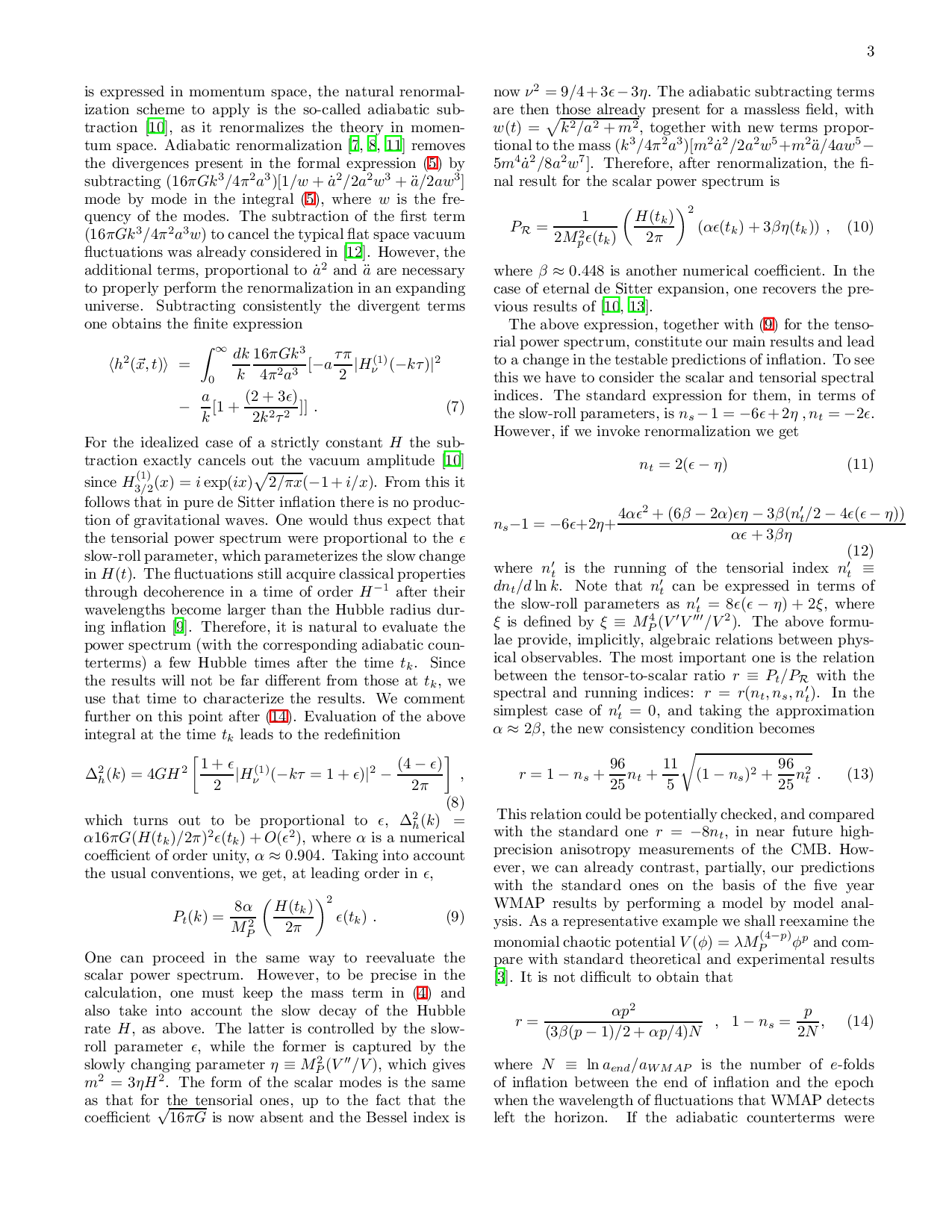
We point out that if quantum field renormalization is taken into account, and the counterterms are evaluated at the Hubble-radius crossing time or few e-foldings after it, the predictions of slow-roll inflation for both the scalar and tensorial power spectrum change significantly. This leads to a change in the consistency condition that relates the tensor-to-scalar amplitude ratio with spectral indices. A reexamination of the potentials $\bf{\phi^2, \phi^4}$, shows that both are compatible with five-year WMAP data. Only when the counterterms are evaluated at much larger times beyond the end of inflation one recovers the standard predictions. The alternative predictions presented here may soon come within the range of measurement of near-future experiments.
Deep Dive into Revising the predictions of inflation for the cosmic microwave background anisotropies.
We point out that if quantum field renormalization is taken into account, and the counterterms are evaluated at the Hubble-radius crossing time or few e-foldings after it, the predictions of slow-roll inflation for both the scalar and tensorial power spectrum change significantly. This leads to a change in the consistency condition that relates the tensor-to-scalar amplitude ratio with spectral indices. A reexamination of the potentials $\bf{\phi^2, \phi^4}$, shows that both are compatible with five-year WMAP data. Only when the counterterms are evaluated at much larger times beyond the end of inflation one recovers the standard predictions. The alternative predictions presented here may soon come within the range of measurement of near-future experiments.
A sufficiently long period of accelerated expansion in the very early universe is able to solve the questions raised by the standard big bang cosmology [1]. The hot big bang cosmology is an extremely successful theory. It explains the existence of the cosmic microwave background (CMB) and its thermal nature, the observed expansion of the universe, the abundance of light elements and the astrophysical fits for the age of the universe. However, it leaves without answer why our universe appears so homogeneous and nearly flat at large scales. Inflation offers a natural answer to these questions and, at the same time, provides a predictive mechanism to account for the small observed inhomogeneities [2] responsible for the structure formation in the universe and the anisotropies present in the cosmic microwave background (CMB), as first detected by the COBE satellite and further analyzed by the Wilkinson Microwave Anisotropy Probe (WMAP) satellite [3]. Inflation predicts production of primordial density perturbations and relic gravitational waves as amplifications of vacuum fluctuations together with a quantum-to-classical transition at the scale of Hubble sphere crossing. Primordial perturbations leave an imprint in the CMB anisotropies, which are, therefore, of major importance for understanding our universe and its origin. The potential-energy density of a scalar (inflaton) field is assumed to cause the inflationary expansion, and the amplification of its quantum fluctuations and those of the metric are inevitable consequences in an expanding universe [4]. The metric fluctuations provide the initial conditions for the acoustic oscillations of the plasma at the onset of the subsequent radiation-dominated epoch. The detection of the effects of primordial gravitational waves in future high-precision measurements of the CMB anisotropies, as for instance in the PLANCK satellite mission [5], will serve as a highly non-trivial test for inflation. Therefore, it is particularly important to scrutinize, from all points of view, the standard predictions of inflation (as summarized for instance, in [6]) to be tested empirically. This is the aim of this paper. We point out that if quantum field renormalization is taken into account, as in the experimentally tested Casimir effect, the quantitative predictions of inflation change significantly, and may be tested in forthcoming CMB measurements.
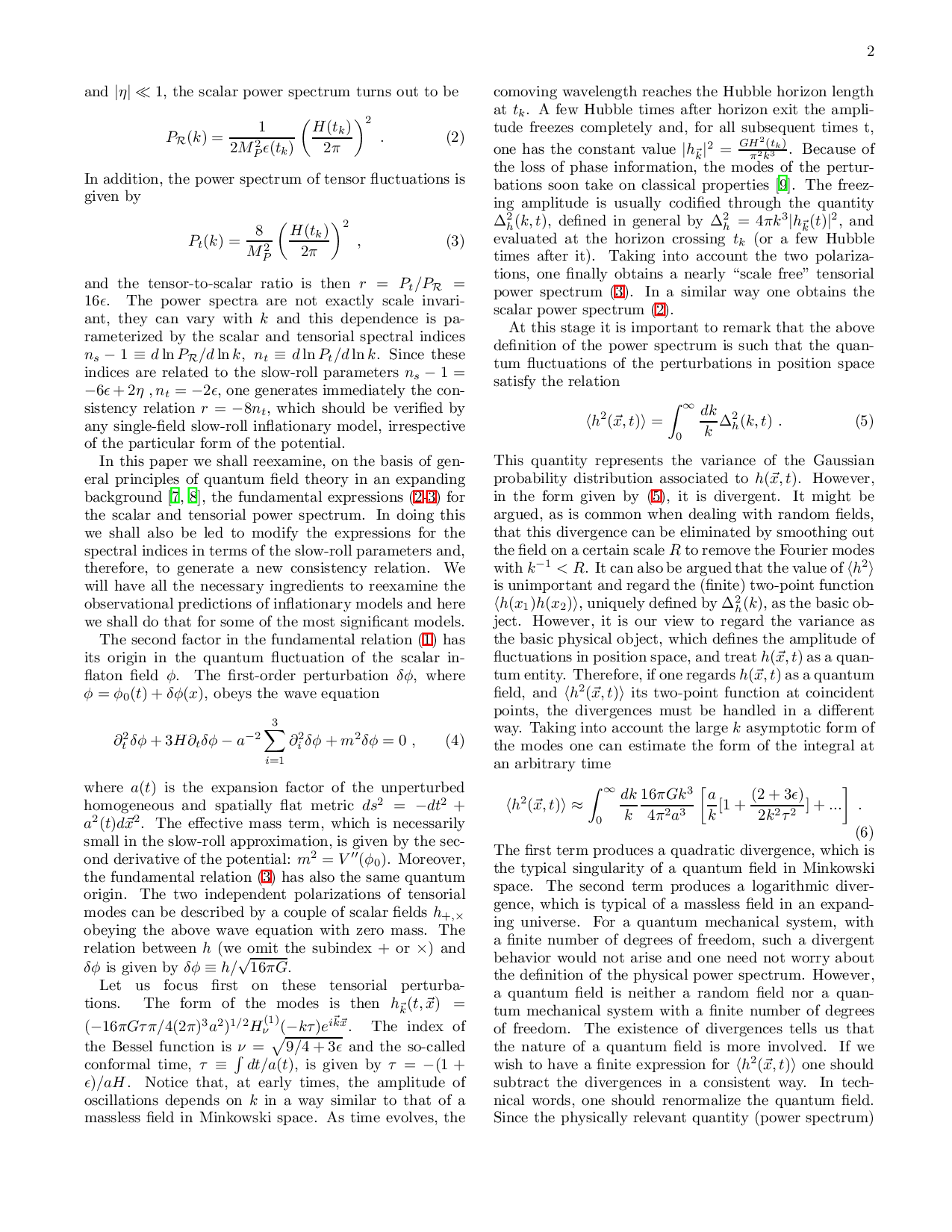
The scalar perturbations, which constitute the “seeds” for structure formation, are characterized by the power spectrum
where φ represents the inflaton scalar field, which dominates the energy density during inflation. Here H stands for the Hubble rate H ≡ ȧ/a, where a(t) is the expansion factor and dot means derivative with respect to the comoving time. The above expression is evaluated at the Hubble radius crossing time t k (usually called “horizon crossing” time), where k/a(t k ) = H. In the typical slow-roll inflationary scenario the homogeneous part of the inflaton field φ 0 (t) rolls slowly down its potential V (φ) towards a minimum. Both φ and H ≡ 8πG 3 V (φ 0 ) are changing very gradually and this change is parameterized by the slow-roll parameters ǫ, η, where ǫ ≡ -Ḣ/H 2 , and η -ǫ ≡ φ/(H φ). These parameters can be related to the derivatives of the inflaton potential ǫ = (M 2 P /2)(V ′ /V ) 2 , η = M 2 P (V ′′ /V ), where M P = 1/ √ 8πG is the reduced Planck mass in natural units = 1 = c. In the slow-roll approximation, ǫ ≪ 1 and |η| ≪ 1, the scalar power spectrum turns out to be
In addition, the power spectrum of tensor fluctuations is given by
and the tensor-to-scalar ratio is then r = P t /P R = 16ǫ. In this paper we shall reexamine, on the basis of general principles of quantum field theory in an expanding background [7,8], the fundamental expressions (2-3) for the scalar and tensorial power spectrum. In doing this we shall also be led to modify the expressions for the spectral indices in terms of the slow-roll parameters and, therefore, to generate a new consistency relation. We will have all the necessary ingredients to reexamine the observational predictions of inflationary models and here we shall do that for some of the most significant models.
The second factor in the fundamental relation (1) has its origin in the quantum fluctuation of the scalar inflaton field φ. The first-order perturbation δφ, where φ = φ 0 (t) + δφ(x), obeys the wave equation
where a(t) is the expansion factor of the unperturbed homogeneous and spatially flat metric ds 2 = -dt 2 + a 2 (t)d x 2 . The effective mass term, which is necessarily small in the slow-roll approximation, is given by the second derivative of the potential: m 2 = V ′′ (φ 0 ). Moreover, the fundamental relation (3) has also the same quantum origin. The two independent polarizations of tensorial modes can be described by a couple of scalar fields h +,× obeying the above wave equation with zero mass. The relation between h (we omit the subindex + or ×) and δφ is given b
…(Full text truncated)…
This content is AI-processed based on ArXiv data.