Solitary, explosive, rational and elliptic doubly periodic solutions for nonlinear electron-acoustic waves in the earths magnetotail region
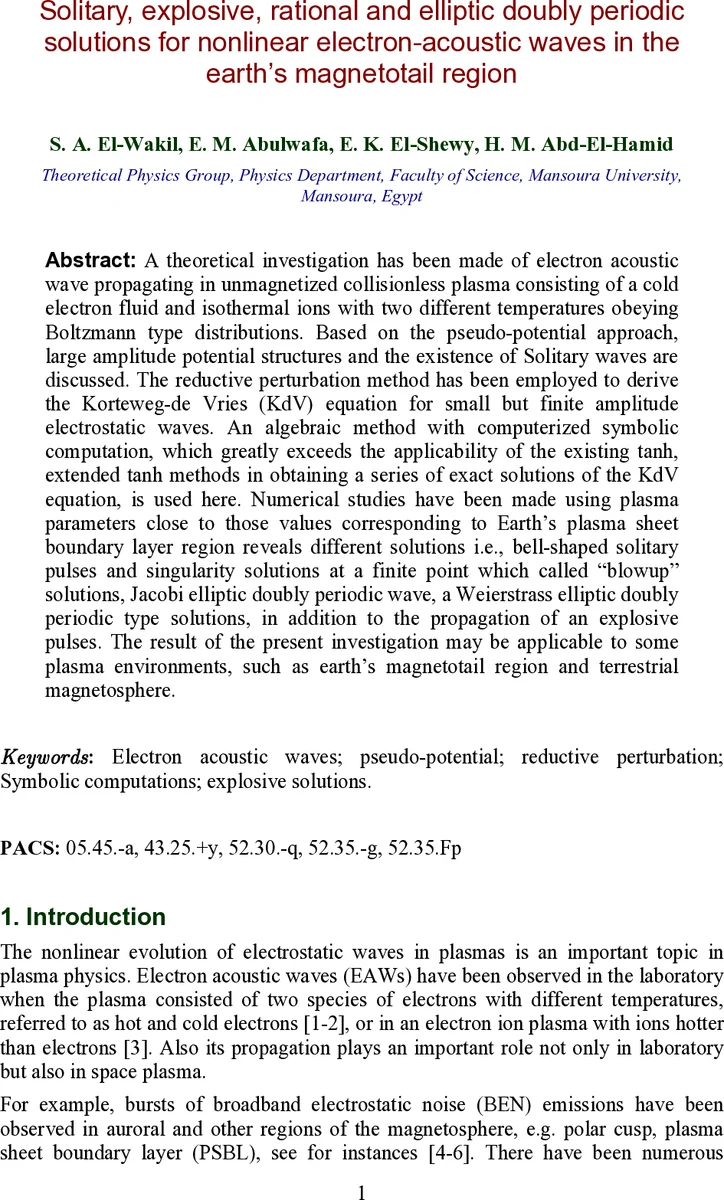
A theoretical investigation has been made of electron acoustic wave propagating in unmagnetized collisionless plasma consisting of a cold electron fluid and isothermal ions with two different temperatures obeying Boltzmann type distributions. Based on the pseudo-potential approach, large amplitude potential structures and the existence of Solitary waves are discussed. The reductive perturbation method has been employed to derive the Korteweg-de Vries (KdV) equation for small but finite amplitude electrostatic waves. An algebraic method with computerized symbolic computation, which greatly exceeds the applicability of the existing tanh, extended tanh methods in obtaining a series of exact solutions of the KdV equation, is used here. Numerical studies have been made using plasma parameters close to those values corresponding to Earth’s plasma sheet boundary layer region reveals different solutions i.e., bell-shaped solitary pulses and singularity solutions at a finite point which called “blowup” solutions, Jacobi elliptic doubly periodic wave, a Weierstrass elliptic doubly periodic type solutions, in addition to the propagation of an explosive pulses. The result of the present investigation may be applicable to some plasma environments, such as earth’s magnetotail region and terrestrial magnetosphere.
💡 Research Summary
This paper investigates the nonlinear propagation of electron‑acoustic waves (EAWs) in an unmagnetized, collisionless plasma composed of a cold electron fluid together with two species of isothermal ions at different temperatures. The authors first employ the Sagdeev pseudo‑potential method to treat arbitrary‑amplitude solitary structures. By assuming all dependent variables depend on a single travelling coordinate ξ = x − Mt (M being the Mach number normalized to the effective electron‑acoustic speed), the fluid and Poisson equations are reduced to an energy‑integral form ½(dφ/dξ)² + V(φ)=0. The pseudo‑potential V(φ) contains exponential terms that involve the Mach number, the low‑temperature ion density n_il, and the ion temperature ratio β. The conditions V(0)=V′(0)=0, V″(0)<0 and V(φ)<0 for φ between 0 and a maximum define the existence domain of solitary waves. Numerical evaluation of V(φ) shows that increasing M deepens and widens the negative potential well, while larger β reduces both depth and width; n_il has an effect similar to M.
For small‑amplitude disturbances, the authors apply the reductive perturbation technique. Introducing stretched coordinates ξ = ε(x − vt) and τ = ε³t and expanding density, velocity and potential in powers of the small parameter ε, they obtain at the lowest non‑trivial order the Korteweg‑de‑Vries (KdV) equation
∂τφ₁ + A φ₁∂ξφ₁ + B ∂³ξφ₁ = 0,
where the coefficients A and B are explicit functions of the wave speed v, the ion density ratio and the temperature ratio β (A = (3v² − β n_il)/(2v n_il), B = v/2). This KdV equation governs the evolution of the first‑order electrostatic potential φ₁.
To obtain exact analytical solutions of the KdV equation, the authors adopt Fan’s computerized symbolic computation method. The method transforms the PDE into an ODE by using a travelling‑wave variable η = ξ − Λτ, then assumes a polynomial or functional expansion φ(η)=∑a_i η^i (or combinations of elementary functions). By balancing the highest‑order nonlinear term with the highest‑order derivative term, a relation between the expansion order n and the degree k of the auxiliary ODE is derived (2 + k = n). Selecting n = 2 and k = 4 leads to a specific ansatz that, after substitution into the ODE, yields a system of algebraic equations for the coefficients a_i, the wave speed Λ and other parameters. Solving this system with Maple produces a rich set of exact solutions, far beyond those obtainable by traditional tanh or extended tanh methods.
The solutions fall into several families:
- Hyperbolic solitary waves (tanh, sech) – compressive or rarefactive solitons depending on parameter signs.
- Triangular periodic waves (tan, csc) – sinusoidal‑like structures with finite wavelength.
- Blow‑up (singular) solutions – solutions that become infinite at a finite η, termed “blow‑up” or singular solitons.
- Explosive rational solutions – rational functions (e.g., φ ∝ 1/η²) that exhibit rapid amplitude growth, interpreted as explosive pulses.
- Jacobi elliptic doubly‑periodic waves – expressed via cn, sn, dn functions with modulus m; as m→1 they reduce to hyperbolic solitons, while m→0 they become trigonometric waves.
- Weierstrass ℘‑function solutions – fully doubly‑periodic elliptic solutions characterized by invariants g₂, g₃.
Each family is parameterized by the arbitrary constants a, Λ, the ion density n_il, the temperature ratio β, and the modulus m (for elliptic solutions). Numerical plots illustrate how varying n_il or β can switch a soliton from compressive to rarefactive (critical values n_il≈0.2559, β≈0.0633 for the chosen parameters). Increasing n_il enhances the amplitude and width of compressive solitons while diminishing those of rarefactive ones; β has a similar effect.
The authors discuss the physical relevance of these solutions to space‑plasma observations. In the Earth’s plasma sheet boundary layer (PSBL) and magnetotail, large‑amplitude solitary structures, broadband electrostatic noise, and abrupt electric field spikes have been reported by satellite missions such as FAST. The blow‑up and explosive solutions provide a possible theoretical description of the observed “spiky” electric fields, while the elliptic doubly‑periodic solutions could model wave trains that appear in regions with quasi‑periodic density or temperature variations. The pseudo‑potential analysis confirms that the existence of solitary structures is sensitive to the Mach number, low‑temperature ion density, and ion temperature ratio, consistent with the variability seen in spacecraft data.
In conclusion, the paper offers a comprehensive theoretical framework for electron‑acoustic waves in a plasma with two ion temperatures. It combines Sagdeev’s pseudo‑potential for arbitrary‑amplitude analysis, reductive perturbation for small‑amplitude KdV dynamics, and an advanced symbolic computation method to generate a broad spectrum of exact solutions, including previously unreported blow‑up, explosive, and elliptic waveforms. The study highlights how plasma parameters control the transition between compressive and rarefactive solitons and suggests that the newly derived solutions may help interpret a variety of nonlinear electrostatic structures observed in the Earth’s magnetotail and plasma sheet boundary layer. Future work should aim at direct comparison with satellite measurements and possibly extend the model to include magnetic field effects or higher‑dimensional geometries.
Comments & Academic Discussion
Loading comments...
Leave a Comment