The asymptotic values of the general Zagreb and Randic indices of trees with bounded maximum degree
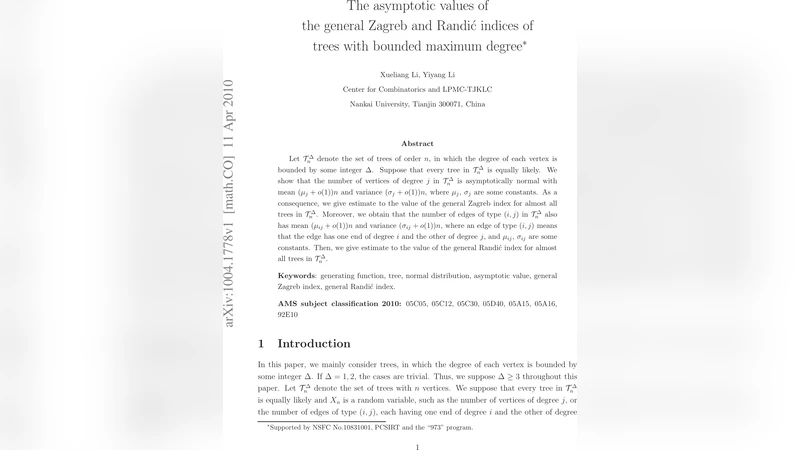
Let $\mathcal {T}^{\Delta}_n$ denote the set of trees of order $n$, in which the degree of each vertex is bounded by some integer $\Delta$. Suppose that every tree in $\mathcal {T}^{\Delta}n$ is equally likely. We show that the number of vertices of degree $j$ in $\mathcal {T}^{\Delta}n$ is asymptotically normal with mean $(\mu_j+o(1))n$ and variance $(\sigma_j+o(1))n$, where $\mu_j$, $\sigma_j$ are some constants. As a consequence, we give estimate to the value of the general Zagreb index for almost all trees in $\mathcal {T}^{\Delta}n$. Moreover, we obtain that the number of edges of type $(i,j)$ in $\mathcal {T}^{\Delta}n$ also has mean $(\mu{ij}+o(1))n$ and variance $(\sigma{ij}+o(1))n$, where an edge of type $(i,j)$ means that the edge has one end of degree $i$ and the other of degree $j$, and $\mu{ij}$, $\sigma{ij}$ are some constants. Then, we give estimate to the value of the general Randi'{c} index for almost all trees in $\mathcal {T}^{\Delta}_n$.
💡 Research Summary
The paper investigates the asymptotic behavior of two widely studied topological indices – the general Zagreb index and the general Randić index – on the family 𝒯⁽Δ⁾ₙ of labelled trees with n vertices whose vertex degrees are bounded by a fixed integer Δ ≥ 3. The authors assume a uniform distribution over all such trees and use analytic combinatorics to obtain precise probabilistic statements about the degree distribution and the distribution of edge‑type counts.
First, they recall Otter’s classic result that the ordinary generating function t(x) for the number of trees satisfies a square‑root singular expansion near its dominant singularity x₀ (with x₀ ≤ ½). From this they obtain the well‑known asymptotic |𝒯⁽Δ⁾ₙ| ≈ τ·x₀⁻ⁿ·n⁻⁵ᐟ². They then introduce rooted trees (R⁽Δ⁾ₙ) and planted trees (P⁽Δ⁾ₙ) together with their bivariate generating functions r(x,u) and p(x,u), where the auxiliary variable u marks the number of vertices of a prescribed degree j.
The core technical tool is a multivariate singularity analysis lemma (Lemma 1) originally due to Drmota, Chyzak and co‑authors. The lemma states that for a system of functional equations y = F(x,y,u) whose dependency graph is strongly connected, the solution vector y(x,u) can be written in the form
y_i(x,u) = g_i(x,u) − h_i(x,u)·(1 − x/f(u))⁻¹,
where f(u) is analytic near u = 1 and f(1) equals the dominant singularity x₀. Moreover, the coefficients of the series expansion of y_i(x,u) satisfy a central limit theorem with mean μ = −f′(1)/f(1) and variance determined by second derivatives.
Applying this framework to p(x,u) (the generating function for planted trees with a marked degree‑j vertex) yields that the random variable Xₙ, the number of vertices of degree j in a uniformly random tree from 𝒯⁽Δ⁾ₙ, is asymptotically normal with
E
Comments & Academic Discussion
Loading comments...
Leave a Comment