A New Approach to Analyzing Patterns of Collaboration in Co-authorship Networks - Mesoscopic Analysis and Interpretation
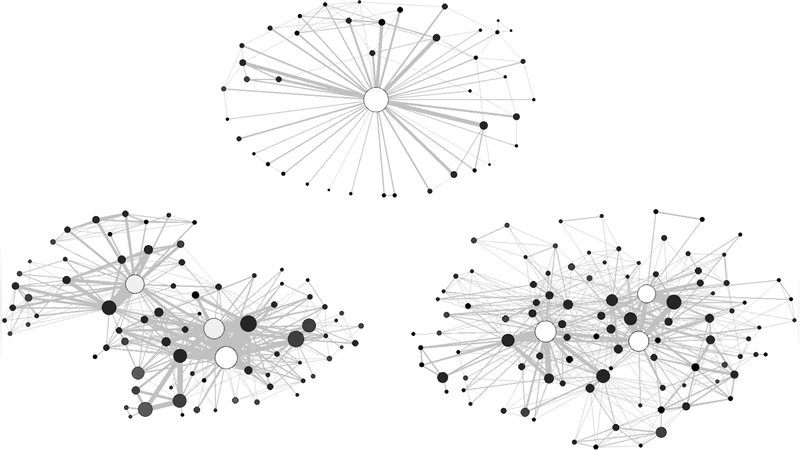
This paper focuses on methods to study patterns of collaboration in co-authorship networks at the mesoscopic level. We combine qualitative methods (participant interviews) with quantitative methods (network analysis) and demonstrate the application and value of our approach in a case study comparing three research fields in chemistry. A mesoscopic level of analysis means that in addition to the basic analytic unit of the individual researcher as node in a co-author network, we base our analysis on the observed modular structure of co-author networks. We interpret the clustering of authors into groups as bibliometric footprints of the basic collective units of knowledge production in a research specialty. We find two types of coauthor-linking patterns between author clusters that we interpret as representing two different forms of cooperative behavior, transfer-type connections due to career migrations or one-off services rendered, and stronger, dedicated inter-group collaboration. Hence the generic coauthor network of a research specialty can be understood as the overlay of two distinct types of cooperative networks between groups of authors publishing in a research specialty. We show how our analytic approach exposes field specific differences in the social organization of research.
💡 Research Summary
The paper introduces a novel mesoscopic framework for studying co‑authorship networks that moves beyond the traditional node‑centric view of individual researchers. By treating the empirically detected modules (clusters) of authors as the primary analytical units, the authors capture the collective “knowledge‑production groups” that naturally emerge within a scientific specialty. The methodology combines quantitative network analysis with qualitative interviews, allowing the authors to link structural patterns to the lived experiences and career trajectories of researchers.
First, bibliographic data from three chemistry sub‑fields—organic synthesis, catalysis, and analytical chemistry—are transformed into author‑author networks. Standard network metrics (density, average path length, clustering coefficient) are computed, and community detection algorithms (Louvain, Infomap, etc.) are applied to identify robust clusters. Each cluster exhibits high internal cohesion and relatively sparse external ties, which the authors interpret as distinct research teams or laboratories that repeatedly co‑publish.
Second, semi‑structured interviews are conducted with representative scholars from each cluster. The interview protocol probes research focus continuity, institutional mobility, motivations for collaboration, and the perceived outcomes of joint work. This qualitative layer reveals the social mechanisms behind the observed links between clusters.
Integrating the two data streams, the authors discover two qualitatively different types of inter‑cluster connections. “Transfer‑type” links arise when a researcher moves between institutions or participates in a one‑off project. These links are characterized by low edge weight (few joint papers), short temporal duration, and high betweenness centrality, acting as bridges that facilitate the diffusion of methods, ideas, or equipment across otherwise separate groups. In contrast, “dedicated” links reflect sustained, intensive collaboration between two clusters, often involving multiple co‑authored papers, shared large‑scale facilities, or long‑term grant‑based projects. Dedicated links have high edge weight, dense reciprocal ties, and form a core‑core backbone in the network visualization.
When the three chemistry fields are compared, distinct patterns emerge. Catalysis shows a predominance of dedicated links (≈68 % of inter‑cluster edges), reflecting the field’s reliance on large, well‑funded consortia and shared instrumentation. Analytical chemistry, by contrast, exhibits a higher proportion of transfer‑type links (≈55 %), consistent with its fragmented infrastructure and frequent researcher mobility. Organic synthesis displays a more balanced mix (≈45 % transfer, ≈50 % dedicated), mirroring its hybrid culture of both small‑scale, investigator‑driven projects and occasional large collaborations.
The authors argue that these differences are rooted in field‑specific research cultures, funding mechanisms, and institutional arrangements. The mesoscopic approach thus uncovers not only structural properties of co‑authorship networks but also the underlying social and organizational dynamics that shape them.
In the discussion, the paper outlines practical implications. For fields dominated by transfer‑type connections, policies that facilitate researcher mobility—such as targeted fellowships, post‑doctoral exchange programs, and short‑term visiting scholar schemes—could enhance knowledge diffusion. Conversely, in fields where dedicated links prevail, investment in shared facilities, coordinated large‑scale grant programs, and mechanisms that reward long‑term team science become more pertinent. At the institutional level, identifying “bridge” scholars who maintain transfer‑type ties can inform strategic hiring and talent‑retention decisions.
Overall, the study demonstrates that viewing co‑authorship networks as an overlay of two distinct cooperative subnetworks—transfer‑type and dedicated—provides a richer, more actionable understanding of scientific collaboration. This mesoscopic perspective bridges quantitative network metrics with qualitative insights, offering a robust template for future bibliometric investigations and for designing evidence‑based research policy.
Comments & Academic Discussion
Loading comments...
Leave a Comment