On Hopf 2-algebras
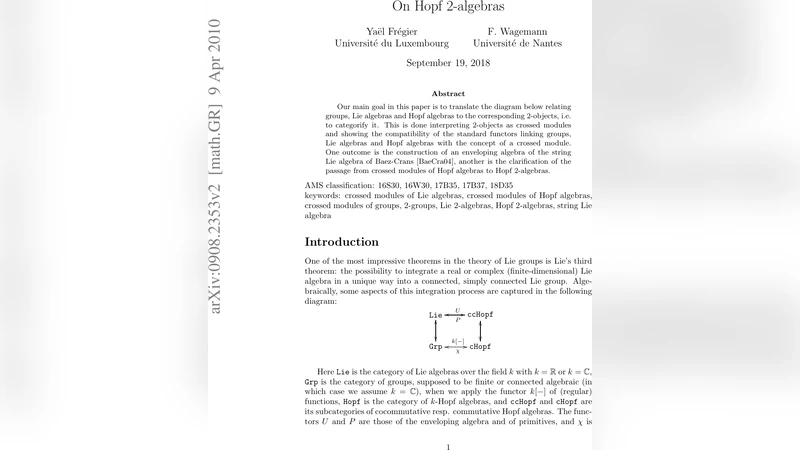
Our main goal in this paper is to translate the diagram relating groups, Lie algebras and Hopf algebras to the corresponding 2-objects, i.e. to categorify it. This is done interpreting 2-objects as crossed modules and showing the compatibility of the standard functors linking groups, Lie algebras and Hopf algebras with the concept of a crossed module. One outcome is the construction of an enveloping algebra of the string Lie algebra of Baez-Crans, another is the clarification of the passage from crossed modules of Hopf algebras to Hopf 2-algebras.
💡 Research Summary
The paper “On Hopf 2‑algebras” undertakes a systematic categorification of the classical triangle linking groups, Lie algebras, and Hopf algebras. The authors observe that each of these algebraic objects can be viewed as a one‑dimensional instance of a more general notion—crossed modules— which naturally encode the data of a 2‑object (a 2‑group, a Lie 2‑algebra, or a Hopf 2‑algebra). By re‑expressing groups, Lie algebras and Hopf algebras as crossed modules, the familiar functors (group‑to‑Lie‑algebra, Lie‑algebra‑to‑universal‑enveloping‑algebra, Lie‑algebra‑to‑Hopf‑algebra) lift to strict 2‑functors between the corresponding 2‑categories.
The first part of the work reviews the classical diagram and recalls the standard constructions: the Lie algebra of a group, the universal enveloping algebra of a Lie algebra, and the Hopf algebra structure obtained from a Lie algebra via the Poincaré–Birkhoff–Witt theorem. Then the authors introduce crossed modules of groups, showing that they are equivalent to strict 2‑groups. This provides the first level of categorification: a group crossed module (∂ : E → G) encodes a 2‑group whose objects are elements of G and whose morphisms are elements of E.
Next, they treat crossed modules of Lie algebras. In particular, they focus on the “string Lie algebra” ℓₛ introduced by Baez and Crans, which is a Lie 2‑algebra given by a crossed module ℓ₁ → ℓ₀. The authors construct an enveloping Hopf 2‑algebra U₂(ℓₛ) that simultaneously generalizes the universal enveloping algebra of ℓ₀ and incorporates the extra degree‑1 data ℓ₁ as a co‑action. This construction respects the Lie 2‑algebra brackets, the differential ∂, and the action of ℓ₀ on ℓ₁, yielding a Hopf algebra object in the 2‑category of crossed modules. The resulting U₂(ℓₛ) is shown to be co‑commutative, to possess a compatible antipode, and to satisfy a 2‑dimensional version of the PBW theorem.
The core novelty lies in the definition of crossed modules of Hopf algebras. A Hopf crossed module consists of Hopf algebras H and G together with a Hopf algebra morphism ∂ : H → G and an action of G on H that is simultaneously a module and a comodule, subject to a set of compatibility (crossed) conditions. The authors prove that such data form a strict 2‑category, whose objects are Hopf crossed modules, 1‑morphisms are morphisms of crossed modules, and 2‑morphisms are natural transformations respecting both algebraic and coalgebraic structures. They then demonstrate that the standard functors from groups to Lie algebras and from Lie algebras to Hopf algebras extend to this 2‑level: a group crossed module yields a Lie algebra crossed module via differentiation, and a Lie algebra crossed module yields a Hopf crossed module via the universal enveloping construction. Consequently, the classical triangle lifts to a “crossed‑module triangle” linking 2‑groups, Lie 2‑algebras, and Hopf 2‑algebras.
The paper also discusses the passage from a Hopf crossed module (H → G) to a Hopf 2‑algebra. By interpreting the crossed module as a single object in a monoidal 2‑category, the authors define a tensor product, unit, and braiding that satisfy the coherence axioms of a Hopf 2‑algebra. They verify that the antipode lifts to a 2‑antipode and that the co‑associativity and associativity constraints are compatible with the 2‑cell structure.
In the concluding section the authors outline several directions for future research. They suggest extending the framework to weak (non‑strict) 2‑algebras, exploring connections with higher gauge theory and categorified quantum groups, and investigating higher‑dimensional analogues such as 3‑Hopf algebras. The work thus provides a solid algebraic foundation for incorporating 2‑dimensional symmetry into quantum algebra and offers a unified language—crossed modules—for navigating between groups, Lie algebras, and Hopf algebras at the categorified level.
Comments & Academic Discussion
Loading comments...
Leave a Comment