Atiyahs $L^2$-Index theorem
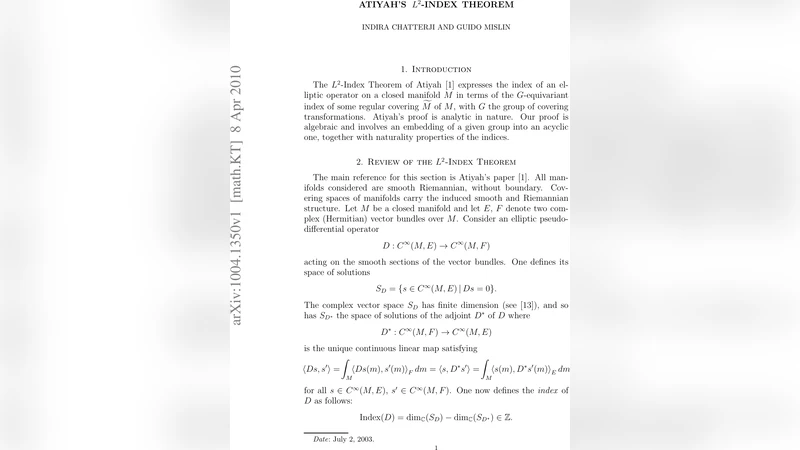
The $L^2$-Index Theorem of Atiyah \cite{atiyah} expresses the index of an elliptic operator on a closed manifold $M$ in terms of the $G$-equivariant index of some regular covering $\widetilde{M}$ of $M$, with $G$ the group of covering transformations. Atiyah’s proof is analytic in nature. Our proof is algebraic and involves an embedding of a given group into an acyclic one, together with naturality properties of the indices.
💡 Research Summary
The paper revisits Atiyah’s celebrated L²‑index theorem, which relates the analytic index of an elliptic operator D on a closed manifold M to the G‑equivariant L²‑index of its lift (\widetilde D) to a regular covering (\widetilde M) with covering transformation group G. While Atiyah’s original proof relies heavily on analytic techniques—spectral theory of Hilbert‑space operators, heat‑kernel asymptotics, and von Neumann trace calculations—the authors present a completely algebraic argument. The central idea is to embed the possibly complicated group G into a larger group A that is acyclic, i.e., its reduced group homology vanishes in positive degrees. Such an embedding (i\colon G\hookrightarrow A) can always be constructed using standard group‑theoretic methods (e.g., by adjoining cells to kill homology).
Once the embedding is in place, the authors study the index as a functor from the reduced C(^)‑algebra K‑theory (K_0(C^_r G)) to the real numbers, defined via the von Neumann dimension. They prove a naturality property: for any group homomorphism (\phi\colon G\to H) the diagram
\
Comments & Academic Discussion
Loading comments...
Leave a Comment