The Potato Radius: a Lower Minimum Size for Dwarf Planets
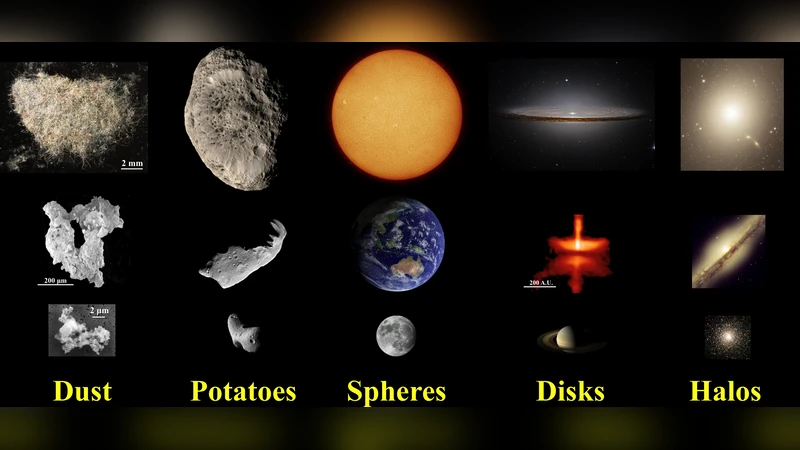
Gravitational and electronic forces produce a correlation between the mass and shape of objects in the universe. For example, at an average radius of ~ 200 km - 300 km, the icy moons and rocky asteroids of our Solar System transition from a rounded potato shape to a sphere. We derive this potato-to-sphere transition radius – or “potato radius” – from first principles. Using the empirical potato radii of asteroids and icy moons, we derive a constraint on the yield strength of these bodies during their formative years when their shapes were determined. Our proposed ~ 200 km potato radius for icy moons would substantially increase the number of trans-Neptunian objects classified as dwarf planets.
💡 Research Summary
The paper investigates the physical origin of the transition from irregular “potato‑shaped” bodies to nearly spherical ones in the Solar System, introducing the concept of a “potato radius” – the minimum size at which self‑gravity overcomes material strength and forces a body into hydrostatic equilibrium. Starting from first principles, the authors balance the internal gravitational pressure (∼ρ g R, where ρ is mean density, g the surface gravity, and R the radius) against the material’s yield strength σ_y. By equating these forces they derive an analytical expression for the critical radius:
R_p ≈ √
Comments & Academic Discussion
Loading comments...
Leave a Comment