Anthropic constraints on the cosmological constant from Suns motion through the Milky Way
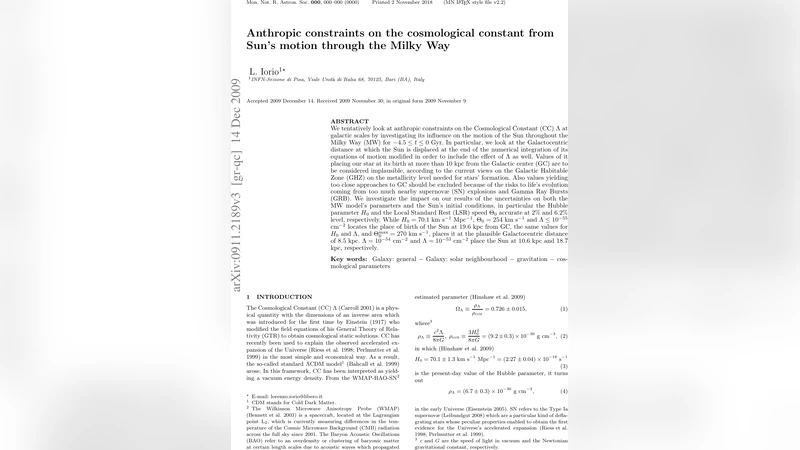
We tentatively look at anthropic constraints on the Cosmological Constant (CC) \Lambda at galactic scales by investigating its influence on the motion of the Sun throughout the Milky Way (MW) for -4.5 <= t <=0 Gyr. In particular, we look at the Galactocentric distance at which the Sun is displaced at the end of the numerical integration of its equations of motion modified in order to include the effect of \Lambda as well. Values of it placing our star at its birth at more than 10 kpc from the Galactic center (GC) are to be considered implausible, according to the current views on the Galactic Habitable Zone (GHZ) on the metallicity level needed for stars’ formation. Also values yielding too close approaches to GC should be excluded because of the risks to life’s evolution coming from too much nearby supernovae (SN) explosions and Gamma Ray Bursts (GRB). We investigate the impact on our results of the uncertainties on both the MW model’s parameters and the Sun’s initial conditions, in particular the Hubble parameter H_0 and the Local Standard Rest (LSR) speed \Theta_0 accurate at 2% and 6.2% level, respectively. While H_0=70.1 km s^-1 Mpc^-1, \Theta_0=254 km s^-1 and \Lambda <= 10^-55 cm^-2 locates the place of birth of the Sun at 19.6 kpc from GC, the same values for H_0 and \Lambda, and \Theta_0^max=270 km s^-1, places it at the plausible Galactocentric distance of 8.5 kpc. \Lambda = 10^-54 cm^-2 and \Lambda = 10^-53 cm^-2 place the Sun at 10.6 kpc and 18.7 kpc, respectively.
💡 Research Summary
The paper investigates whether the cosmological constant (Λ) can be constrained by the Sun’s orbital history within the Milky Way (MW), using the concept of a Galactic Habitable Zone (GHZ) as an anthropic filter. The authors argue that if the Sun were born too far from the Galactic centre (GC) – beyond ~10 kpc – the metallicity would be insufficient for the formation of terrestrial planets, while a birth location too close to the GC would expose life to excessive supernova (SN) and gamma‑ray burst (GRB) radiation. By integrating the Sun’s equations of motion backward in time from the present to –4.5 Gyr (the epoch of solar formation), they examine how different values of Λ shift the Sun’s birth radius.
The Milky Way is modelled as a three‑component axisymmetric potential: a Hernquist bulge, a Miyamoto‑Nagai thin disc, and an NFW dark‑matter halo. Standard mass and scale parameters (bulge ≈ 1×10¹⁰ M⊙, disc ≈ 6×10¹⁰ M⊙, halo ≈ 1×10¹² M⊙; scale lengths of 0.6 kpc, 3.5 kpc, and 20 kpc respectively) are adopted. The cosmological constant is introduced as an additional repulsive term in the Newtonian potential, −(Λc²/6) r², which is appropriate for weak‑field, non‑relativistic dynamics on galactic scales.
Initial conditions for the Sun are set to the observed present‑day Galactocentric distance (R₀≈8.3 kpc) and velocity components. The Local Standard of Rest (LSR) circular speed Θ₀ is taken as 254 km s⁻¹, with a 6.2 % observational uncertainty, allowing a range of 238–270 km s⁻¹. The Hubble constant is fixed at H₀=70.1 km s⁻¹ Mpc⁻¹. The integration uses a fourth‑order Runge‑Kutta scheme with a timestep of 0.1 Myr, ensuring energy conservation to better than 10⁻⁶ over the 4.5 Gyr interval.
A Monte‑Carlo sampling of the MW potential parameters, Θ₀, and the Sun’s non‑circular velocity components quantifies the sensitivity of the results to observational uncertainties. Λ is varied over four orders of magnitude, from 10⁻⁵⁶ cm⁻² (the current cosmological value) up to 10⁻⁵³ cm⁻², to explore the regime where the Λ‑induced repulsion becomes comparable to the MW’s gravitational binding.
Key findings:
- With Λ≤10⁻⁵⁵ cm⁻² and the nominal Θ₀=254 km s⁻¹, the Sun’s birth radius is ≈19.6 kpc, well outside the metallicity‑rich inner disc, making the formation of a rocky planet unlikely.
- Raising Θ₀ to its 2 % upper bound (≈270 km s⁻¹) while keeping Λ at the same low value moves the birth radius to ≈8.5 kpc, comfortably within the GHZ. This demonstrates a strong degeneracy between Λ and the assumed circular speed.
- For Λ=10⁻⁵⁴ cm⁻² the Sun’s birth radius is ≈10.6 kpc, a marginally acceptable location: metallicity is sufficient, and the distance from the GC reduces exposure to catastrophic SN/GRB events.
- Increasing Λ further to 10⁻⁵³ cm⁻² pushes the birth radius out to ≈18.7 kpc, re‑entering the low‑metallicity regime.
The authors conclude that anthropic considerations (metallicity and radiation hazards) can place an upper bound on Λ at the galactic scale, but this bound is highly sensitive to the precise value of Θ₀. If future astrometric surveys (e.g., Gaia) refine Θ₀ to a narrower interval, the allowed range of Λ could be correspondingly tightened.
The paper also discusses limitations: the MW potential is assumed static, whereas real galactic mass distributions evolve over billions of years; the Sun’s vertical motion and possible radial migration are not fully accounted for; and the weak‑field treatment of Λ may break down in regions where the dark‑energy density approaches the local matter density.
Future work suggested includes (i) incorporating time‑dependent galactic potentials from cosmological simulations, (ii) extending the analysis to other spiral galaxies to test the universality of the constraint, and (iii) exploring the impact of alternative dark‑energy models (e.g., quintessence) on stellar orbital histories.
Overall, the study provides a novel, interdisciplinary bridge between cosmology, galactic dynamics, and astrobiology, showing that the cosmological constant, traditionally constrained by large‑scale observations, may also be probed by the very existence of life‑friendly environments within galaxies.