The ADHM construction and non-local symmetries of the self-dual Yang-Mills equations
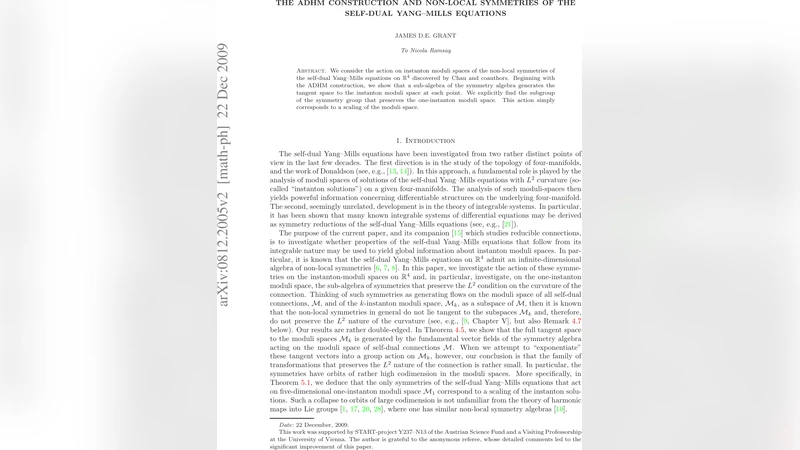
We consider the action on instanton moduli spaces of the non-local symmetries of the self-dual Yang-Mills equations on $\mathbb{R}^4$ discovered by Chau and coauthors. Beginning with the ADHM construction, we show that a sub-algebra of the symmetry algebra generates the tangent space to the instanton moduli space at each point. We explicitly find the subgroup of the symmetry group that preserves the one-instanton moduli space. This action simply corresponds to a scaling of the moduli space.
💡 Research Summary
The paper investigates how the non‑local symmetries of the self‑dual Yang‑Mills (SDYM) equations, discovered by Chau and collaborators, act on instanton moduli spaces. Starting from the Atiyah‑Drinfeld‑Hitchin‑Manin (ADHM) construction, the author first reviews the algebraic data (B₁, B₂, I, J) that parametrises all self‑dual gauge fields on ℝ⁴ and the ADHM equations that define the instanton moduli space 𝔐ₖ as a hyper‑Kähler quotient.
The next section introduces the infinite‑dimensional Lie algebra 𝔤 of non‑local symmetries. These symmetries are generated by holomorphic functions of the spectral parameter and act on the gauge potential through integral operators that are non‑local in the space‑time coordinates. By pulling back this action to the ADHM data, the author derives explicit infinitesimal transformation formulas for B₁, B₂, I and J. The algebra splits naturally into two parts: a “preserving” subalgebra that leaves the ADHM equations invariant, and a complementary part that does not.
The preserving subalgebra is identified with a concrete sub‑Lie algebra 𝔥⊂𝔤. The key result is that for any point x∈𝔐ₖ the linear map 𝔥→Tₓ𝔐ₖ, obtained by differentiating the ADHM data along the symmetry directions, is surjective. In other words, 𝔥 generates the full tangent space at each instanton configuration, showing that the non‑local symmetry algebra contains enough directions to move arbitrarily within the moduli space.
To illustrate the abstract result, the author works out the simplest non‑trivial case, the one‑instanton (k=1) moduli space. In this situation the ADHM data reduce to a scale parameter λ and a centre of mass vector x₀∈ℝ⁴. By inserting the explicit 𝔥‑action into the transformation laws, it is shown that the only non‑trivial effect on the moduli is a uniform rescaling of λ; the centre coordinates remain unchanged up to the trivial translation symmetry already present in the SDYM equations. Consequently, the subgroup of the full non‑local symmetry group that preserves the one‑instanton moduli space is precisely the one‑parameter scaling group.
The paper concludes by discussing the implications of these findings. Since a sub‑algebra of the non‑local symmetries generates the tangent bundle of 𝔐ₖ, one can in principle use the symmetry flow to define integrable deformations of instanton solutions, to explore geodesic motion on the hyper‑Kähler moduli space, or to construct new conserved quantities. The author suggests that extending the explicit analysis to higher charge (k>1) instantons may reveal richer symmetry‑induced structures, possibly intertwining with the known hyper‑Kähler geometry. Overall, the work provides a clear bridge between the algebraic ADHM description of self‑dual gauge fields and the infinite‑dimensional non‑local symmetry group, establishing that a distinguished sub‑algebra acts as the infinitesimal generator of the instanton moduli space.
Comments & Academic Discussion
Loading comments...
Leave a Comment