A connection between palindromic and factor complexity using return words
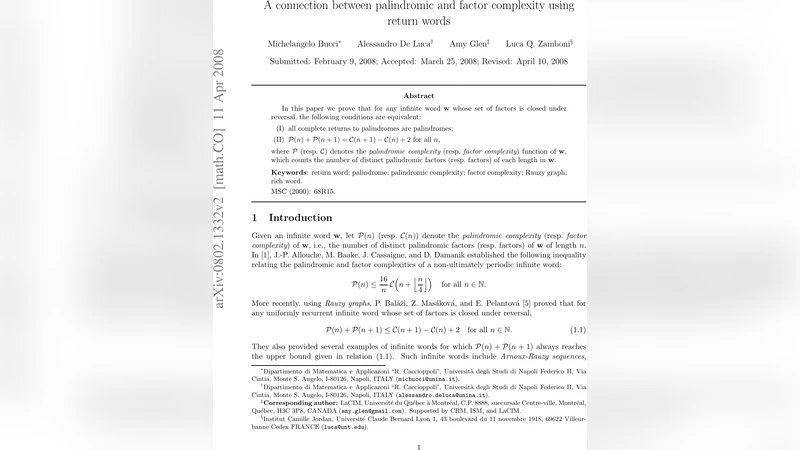
In this paper we prove that for any infinite word W whose set of factors is closed under reversal, the following conditions are equivalent: (I) all complete returns to palindromes are palindromes; (II) P(n) + P(n+1) = C(n+1) - C(n) + 2 for all n, where P (resp. C) denotes the palindromic complexity (resp. factor complexity) function of W, which counts the number of distinct palindromic factors (resp. factors) of each length in W.
💡 Research Summary
The paper investigates the precise relationship between palindromic complexity P(n) and factor (or subword) complexity C(n) for infinite words whose set of factors is closed under reversal. The authors prove a striking equivalence: for any such infinite word w, the following two statements are equivalent:
(I) Every complete return to a palindromic factor of w is itself a palindrome.
(II) For every integer n ≥ 0 the equality P(n)+P(n+1)=C(n+1)−C(n)+2 holds.
A “complete return” to a factor u is a factor r that contains exactly two occurrences of u, one as a prefix and one as a suffix, and no other internal occurrences of u. Condition (I) is known to characterize “rich” words – infinite words that contain the maximal possible number of distinct palindromes, namely |u|+1 for each factor u. The paper therefore provides a new characterization of rich words in terms of the exact equality (II).
The authors first set up notation: A is a finite alphabet, w an infinite word, Fₙ(w) the set of factors of length n, C(n)=|Fₙ(w)|, and P(n)=|{u∈Fₙ(w) | u=ũ}|. They recall that if F(w) is closed under reversal then w is recurrent (Proposition 2.2). They then introduce two key propositions.
Proposition 2.3 gives a fresh description of richness: for every factor v, any factor that starts with v, ends with its reversal ˜v, and does not contain v or ˜v as an interior factor must be a palindrome. The proof shows this condition is equivalent to the classical definition of richness.
Proposition 2.4 states that for any non‑palindromic factor v, the reversal ˜v occurs exactly once inside any complete return to v. This “alternation” property is crucial for later graph arguments.
The main technical tool is the Rauzy graph Γₙ(w). Its vertices are the length‑n factors, edges are length‑(n+1) factors, and the out‑degree (resp. in‑degree) of a vertex counts extensions on the right (resp. left). The authors observe that C(n+1)−C(n)=∑_{v∈Sₙ(w)}(deg⁺(v)−1), where Sₙ(w) is the set of special factors (those with degree ≥2). They introduce the reduced Rauzy graph Γ′ₙ(w), obtained by collapsing each simple path between special vertices into a single edge labelled by the concatenated word.
Lemma 3.2 proves that the label of any non‑trivial path in Γₙ(w) is itself a rich word, using induction on the number of vertices. Lemmas 3.3 and 3.4 extend Propositions 2.3 and 2.4 from factors to paths: a path from v to ˜v that avoids interior occurrences of v or ˜v is palindromic, and any non‑trivial path from v to v must pass through ˜v exactly once.
With these lemmas, the authors show that the reduced Rauzy graph of a rich word is a tree. Consequently each level n contributes exactly one “right‑special” (or left‑special) factor, which forces the sum ∑(deg⁺(v)−1) to be 1. Substituting into the earlier formula yields C(n+1)−C(n)=P(n)+P(n+1)−2, i.e. condition (II). Conversely, assuming (II) one can reconstruct the tree structure, deduce the alternation property, and finally obtain condition (I). Thus the equivalence is established.
The paper also discusses numerous examples: episturmian words, Arnoux–Rauzy sequences, words arising from β‑expansions, and Fischler’s “abundant palindromic prefixes”. All these satisfy the equality (II) and therefore meet condition (I). The authors note that any rich infinite word is recurrent, and recurrence together with reversal‑closure characterizes the class of words for which the equality holds.
In summary, the work provides a clean combinatorial characterization of the class of infinite words that simultaneously achieve the maximal possible palindromic complexity and satisfy the exact linear relation between P and C. The proof elegantly combines classical palindrome arguments with modern graph‑theoretic tools (Rauzy graphs and their reductions), shedding new light on the structural interplay between palindromes and factor growth in symbolic dynamics.
Comments & Academic Discussion
Loading comments...
Leave a Comment