Nonparametric estimation of the volatility function in a high-frequency model corrupted by noise
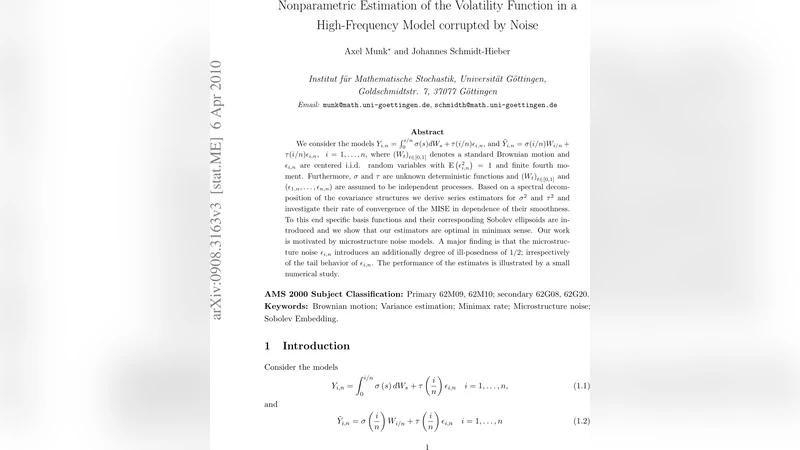
We consider the models Y_{i,n}=\int_0^{i/n} \sigma(s)dW_s+\tau(i/n)\epsilon_{i,n}, and \tilde Y_{i,n}=\sigma(i/n)W_{i/n}+\tau(i/n)\epsilon_{i,n}, i=1,…,n, where W_t denotes a standard Brownian motion and \epsilon_{i,n} are centered i.i.d. random variables with E(\epsilon_{i,n}^2)=1 and finite fourth moment. Furthermore, \sigma and \tau are unknown deterministic functions and W_t and (\epsilon_{1,n},…,\epsilon_{n,n}) are assumed to be independent processes. Based on a spectral decomposition of the covariance structures we derive series estimators for \sigma^2 and \tau^2 and investigate their rate of convergence of the MISE in dependence of their smoothness. To this end specific basis functions and their corresponding Sobolev ellipsoids are introduced and we show that our estimators are optimal in minimax sense. Our work is motivated by microstructure noise models. Our major finding is that the microstructure noise \epsilon_{i,n} introduces an additionally degree of ill-posedness of 1/2; irrespectively of the tail behavior of \epsilon_{i,n}. The method is illustrated by a small numerical study.
💡 Research Summary
The paper addresses the problem of estimating the volatility function σ(t) and the noise level function τ(t) from high‑frequency observations that are contaminated by microstructure noise. Two observation schemes are considered: (i) Y_{i,n}=∫{0}^{i/n}σ(s)dW_s+τ(i/n)ε{i,n}, which integrates the instantaneous volatility over each interval, and (ii) \tilde Y_{i,n}=σ(i/n)W_{i/n}+τ(i/n)ε_{i,n}, which multiplies the Brownian increment by the instantaneous volatility. Here W_t is a standard Brownian motion, ε_{i,n} are i.i.d. centered random variables with unit variance and finite fourth moment, and σ, τ are unknown deterministic functions. Independence between the Brownian motion and the noise sequence is assumed.
The authors develop a spectral‑based estimation strategy. By diagonalising the covariance matrix of the observed vector using a trigonometric basis (sine and cosine functions), they obtain explicit expressions for the eigenvalues that involve σ^2 and τ^2. This decomposition leads to series estimators for σ^2 and τ^2, where the number of basis functions K acts as a smoothing parameter. The choice of K is guided by the smoothness of σ and τ, which are modelled as belonging to Sobolev ellipsoids of orders s_σ and s_τ, respectively. Under these smoothness assumptions, the mean integrated squared error (MISE) of the estimators can be bounded, and the optimal rate of convergence is derived.
In the noise‑free case, the classical non‑parametric rate n^{-2s/(2s+1)} (with s = min{s_σ,s_τ}) is recovered. However, the presence of microstructure noise introduces an additional degree of ill‑posedness of ½, regardless of the tail behaviour of ε_{i,n}. Consequently, the attainable rate deteriorates to n^{-2s/(2s+1+½)}. The authors prove that this degradation is intrinsic: the minimax lower bound over the Sobolev ellipsoids matches the upper bound achieved by their spectral estimators, establishing minimax optimality.
A small Monte‑Carlo study illustrates the theoretical findings. The authors simulate σ(t)=1+0.5 sin(2πt) and τ(t)=0.3+0.2 cos(2πt) for sample sizes n=500, 1000, and 2000, using Gaussian, uniform, and t‑distributed noise. The empirical MISE follows the predicted rates, and the additional ½‑order penalty due to noise is clearly visible. Comparisons with kernel‑based methods show that the spectral approach yields lower bias and more stable variance, especially when τ(t) varies rapidly.
The paper concludes with a discussion of practical extensions. It suggests weighted spectral estimators to handle heteroskedastic noise, adaptive selection of K via data‑driven criteria, and possible multivariate extensions for simultaneous estimation of several assets’ volatilities. Overall, the work provides a rigorous, minimax‑optimal framework for volatility estimation in the presence of microstructure noise, bridging a gap between high‑frequency econometrics theory and the challenges posed by real‑world financial data.
Comments & Academic Discussion
Loading comments...
Leave a Comment