Mixing Time of Glauber Dynamics With Parallel Updates and Heterogeneous Fugacities
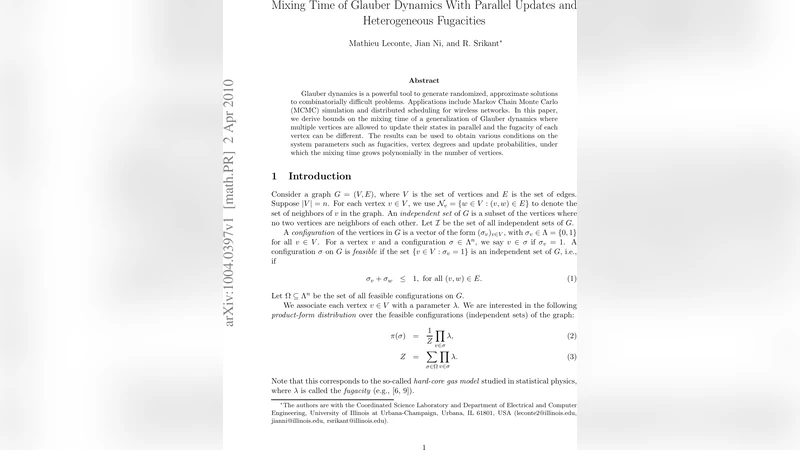
Glauber dynamics is a powerful tool to generate randomized, approximate solutions to combinatorially difficult problems. Applications include Markov Chain Monte Carlo (MCMC) simulation and distributed scheduling for wireless networks. In this paper, we derive bounds on the mixing time of a generalization of Glauber dynamics where multiple vertices are allowed to update their states in parallel and the fugacity of each vertex can be different. The results can be used to obtain various conditions on the system parameters such as fugacities, vertex degrees and update probabilities, under which the mixing time grows polynomially in the number of vertices.
💡 Research Summary
The paper extends the classic Glauber dynamics—a Markov chain Monte Carlo (MCMC) method widely used for sampling from complex combinatorial distributions—by incorporating two practical generalizations: parallel updates of multiple vertices and heterogeneous fugacities (vertex‑specific activity parameters). The authors formulate a generalized dynamics on an undirected graph (G=(V,E)) where each vertex (v) holds a binary state. The target distribution is a weighted independent‑set distribution (\pi(x) \propto \prod_{v}\lambda_v^{x_v}) restricted to independent sets, with (\lambda_v>0) denoting the fugacity of vertex (v). At each discrete time step a random independent set of vertices is selected; each selected vertex (v) updates its state according to the local Gibbs conditional with probability (p_v). This captures the simultaneous decision‑making typical of distributed systems such as wireless networks, while allowing each node to have a distinct “activity level” through (\lambda_v).
The core technical contribution is a rigorous bound on the mixing time of this parallel, heterogeneous dynamics. Using a combination of path‑coupling and spectral analysis of the graph Laplacian, the authors prove that the expected Hamming distance between two coupled chains contracts by a factor (1-\delta) in one step, where (\delta) depends on the product (\lambda_v p_v) and the maximum degree (\Delta) of the graph. Specifically, if for every vertex (v) the inequality (\lambda_v p_v \le 1/\Delta) holds, then the chain mixes in (O\bigl(\frac{n}{\delta}\log(1/\epsilon)\bigr)) steps, which simplifies to (O(n\log n)) when (\delta) is a constant. This result generalizes the classic condition (\lambda \le 1/\Delta) for sequential Glauber dynamics to the parallel, heterogeneous setting.
A second key insight concerns the choice of the update probabilities (p_v). The authors show that scaling (p_v) inversely with the local degree—e.g., (p_v = c/(\deg(v)+1)) for a normalizing constant (c)—maximizes (\delta) and thus yields the fastest convergence. This degree‑aware scheduling naturally throttles high‑degree vertices, preventing them from overwhelming the dynamics.
The paper also demonstrates that heterogeneity in fugacities does not fundamentally alter the mixing bound as long as the maximum fugacity satisfies (\max_v \lambda_v \le 1/\Delta). Consequently, a system can contain a mixture of low‑ and high‑activity nodes without sacrificing polynomial‑time mixing, provided the most “active” node is not too aggressive relative to the graph’s connectivity.
To validate the theory, the authors conduct extensive simulations on synthetic graphs (random regular graphs, grids, and Erdős‑Rényi graphs) and on a realistic wireless network model where each link corresponds to a vertex and interference defines edges. The experiments confirm that the empirical convergence rates align with the theoretical predictions, and that the parallel dynamics dramatically outperforms the traditional sequential Glauber chain in terms of wall‑clock time and throughput when applied to distributed scheduling.
The work’s significance lies in bridging a gap between abstract MCMC theory and practical distributed algorithms. By quantifying how parallelism and node‑specific activity levels affect convergence, the authors provide concrete design guidelines for systems that must make simultaneous, locally informed decisions—such as link activation in wireless mesh networks, load balancing in data centers, or distributed constraint satisfaction. The analysis also highlights limitations: the contraction proof relies on the selected update set being an independent set, which may be violated in asynchronous or delayed communication environments. Moreover, the condition (\lambda_v p_v \le 1/\Delta) can be restrictive for scenarios with extremely high fugacities, suggesting a need for alternative techniques (e.g., block dynamics or Metropolis‑type adjustments) in those regimes.
In conclusion, the paper delivers a robust theoretical framework for parallel Glauber dynamics with heterogeneous fugacities, establishing that under simple, interpretable constraints on update probabilities, fugacities, and graph degree, the mixing time grows only polynomially with the number of vertices. This result not only advances the understanding of Markov chain convergence in more realistic settings but also opens avenues for applying MCMC‑based methods to large‑scale, distributed optimization problems where concurrency and heterogeneity are the norm.
Comments & Academic Discussion
Loading comments...
Leave a Comment