Discriminating Strange Star Mergers from Neutron Star Mergers by Gravitational-Wave Measurements
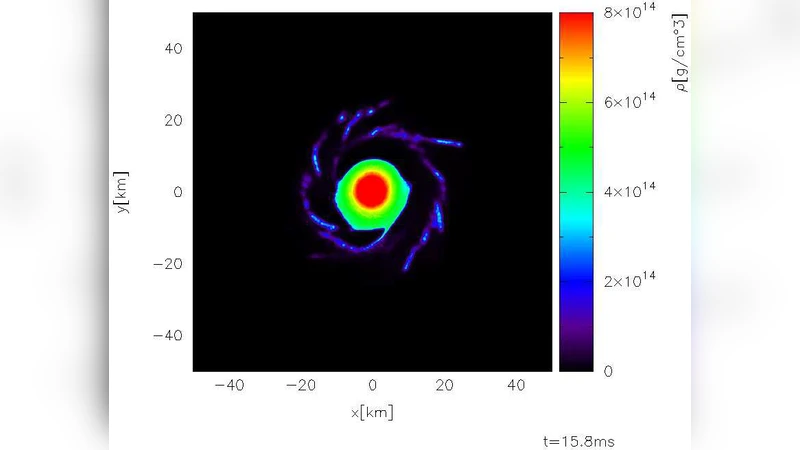
We perform three-dimensional relativistic hydrodynamical simulations of the coalescence of strange stars (SSs) and explore the possibility to decide on the strange matter hypothesis by means of gravitational-wave (GW) measurements. Selfbinding of strange quark matter (SQM) and the generally more compact stars yield features that clearly distinguish SS from neutron star (NS) mergers, e.g. hampering tidal disruption during the plunge of quark stars. Furthermore, instead of forming dilute halos around the remnant as in the case of NS mergers, the coalescence of SSs results in a differentially rotating hypermassive object with a sharp surface layer surrounded by a geometrically thin, clumpy high-density SQM disk. We also investigate the importance of including non-zero temperature equations of state (EoSs) in NS and SS merger simulations. In both cases we find a crucial sensitivity of the dynamics and outcome of the coalescence to thermal effects, which, e.g., determine the outer remnant structure and the delay time of the dense remnant core to black hole collapse. For comparing and classifying the GW signals, we use a number of characteristic quantities like the maximum frequency during inspiral or the dominant frequency of oscillations of the postmerger remnant. In general, these frequencies are higher for SS mergers. If not, additional features of the GW luminosity spectrum may help to discriminate coalescence events of the different types. Future GW measurements may thus help to decide on the existence of SQM stars. (abridged)
💡 Research Summary
The paper presents three‑dimensional relativistic hydrodynamic simulations of binary mergers involving strange stars (SSs) composed of self‑bound strange quark matter (SQM) and compares them with conventional neutron‑star (NS) mergers. Because SQM is self‑bound, SSs are more compact and have higher average densities than NSs of the same mass. This structural difference suppresses tidal deformation during the inspiral, so that SS–SS binaries experience little or no tidal disruption at plunge, unlike NS–NS systems where strong tidal forces can strip material and form extended, low‑density halos.
The authors employ temperature‑dependent equations of state (EoSs) for both SQM and nuclear matter, demonstrating that thermal effects are crucial for the post‑merger dynamics. In NS mergers, heating leads to the formation of a diffuse, hot envelope around the remnant, while in SS mergers the heated SQM forms a geometrically thin, high‑density disk that is clumpy and confined close to the central hypermassive object. The hot SQM disk lacks the dilute halo seen in NS cases, and its sharp surface layer results in a differentially rotating hypermassive remnant whose collapse to a black hole is delayed by thermal pressure.
Gravitational‑wave (GW) signatures are analyzed using several characteristic frequencies. The maximum GW frequency reached during inspiral (f_max) and the dominant post‑merger oscillation frequency (f_peak) are systematically higher for SS mergers. The higher frequencies stem from the smaller tidal radius and higher compactness of SSs, which push the orbital motion to tighter separations before contact. Moreover, SS mergers exhibit an additional high‑frequency spectral feature (≈3–4 kHz) associated with rapid core collision and the vibration of the thin SQM disk. This feature is absent or much weaker in NS mergers, where the GW spectrum is dominated by lower‑frequency modes of the massive, more extended remnant.
The study also shows that the inclusion of finite‑temperature EoSs markedly changes the merger outcome: thermal pressure can temporarily support the remnant against collapse, altering the delay time before black‑hole formation and modifying the GW amplitude and duration. Consequently, the GW luminosity spectrum carries imprints of both the underlying EoS (cold vs. hot) and the nature of the compact objects (self‑bound SQM vs. nuclear matter).
In summary, the paper identifies three robust discriminants between SS and NS mergers: (1) suppressed tidal disruption and a more abrupt plunge for SSs; (2) a thin, high‑density SQM disk rather than an extended halo in the post‑merger remnant; and (3) systematically higher inspiral‑ and post‑merger GW frequencies, together with a distinctive high‑frequency spectral peak. These signatures lie within the sensitivity band of current ground‑based detectors (LIGO, Virgo, KAGRA) and will be even more accessible to next‑generation observatories such as the Einstein Telescope. Therefore, future GW observations have the potential to test the strange‑matter hypothesis by distinguishing SS mergers from ordinary NS mergers.
Comments & Academic Discussion
Loading comments...
Leave a Comment