Post-merger electromagnetic emissions from disks perturbed by binary black holes
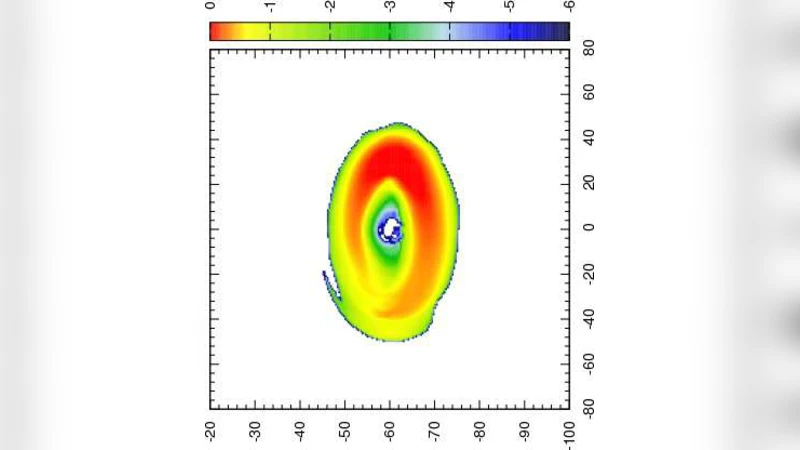
We simulate the possible emission from a disk perturbed by a recoiling super-massive black hole. To this end, we study radiation transfer from the system incorporating bremsstrahlung emission from a Maxwellian plasma and absorption given by Kramer’s opacity law modified to incorporate blackbody effects. We employ this model in the radiation transfer integration to compute the luminosity at several frequencies, and compare with previous bremsstrahlung luminosity estimations from a transparent limit (in which the emissivity is integrated over the computational domain and over all frequencies) and with a simple thermal emission model. We find close agreement between the radiation transfer results and the estimated bremsstrahlung luminosity from previous work for electromagnetic signals above $10^{14}$ Hz. For lower frequencies, we find a self-eclipsing behavior in the disk, resulting in a strong intensity variability connected to the orbital period of the disk.
💡 Research Summary
This paper investigates the electromagnetic signatures that arise when a recoiling super‑massive black hole (SMBH) perturbs its surrounding accretion disk after a binary merger. The authors first perform three‑dimensional hydrodynamic simulations of a disk that is struck by a black hole moving at a recoil velocity of order 1000 km s⁻¹. The simulations capture the formation of shock‑heated, high‑density regions and the resulting non‑axisymmetric density and temperature structures that evolve on the orbital timescale of the disk.
To translate these dynamical disturbances into observable radiation, the authors construct a radiation‑transfer framework that incorporates two key physical ingredients. The emissivity is modeled as thermal bremsstrahlung from a Maxwellian plasma, using the standard free‑free formula that depends on the local electron and ion densities, temperature, and photon frequency. The absorption coefficient follows a Kramers‑type opacity law, but the authors augment it with a blackbody correction term to ensure that the opacity behaves correctly in the high‑temperature, high‑frequency regime where pure Kramers opacity would underestimate absorption.
The radiative transfer equation, dIν/ds = εν − κν Iν, is solved numerically along a large set of sight‑lines that sample the entire computational domain. The authors integrate over frequencies ranging from 10¹² Hz (radio) to 10¹⁸ Hz (hard X‑ray) using a logarithmic grid of 10⁴ points, thereby constructing a full spectral energy distribution (SED) for the perturbed disk.
The results fall into two distinct regimes. At frequencies above ~10¹⁴ Hz (infrared, optical, UV, and X‑ray bands) the computed luminosities agree closely with the “transparent‑limit” estimates from earlier work, in which the bremsstrahlung emissivity is simply integrated over the volume without accounting for absorption. This agreement indicates that the disk is effectively optically thin at high frequencies, so that most of the emitted photons escape unimpeded.
In contrast, at lower frequencies (10¹²–10¹⁴ Hz) the disk becomes optically thick due to the Kramers opacity. The radiation‑transfer calculations reveal a pronounced self‑eclipsing behavior: as the recoiling black hole drives asymmetric density enhancements, parts of the disk block the line‑of‑sight emission from other regions. Consequently, the observed flux exhibits strong, periodic variations that are synchronized with the orbital period of the perturbed disk. This variability is absent in the simple transparent‑limit model and is also more pronounced than in a naïve blackbody‑only model, which cannot capture the complex interplay between emission and absorption in the radio–millimeter regime.
The authors discuss the astrophysical implications of these findings. The high‑frequency agreement validates previous estimates of post‑merger electromagnetic counterparts, suggesting that infrared to X‑ray observations could reliably detect the thermal bremsstrahlung flash associated with a recoiling SMBH. The low‑frequency self‑eclipsing signature, on the other hand, offers a potential diagnostic of the disk’s dynamical response: periodic radio or millimeter variability on the timescale of months to years (depending on the black hole mass and disk radius) could be a tell‑tale sign of a recent merger and recoil event.
Limitations of the study are acknowledged. The radiation‑transfer calculation is performed on a two‑dimensional slice of the disk, neglecting vertical structure and three‑dimensional radiative effects. Moreover, the plasma is assumed to be in Maxwellian equilibrium, ignoring possible electron–ion temperature decoupling that could alter the bremsstrahlung spectrum. The opacity model also excludes other processes such as synchrotron emission, inverse‑Compton scattering, and line absorption, which may become important in magnetized or highly relativistic environments.
Future work is proposed to address these shortcomings: extending the simulations to fully three‑dimensional radiation‑hydrodynamics, incorporating non‑thermal emission mechanisms, and exploring a broader range of recoil velocities and black‑hole mass ratios. Such extensions would refine predictions for multi‑wavelength surveys seeking electromagnetic counterparts to gravitational‑wave detections of SMBH mergers, and could help disentangle the complex signatures that arise when a recoiling black hole reshapes its host accretion disk.
Comments & Academic Discussion
Loading comments...
Leave a Comment