A Dichotomy Theorem for General Minimum Cost Homomorphism Problem
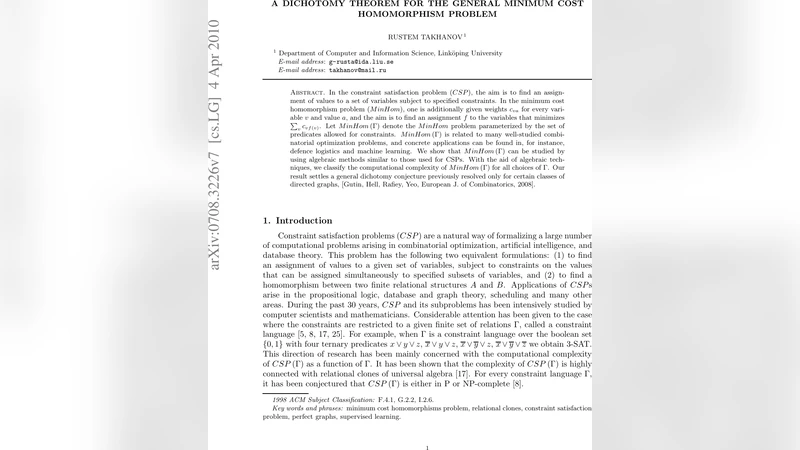
In the constraint satisfaction problem ($CSP$), the aim is to find an assignment of values to a set of variables subject to specified constraints. In the minimum cost homomorphism problem ($MinHom$), one is additionally given weights $c_{va}$ for every variable $v$ and value $a$, and the aim is to find an assignment $f$ to the variables that minimizes $\sum_{v} c_{vf(v)}$. Let $MinHom(\Gamma)$ denote the $MinHom$ problem parameterized by the set of predicates allowed for constraints. $MinHom(\Gamma)$ is related to many well-studied combinatorial optimization problems, and concrete applications can be found in, for instance, defence logistics and machine learning. We show that $MinHom(\Gamma)$ can be studied by using algebraic methods similar to those used for CSPs. With the aid of algebraic techniques, we classify the computational complexity of $MinHom(\Gamma)$ for all choices of $\Gamma$. Our result settles a general dichotomy conjecture previously resolved only for certain classes of directed graphs, [Gutin, Hell, Rafiey, Yeo, European J. of Combinatorics, 2008].
💡 Research Summary
The paper investigates the Minimum Cost Homomorphism problem (MinHom), an optimization extension of the classic Constraint Satisfaction Problem (CSP). In a MinHom instance one is given a finite domain D, a set of variables V, a collection of constraints drawn from a fixed relational language Γ⊆{R⊆D^k | k≥1}, and a cost function c:V×D→ℕ assigning a non‑negative weight c_{va} to each possible assignment of value a to variable v. The goal is to find a mapping f:V→D that satisfies all constraints while minimizing the total cost ∑{v∈V} c{v f(v)}. The notation MinHom(Γ) denotes the family of such problems when only relations from Γ are allowed.
The authors adopt the algebraic approach that has proved decisive for the CSP dichotomy theorem. They define the polymorphism clone Pol(Γ), i.e., the set of all operations on D that preserve every relation in Γ. A central new concept is that of a σ‑preserving polymorphism: an operation f∈Pol(Γ) such that for any two feasible assignments α,β the cost of the pointwise application f(α,β) does not exceed the larger of the two original costs. In other words, the operation never increases the objective value. The existence of any non‑trivial σ‑preserving operation (i.e., an operation that is not a simple projection) yields a powerful “cost‑combination” tool: given two feasible solutions one can combine them to obtain a third solution that is at least as cheap, enabling a polynomial‑time algorithm based on local improvement or linear programming relaxation.
Conversely, if Pol(Γ) consists solely of projections, the language lacks any structure that could be exploited to reduce costs. In this case the authors construct reductions from classic NP‑complete optimization problems (minimum vertex cover, minimum cost coloring, subgraph isomorphism with costs, etc.) to MinHom(Γ). The reductions carefully encode the original objective into the cost matrix c while preserving feasibility via the constraints in Γ. This shows that, absent a σ‑preserving polymorphism, MinHom(Γ) is NP‑hard, and indeed NP‑complete because the decision version (“is there a solution of cost ≤ K?”) belongs to NP.
The main theorem—referred to as the Dichotomy Theorem for MinHom—states that for every finite relational language Γ, exactly one of the following holds:
1. Pol(Γ) contains a non‑trivial σ‑preserving polymorphism. Then MinHom(Γ) can be solved in polynomial time (the authors give an explicit algorithm based on iterative improvement and a reduction to a tractable linear program).
2. Pol(Γ) consists only of projections. Then MinHom(Γ) is NP‑complete.
The proof proceeds by extending the clone‑theoretic machinery used in the CSP dichotomy (Bulatov, Zhuk) to the cost setting. The authors introduce the notion of the “least clone” containing Γ and show that the presence of a σ‑preserving operation is equivalent to the clone being of a certain well‑understood type (e.g., having a Maltsev or majority operation that respects costs). They also demonstrate that the dichotomy is robust: adding or removing redundant relations from Γ does not change the classification.
A significant contribution is the unification of previous results that dealt only with special classes of directed graphs (the earlier work of Gutin, Hell, Rafiey, Yeo). Those papers proved a dichotomy for MinHom when Γ corresponds to the set of arcs of a digraph. By treating Γ as an arbitrary relational structure, the present work subsumes those graph‑specific theorems and shows that the same algebraic criterion governs the complexity in full generality.
The paper concludes with a discussion of implications. First, it confirms that algebraic methods are powerful enough to handle weighted CSP variants, suggesting that similar dichotomies may be achievable for Valued CSPs, submodular CSPs, and other cost‑augmented frameworks. Second, from a practical standpoint, the classification provides a pre‑analysis tool: given a concrete application (e.g., logistics planning or structured prediction in machine learning), one can examine the polymorphisms of the underlying constraint language to decide whether a polynomial‑time algorithm is plausible or whether the problem is inherently intractable. Finally, the authors outline open directions, such as extending the result to infinite domains, exploring approximation thresholds for the NP‑hard cases, and integrating the σ‑preserving condition with known tractable fragments of the Valued CSP literature.
Comments & Academic Discussion
Loading comments...
Leave a Comment