Amenable actions, invariant means and bounded cohomology
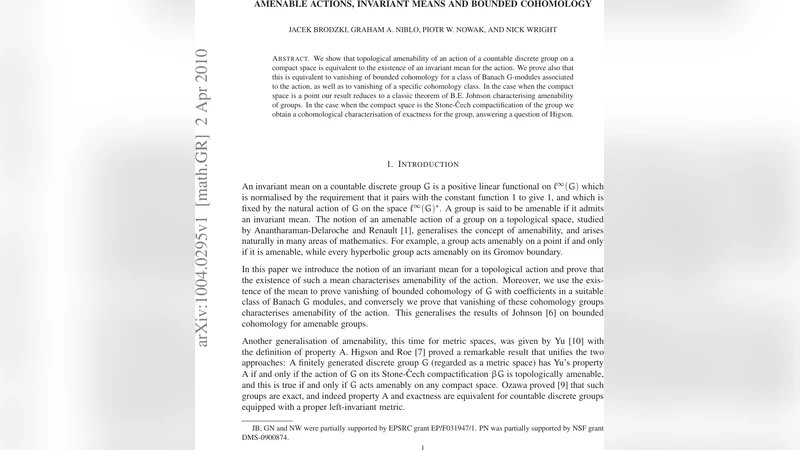
We show that topological amenability of an action of a countable discrete group on a compact space is equivalent to the existence of an invariant mean for the action. We prove also that this is equivalent to vanishing of bounded cohomology for a class of Banach G-modules associated to the action, as well as to vanishing of a specific cohomology class. In the case when the compact space is a point our result reduces to a classic theorem of B.E. Johnson characterising amenability of groups. In the case when the compact space is the Stone-\v{C}ech compactification of the group we obtain a cohomological characterisation of exactness for the group, answering a question of Higson.
💡 Research Summary
The paper establishes a precise equivalence between three notions associated with a countable discrete group G acting on a compact space X: topological amenability of the action, the existence of a G‑invariant mean on C(X), and the vanishing of bounded cohomology for a naturally constructed Banach G‑module V_X. The authors begin by recalling the definition of topological amenability, which requires a net of continuous probability measures on X×G that becomes asymptotically invariant under the diagonal G‑action. They then show that such a net gives rise to a linear functional μ ∈ C(X)∗ satisfying μ(g·f)=μ(f) for all f∈C(X) and g∈G; conversely, any invariant mean yields the required net of measures. This extends the classical equivalence known for the trivial action (X a point) to arbitrary compact actions.
Next, the paper introduces the Banach G‑module V_X = ℓ¹(G, C(X)∗), equipped with the left regular action of G on the ℓ¹‑coordinate and the natural dual action on C(X)∗. The main cohomological result is that the bounded cohomology groups H_bⁿ(G, V_X) vanish for every n ≥ 1 if and only if the action is topologically amenable. The proof constructs a G‑equivariant averaging operator on the bounded cochain complex C_bⁿ(G, V_X) using the invariant mean, and shows that this operator provides a contracting homotopy. In degree two the authors isolate a specific class
Comments & Academic Discussion
Loading comments...
Leave a Comment