Signatures of arithmetic simplicity in metabolic network architecture
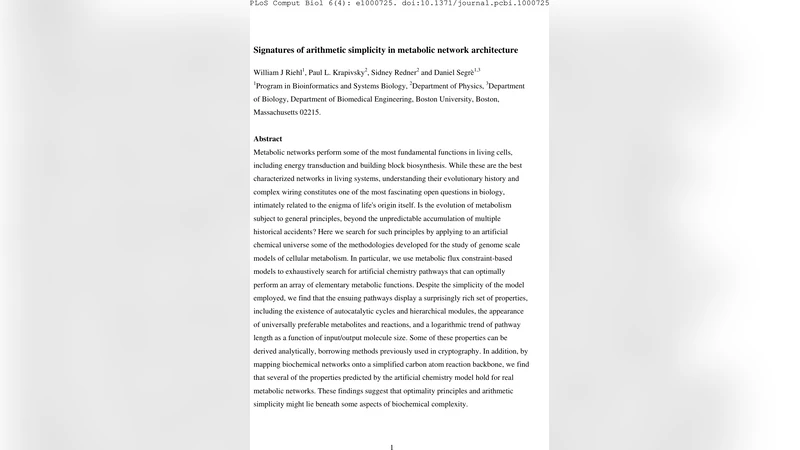
Metabolic networks perform some of the most fundamental functions in living cells, including energy transduction and building block biosynthesis. While these are the best characterized networks in living systems, understanding their evolutionary history and complex wiring constitutes one of the most fascinating open questions in biology, intimately related to the enigma of life’s origin itself. Is the evolution of metabolism subject to general principles, beyond the unpredictable accumulation of multiple historical accidents? Here we search for such principles by applying to an artificial chemical universe some of the methodologies developed for the study of genome scale models of cellular metabolism. In particular, we use metabolic flux constraint-based models to exhaustively search for artificial chemistry pathways that can optimally perform an array of elementary metabolic functions. Despite the simplicity of the model employed, we find that the ensuing pathways display a surprisingly rich set of properties, including the existence of autocatalytic cycles and hierarchical modules, the appearance of universally preferable metabolites and reactions, and a logarithmic trend of pathway length as a function of input/output molecule size. Some of these properties can be derived analytically, borrowing methods previously used in cryptography. In addition, by mapping biochemical networks onto a simplified carbon atom reaction backbone, we find that several of the properties predicted by the artificial chemistry model hold for real metabolic networks. These findings suggest that optimality principles and arithmetic simplicity might lie beneath some aspects of biochemical complexity.
💡 Research Summary
The paper tackles a fundamental question in systems biology: whether the intricate wiring of metabolic networks reflects underlying universal principles rather than a mere accumulation of historical contingencies. To address this, the authors construct a highly abstracted “artificial chemistry” in which molecules are defined solely by their carbon atom count and reactions are limited to simple stoichiometries (e.g., 1 → 2, 2 → 1, 1 ↔ 1) that conserve carbon. Within this toy universe they apply the same constraint‑based flux‑balance analysis (FBA) tools that are standard for genome‑scale metabolic models.
Using linear programming they exhaustively search for the minimal‑cost pathways that achieve a set of elementary metabolic tasks: energy transduction, precursor synthesis, and size conversion between input and output molecules of varying carbon lengths. Because the cost of each reaction is set to one, the optimization reduces to finding the shortest possible sequence of reactions that satisfies mass‑balance constraints.
Four striking regularities emerge from the optimal solutions. First, autocatalytic cycles appear spontaneously. Small subsets of molecules can catalyze their own production, forming closed loops that sustain flux without external input—an abstraction of the self‑reinforcing cycles observed in real biochemistry (e.g., the citric‑acid cycle). Second, the pathways are organized hierarchically: elementary sub‑paths (e.g., C1 → C2, C2 → C4) are reused as building blocks for larger transformations, mirroring the modular architecture often inferred for metabolic evolution. Third, certain carbon numbers (notably C4 and C6) act as “universal precursors,” recurring across many optimal routes. This mirrors the central role of metabolites such as acetyl‑CoA (C2) and pyruvate (C3) in actual cellular metabolism, suggesting that a small set of core molecules is mathematically favored. Fourth, the length of an optimal pathway grows logarithmically with the size of the target molecule: L ≈ a·log₂(N), where L is the number of reaction steps, N the carbon count of the product, and a a constant. The authors derive this relationship analytically by mapping the reaction network onto a binary exponentiation problem, a technique familiar from cryptography. The logarithmic scaling implies that even very large molecules can be assembled with relatively few steps, a property that would be advantageous under evolutionary pressure for efficiency.
To test whether these abstract findings have relevance for real biology, the authors extract a “carbon backbone” from curated genome‑scale metabolic reconstructions of several organisms. They then search for the same four signatures—autocatalytic loops, modular sub‑structures, universal precursors, and log‑scaled pathway lengths—in the empirical networks. All four patterns are statistically enriched, indicating that the simple arithmetic constraints of the artificial system capture genuine organizational principles of living metabolism.
The authors conclude that metabolic networks are not random mosaics of historical accidents but are shaped by optimality criteria that can be expressed in elementary arithmetic terms. This perspective bridges evolutionary biology, network theory, and even cryptographic mathematics, offering a fresh lens through which to view the origin and engineering of biochemical pathways. It suggests that future efforts in synthetic biology and origin‑of‑life research could benefit from explicitly incorporating these arithmetic simplicity constraints to design more robust and evolvable metabolic systems.
Comments & Academic Discussion
Loading comments...
Leave a Comment