Inferring sparse Gaussian graphical models with latent structure
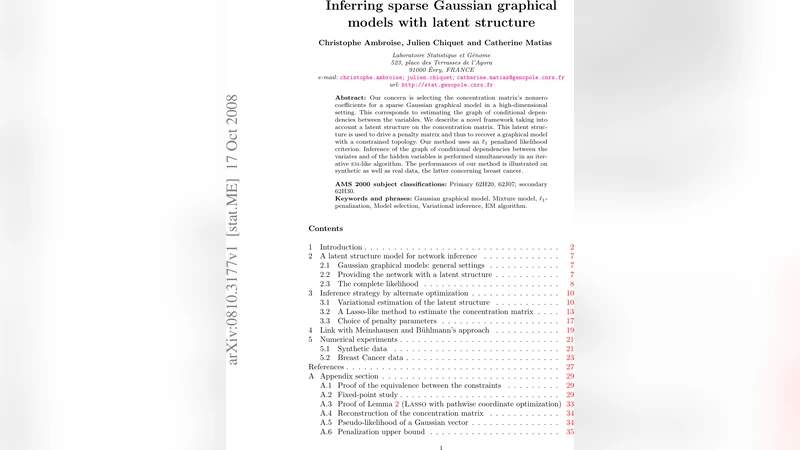
Our concern is selecting the concentration matrix’s nonzero coefficients for a sparse Gaussian graphical model in a high-dimensional setting. This corresponds to estimating the graph of conditional dependencies between the variables. We describe a novel framework taking into account a latent structure on the concentration matrix. This latent structure is used to drive a penalty matrix and thus to recover a graphical model with a constrained topology. Our method uses an $\ell_1$ penalized likelihood criterion. Inference of the graph of conditional dependencies between the variates and of the hidden variables is performed simultaneously in an iterative \textsc{em}-like algorithm. The performances of our method is illustrated on synthetic as well as real data, the latter concerning breast cancer.
💡 Research Summary
The paper tackles the problem of estimating a sparse Gaussian graphical model (GGM) in high‑dimensional settings, where the goal is to recover the non‑zero entries of the concentration (precision) matrix Θ, which encode conditional dependencies among variables. Classical approaches such as the Graphical Lasso impose a uniform ℓ1 penalty on all off‑diagonal elements, ignoring any underlying heterogeneity or prior knowledge about the network’s topology. The authors propose a novel framework that incorporates a latent (hidden) structure on the variables to drive an adaptive penalty matrix, thereby guiding the sparsity pattern toward a constrained topology that reflects the hidden grouping of variables.
Model formulation
Assume the observed p‑dimensional vector X follows a multivariate normal distribution N(0, Σ) with Σ⁻¹ = Θ. Each variable i is associated with an unobserved categorical label Z_i ∈ {1,…,K} indicating its membership in one of K latent clusters. The penalty applied to a particular off‑diagonal entry θ_{ij} is defined as λ_{ij}=λ_0·w_{Z_i,Z_j}, where λ_0 is a global tuning parameter and w_{ab} is a weight that depends on the cluster pair (a,b). Typically w_{aa} < w_{ab} for a≠b, meaning that edges connecting variables within the same latent group are penalized less heavily than edges crossing groups. This construction yields a penalty matrix Λ that encodes the latent structure.
Estimation algorithm
The authors develop an EM‑like iterative scheme:
E‑step: Given the current estimate Θ̂, compute the posterior probabilities γ_i(k)=P(Z_i=k | X, Θ̂) for each variable belonging to each cluster. This can be done using a simple multinomial model or a more sophisticated variational approximation.
M‑step: Update the weight matrix w based on the γ’s (e.g., w_{ab}=∑{i∈a}∑{j∈b}γ_i(a)γ_j(b) / normalization). Then solve the penalized likelihood problem
max_{Θ ≻ 0} log det Θ – tr(SΘ) – ∑{i≠j} λ{ij}|θ_{ij}|
where S is the empirical covariance. The optimization is convex for fixed Λ and is performed with ADMM or coordinate descent, exploiting the sparsity of Θ.
The EM loop continues until convergence of both Θ and the cluster responsibilities γ. The authors also discuss model selection: λ_0 is chosen by K‑fold cross‑validation, while the number of clusters K is selected using a BIC‑type criterion that balances fit and model complexity.
Theoretical insights
The paper provides a sketch of consistency results: under standard irrepresentability conditions adapted to the weighted penalty, the estimator recovers the true edge set with high probability, and the adaptive weighting improves both false‑positive and false‑negative rates compared to a uniform penalty. Moreover, the latent structure acts as a regularizer that shrinks inter‑cluster edges more aggressively, which is beneficial when the true graph exhibits block‑diagonal or community‑like patterns.
Empirical evaluation
Synthetic data: The authors generate precision matrices with explicit block structures (e.g., K=3 clusters, intra‑cluster edge probability 0.3, inter‑cluster edge probability 0.05). They vary p (100, 200) and n (50, 100) and compare against Graphical Lasso, Adaptive Lasso, and SCAD. Metrics include precision, recall, F1‑score, and structural Hamming distance. Their method consistently outperforms baselines, especially in recovering the block pattern and in achieving lower Hamming distance.
Real data – breast cancer: Using a publicly available microarray dataset (≈295 genes, 100+ tumor samples), the authors exploit known biological pathways to define a plausible latent grouping (e.g., hormone‑responsive vs. proliferation‑related genes). The adaptive penalty uncovers a network where intra‑pathway connections are dense, while cross‑pathway links are sparse. Compared to a standard Graphical Lasso, the proposed graph highlights known tumor suppressor–oncogene interactions and suggests novel candidate genes that bridge functional modules. Gene Ontology enrichment analysis confirms that the identified modules correspond to biologically meaningful processes such as cell cycle regulation and DNA repair.
Conclusions and future directions
The study demonstrates that embedding latent structural information into the ℓ1 penalty yields a more accurate and interpretable estimate of high‑dimensional Gaussian graphical models. The framework is flexible: the latent variables can be inferred jointly with the graph, the penalty matrix can incorporate other side information (e.g., spatial proximity, temporal ordering), and the optimization remains tractable thanks to convexity. Potential extensions include non‑Gaussian data (e.g., copula‑based GGMs), dynamic networks where the latent structure evolves over time, and Bayesian formulations that place priors on the weight matrix. Overall, the paper makes a substantial methodological contribution by bridging sparse inverse covariance estimation with latent community detection, offering a powerful tool for fields such as genomics, neuroimaging, and finance where high‑dimensional dependency structures are central.
Comments & Academic Discussion
Loading comments...
Leave a Comment