Excitation of acoustic waves by vortices in the quiet Sun
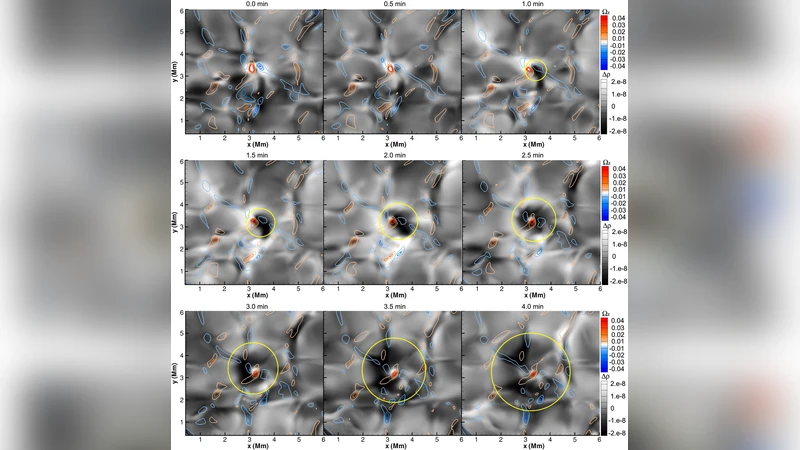
Five-minutes oscillations is one of the basic properties of solar convection. Observations show mixture of a large number of acoustic wave fronts propagating from their sources. We investigate the process of acoustic waves excitation from the point of view of individual events, by using realistic 3D radiative hydrodynamic simulation of the quiet Sun. The results show that the excitation events are related to dynamics vortex tubes (or swirls) in the intergranular lanes. These whirlpool-like flows are characterized by very strong horizontal velocities (7 - 11 km/s) and downflows (~ 7 km/s), and are accompanied by strong decreases of the temperature, density and pressure at the surface and in a ~ 0.5-1 Mm deep layer below the surface. High-speed whirlpool flows can attract and capture other vortices. According to our simulation results, the processes of the vortex interaction, such as vortex annihilation, can cause the excitation of acoustic waves.
💡 Research Summary
The five‑minute oscillations observed across the solar surface are a hallmark of solar convection, yet the precise mechanisms that generate the myriad acoustic wave fronts remain incompletely understood. In this study, the authors employ state‑of‑the‑art three‑dimensional radiative hydrodynamic (RHD) simulations of the quiet Sun to investigate acoustic wave excitation on an event‑by‑event basis. The simulations reproduce realistic granulation patterns, intergranular lanes, and a power spectrum consistent with observed p‑mode oscillations, providing a reliable laboratory for dissecting individual wave‑generation processes.
Analysis of the simulated data reveals that the dominant sources of acoustic waves are vortex tubes—often described as “whirlpools” or swirls—situated in the intergranular lanes. These vortices exhibit exceptionally strong horizontal flows of 7–11 km s⁻¹ and concurrent downflows of roughly 7 km s⁻¹. Within the vortex core, temperature, density, and pressure drop sharply, forming a localized low‑pressure cavity that extends from the photosphere down to depths of 0.5–1 Mm. The steep gradients in pressure and density at the vortex boundary act as a piston, impulsively compressing the surrounding plasma and launching acoustic disturbances.
A key finding is that vortex dynamics, especially interactions between neighboring vortices, are crucial for wave generation. High‑speed vortices can capture smaller, co‑rotating vortices, leading to merging, or they can encounter oppositely rotating vortices. In the latter case, vortex annihilation occurs: the opposing circulations cancel, producing a rapid, localized pressure surge followed by a sharp rarefaction. This transient pressure perturbation is precisely the trigger for the observed acoustic wave fronts. The simulated wave packets propagate upward and outward, reaching the photospheric layer with frequencies centered around 3 mHz, matching the classic five‑minute oscillation band.
These results extend earlier theories that attribute acoustic excitation to stochastic pressure fluctuations in turbulent convection. By pinpointing vortex interaction—particularly vortex annihilation—as a robust, repeatable source of acoustic energy, the study provides a concrete physical mechanism that can explain the observed abundance and spatial distribution of wave fronts. Moreover, the work suggests that the continual formation, evolution, and destruction of vortex tubes sustain the overall p‑mode power budget in the quiet Sun.
In summary, the paper demonstrates that vortex tubes in intergranular lanes, through their intense horizontal motions, deep downflows, and especially their mutual interactions and annihilation, act as efficient, localized generators of solar acoustic waves. This insight bridges the gap between high‑resolution numerical modeling and helioseismic observations, offering a compelling explanation for the pervasive five‑minute oscillations in the quiet solar atmosphere.
Comments & Academic Discussion
Loading comments...
Leave a Comment