Mergers, AGN, and Normal Galaxies: Contributions to the Distribution of Star Formation Rates and Infrared Luminosity Functions
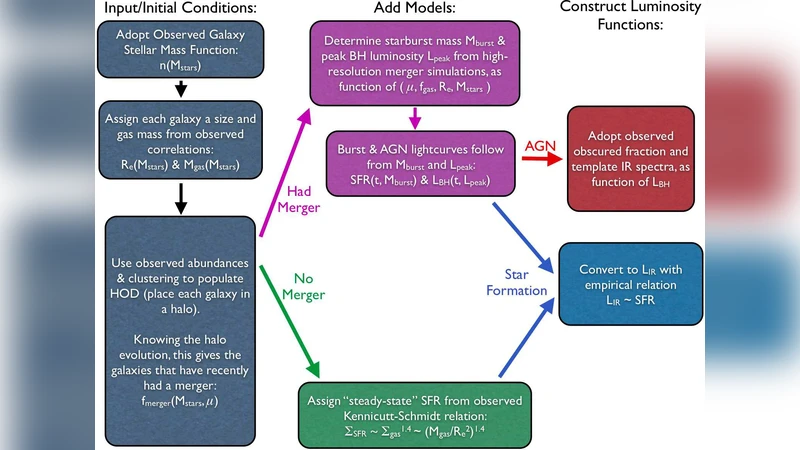
We use a novel method to predict the contribution of normal star-forming galaxies, merger-induced bursts, and obscured AGN, to IR luminosity functions (LFs) and global SFR densities. We use empirical halo occupation constraints to populate halos with galaxies and determine the distribution of normal and merging galaxies. Each system can then be associated with high-resolution hydrodynamic simulations. We predict the distribution of observed luminosities and SFRs, from different galaxy classes, as a function of redshift from z=0-6. We provide fitting functions for the predicted LFs, quantify the uncertainties, and compare with observations. At all redshifts, ’normal’ galaxies dominate the LF at moderate luminosities L* (the ‘knee’). Merger-induced bursts increasingly dominate at L»L*; at the most extreme luminosities, AGN are important. However, all populations increase in luminosity at higher redshifts, owing to increasing gas fractions. Thus the ’transition’ between normal and merger-dominated sources increases from the LIRG-ULIRG threshold at z0 to bright Hyper-LIRG thresholds at z~2. The transition to dominance by obscured AGN evolves similarly, at factor of several higher L_IR. At all redshifts, non-merging systems dominate the total luminosity/SFR density, with merger-induced bursts constituting ~5-10% and AGN ~1-5%. Bursts contribute little to scatter in the SFR-stellar mass relation. In fact, many systems identified as ‘ongoing’ mergers will be forming stars in their ’normal’ (non-burst) mode. Counting this as ‘merger-induced’ star formation leads to a stronger apparent redshift evolution in the contribution of mergers to the SFR density.
💡 Research Summary
This paper presents a comprehensive framework that combines empirical halo‑occupation modeling with high‑resolution hydrodynamic simulations to quantify how three distinct galaxy populations—normal star‑forming disks, merger‑induced starbursts, and heavily obscured active galactic nuclei (AGN)—contribute to the infrared (IR) luminosity function (LF) and the cosmic star‑formation rate (SFR) density from redshift z = 0 to 6.
First, the authors construct a halo‑occupation distribution (HOD) constrained by observed stellar mass functions, clustering measurements, and gas‑fraction trends. Each dark‑matter halo is populated probabilistically with a “normal” galaxy and, where appropriate, a potential merger companion. The gas fraction is allowed to rise steeply with redshift, reflecting recent CO and dust continuum surveys that show high‑z galaxies are far more gas‑rich than their low‑z counterparts.
Second, each assigned galaxy (or galaxy pair) is linked to a library of high‑resolution simulations that resolve gas dynamics, star formation, stellar feedback, and black‑hole growth. Normal galaxies follow a secular disk‑star‑formation mode, while major mergers trigger short‑lived (10–100 Myr) bursts that can boost the instantaneous SFR by factors of 5–10. The simulations also track the obscured growth phase of supermassive black holes, converting the absorbed UV/optical radiation into re‑emitted IR output characteristic of heavily dust‑enshrouded AGN.
Third, the simulation outputs are used to generate probability distributions of IR luminosity (L_IR = 8–1000 µm) and SFR for each population as a function of halo mass and redshift. By integrating over the halo mass function, the authors predict the total IR LF and the SFR density (ρ_SFR) at any redshift between 0 and 6.
The results show a remarkably consistent picture with observations from Herschel, SCUBA‑2, and ALMA. At all epochs, normal galaxies dominate the LF around the characteristic knee (L ≈ L*), because their steady gas supply keeps them on the main sequence of the SFR–M* relation. Merger‑driven bursts become increasingly important at luminosities far above L*, and at the very highest luminosities (L_IR > 10^13 L_⊙) obscured AGN begin to dominate. The “transition luminosity” where mergers overtake normal galaxies shifts from the local LIRG/ULIRG threshold (∼10^11.5 L_⊙) at z ≈ 0 to hyper‑LIRG levels (∼10^13 L_⊙) by z ≈ 2, mirroring the rise in typical gas fractions.
When the contributions are summed, non‑merging normal systems account for roughly 85–95 % of the total SFR density at any redshift. Merger‑induced bursts contribute only about 5–10 %, and obscured AGN add another 1–5 %. The authors emphasize that many systems classified observationally as “ongoing mergers” are actually forming stars in the normal secular mode; counting their SFR as merger‑driven would artificially inflate the apparent redshift evolution of the merger contribution.
Uncertainties are explored by varying gas‑fraction evolution, merger rates, and AGN obscuration prescriptions. These tests confirm that the dominant source of error lies in the assumed gas‑fraction scaling, while the qualitative conclusions remain robust.
In summary, the paper demonstrates that the bulk of cosmic star formation across cosmic time is driven by ordinary, gas‑rich disks, with mergers and AGN providing only modest, luminosity‑dependent enhancements. The framework offers a powerful tool for interpreting future deep IR and sub‑mm surveys, and it underscores the need to disentangle secular, merger‑induced, and AGN‑powered components when deriving physical insights from observed luminosity functions.
Comments & Academic Discussion
Loading comments...
Leave a Comment