A Quillen Model Structure Approach to the Finitistic Dimension Conjectures
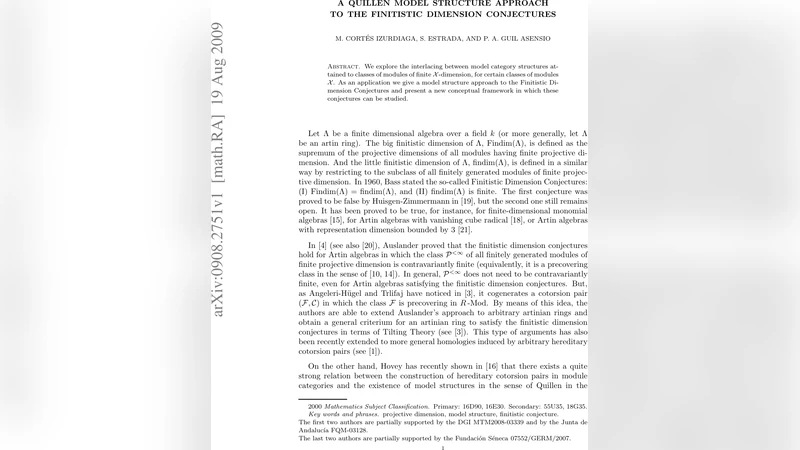
We explore the interlacing between model category structures attained to classes of modules of finite $\mathcal{X}$-dimension, for certain classes of modules $\mathcal{X}$. As an application we give a model structure approach to the Finitistic Dimension Conjectures and present a new conceptual framework in which these conjectures can be studied.
💡 Research Summary
The paper introduces a novel framework that combines model‑category theory with classical homological algebra to study the longstanding finitistic dimension conjectures. The authors begin by defining an “𝔛‑dimension” for modules relative to a chosen class 𝔛 of modules (e.g., projective, injective, Gorenstein‑projective). An 𝔛‑dimension of a module is the minimal length of an 𝔛‑resolution (or 𝔛‑coresolution), and the collection of modules with finite 𝔛‑dimension forms a complete abelian subcategory.
In the second section the authors construct a Quillen model structure on this subcategory. Cofibrant objects are taken to be modules of finite 𝔛‑dimension, fibrant objects are modules of finite 𝔛‑coresolution length, and weak equivalences are the morphisms that induce isomorphisms in the derived 𝔛‑homology. They verify the three model‑category axioms: the existence of factorizations (via two‑out‑of‑three and lifting properties), closure under pushouts and pullbacks, and the compatibility of cofibrations and fibrations with weak equivalences. This structure provides a homotopical language for discussing extensions, syzygies, and derived functors relative to 𝔛.
The third section translates the classical finitistic dimension conjecture into the language of this model structure. When 𝔛 is the class of projective modules, the conjecture that the supremum of projective dimensions of modules with finite projective dimension is itself finite becomes equivalent to the statement that every cofibrant object is weakly equivalent to a fibrant object. In other words, the homotopy category collapses the distinction between cofibrant and fibrant objects, forcing a uniform bound on the lengths of 𝔛‑resolutions.
The authors further extend the approach to Gorenstein homological algebra. By taking 𝔛 to be the class of Gorenstein‑projective (or Gorenstein‑injective) modules, they define a “Gorenstein finitistic dimension” and show that the same Quillen model structure exists. Consequently, the Gorenstein version of the conjecture can be phrased as a homotopical equivalence condition in the corresponding model category, linking it directly to the existence of complete cotorsion pairs and to the stability of the Gorenstein derived category.
In the final part, the paper demonstrates how the model‑categorical machinery simplifies many technical arguments. The existence of functorial factorizations yields canonical cofibrant‑fibrant replacements, which replace ad‑hoc projective or injective resolutions in classical proofs. Moreover, the authors outline computational prospects: algorithms that construct cofibrant‑fibrant replacements could be used to estimate finitistic dimensions algorithmically.
Overall, the work provides a conceptual shift: rather than tackling finitistic dimension problems through explicit homological calculations, it proposes to study them via the structural properties of a suitable model category. This not only unifies various known results under a common homotopical umbrella but also opens new avenues for generalizations, such as applying the framework to other relative homological dimensions, to non‑commutative geometry, or to interactions with algebraic K‑theory.
Comments & Academic Discussion
Loading comments...
Leave a Comment