On perfectly generating projective classes in triangulated categories
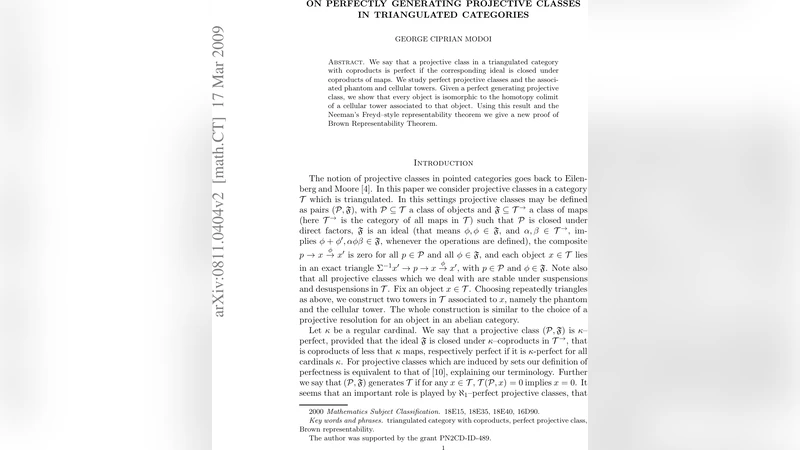
We say that a projective class in a triangulated category with coproducts is perfect if the corresponding ideal is closed under coproducts of maps. We study perfect projective classes and the associated phantom and cellular towers. Given a perfect generating projective class, we show that every object is isomorphic to the homotopy colimit of a cellular tower associated to that object. Using this result and the Neeman’s Freyd–style representability theorem we give a new proof of Brown Representability Theorem.
💡 Research Summary
The paper investigates a special kind of projective class in a triangulated category 𝒯 with arbitrary coproducts. A projective class consists of a collection 𝒫 of objects (the “projectives”) together with an ideal 𝕀 of morphisms that are “𝒫‑null” (i.e., they induce zero maps on Hom‑sets from any object of 𝒫). The authors introduce the notion of a perfect projective class: the ideal 𝕀 must be closed not only under composition but also under arbitrary (in particular, countable) coproducts of morphisms. This extra closure property is crucial when dealing with infinite constructions such as homotopy colimits.
With a perfect projective class at hand, the authors construct two canonical towers associated to any object X in 𝒯:
-
Phantom tower – an inverse tower built by repeatedly taking 𝒫‑null maps and their cofibres. Each step yields a “phantom” morphism, i.e., a map that becomes invisible after pre‑composition with any map from a projective object.
-
Cellular tower – a direct tower obtained by successively attaching 𝒫‑projective cells to approximate X. At each stage one forms a distinguished triangle where the map from the current approximation to X is 𝒫‑null; the next stage is the co‑fibre of that map.
The central technical result shows that if the projective class is generating (the only object orthogonal to all projectives is zero) and perfect, then the homotopy colimit of the cellular tower is canonically isomorphic to X. The proof proceeds by first constructing a “cellular approximation” of X as a transfinite extension of projectives, then using the perfectness of 𝕀 to guarantee that the resulting colimit does not introduce any unwanted phantom maps. Consequently, every object in 𝒯 admits a cellular resolution by projectives whose homotopy colimit recovers the original object.
The paper then connects this construction with Neeman’s Freyd‑style representability theorem. Neeman proved that if a triangulated category possesses a perfect ideal and a cohomological functor H: 𝒯ᵒᵖ → Ab preserves countable coproducts, then H is representable, i.e., H ≅ Hom(–, Y) for some Y in 𝒯. By applying the cellular tower resolution, the authors show that the hypothesis of a perfect generating projective class automatically supplies the perfect ideal required by Neeman’s theorem. Hence any cohomological functor that respects coproducts is representable.
Finally, the authors use this observation to give a new proof of the Brown Representability Theorem. The classical Brown theorem asserts that a cohomological functor from a well‑generated triangulated category to abelian groups, which takes coproducts to products, is representable. Traditional proofs rely on intricate set‑theoretic arguments (e.g., the construction of a “solution set”) or on the machinery of compactly generated categories. In contrast, the present approach replaces those arguments with the existence of a perfect generating projective class and the cellular tower machinery. The proof becomes conceptually cleaner: one shows that every object is a homotopy colimit of a cellular tower, then invokes Neeman’s theorem to obtain representability directly.
Beyond the main theorem, the paper discusses several consequences and potential extensions:
- In stable homotopy theory, the sphere spectrum generates a perfect projective class, so the results apply to the category of spectra, giving an alternative route to Brown representability for spectra.
- In derived categories of rings, projective modules form a perfect generating class, so the same method recovers the classical representability of cohomological functors on D(R).
- The phantom tower provides a systematic way to study phantom maps, which are notoriously subtle in stable homotopy theory; the authors hint that the interplay between phantom and cellular towers could lead to new invariants.
- The notion of perfectness may be relaxed or generalized (e.g., to “locally perfect” ideals) to treat larger classes of triangulated categories that are not necessarily well‑generated.
In summary, the paper introduces the concept of a perfect generating projective class, shows that it yields cellular resolutions for all objects, leverages Neeman’s Freyd‑style representability theorem, and thereby furnishes a streamlined proof of Brown’s representability theorem. This work deepens the structural understanding of triangulated categories, clarifies the role of projective objects in infinite homotopical constructions, and opens avenues for further exploration of phantom phenomena and generalized representability.
Comments & Academic Discussion
Loading comments...
Leave a Comment