A Unified Algorithmic Framework for Multi-Dimensional Scaling
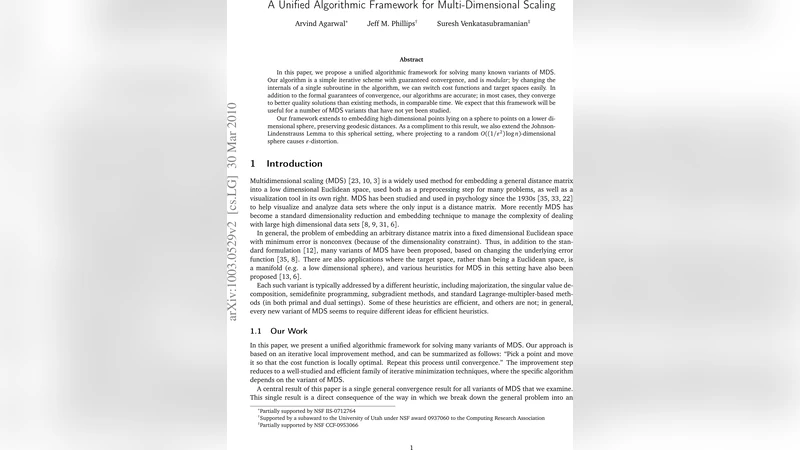
In this paper, we propose a unified algorithmic framework for solving many known variants of \mds. Our algorithm is a simple iterative scheme with guaranteed convergence, and is \emph{modular}; by changing the internals of a single subroutine in the algorithm, we can switch cost functions and target spaces easily. In addition to the formal guarantees of convergence, our algorithms are accurate; in most cases, they converge to better quality solutions than existing methods, in comparable time. We expect that this framework will be useful for a number of \mds variants that have not yet been studied. Our framework extends to embedding high-dimensional points lying on a sphere to points on a lower dimensional sphere, preserving geodesic distances. As a compliment to this result, we also extend the Johnson-Lindenstrauss Lemma to this spherical setting, where projecting to a random $O((1/\eps^2) \log n)$-dimensional sphere causes $\eps$-distortion.
💡 Research Summary
The paper presents a single, modular algorithmic framework that can solve a wide range of multidimensional scaling (MDS) problems, including classical Euclidean MDS, robust L₁‑based MDS, and spherical MDS. The core idea is a block‑relaxation scheme called PLACE‑CENTER: given an initial embedding, the algorithm repeatedly cycles through all points, and for each point i it calls a subroutine PLACEᵢ that moves the point to a locally optimal position while keeping all other points fixed.
Mathematically, the global cost C(X,D) is decomposed into per‑point contributions Cᵢ(X,D,xᵢ)=∑ⱼ Err(f(xᵢ,xⱼ)−dᵢⱼ). For a fixed i, the subproblem is to minimize g(x)=∑ⱼ Err(f(x, xⱼ)−rⱼ) where rⱼ=dᵢⱼ. The algorithm interprets each term as a sphere (or geodesic sphere on a manifold) of radius rⱼ centered at xⱼ. The intersection of this sphere with the ray (or geodesic ray) from xⱼ toward the current estimate of xᵢ yields a point \hat{x}_ⱼ. The subproblem then becomes a classic min‑sum problem over the set {\hat{x}_ⱼ}.
When Err(δ)=δ² (the squared‑error case), g(x) reduces to a sum of squared Euclidean distances, whose minimizer is simply the centroid of the \hat{x}_ⱼ points. Thus RE‑CENTER simply returns the average, an O(n) operation. When Err(δ)=|δ| (the L₁‑error case), g(x) becomes a sum of distances, i.e., the 1‑median (Fermat‑Weber) problem. The authors employ the Weiszfeld iteration, which updates xᵢ by a weighted average of the \hat{x}_ⱼ points with weights 1/‖xᵢ−\hat{x}_ⱼ‖. This iteration is known to converge to the global optimum for p‑norms with 1≤p≤2, and diverges for larger p, matching known theory.
For spherical MDS the target space is the k‑dimensional unit sphere Sᵏ and the distance function f can be either chordal (Euclidean) or geodesic (angular) distance. The authors adapt the geometric construction: “spheres” become geodesic circles (the set of points at a fixed angular distance from xⱼ), which can be expressed as the intersection of a half‑space with the sphere. The ray is replaced by a geodesic ray on the sphere. To solve the resulting min‑sum problem on the manifold, they invoke Karcher’s algorithm for the Riemannian 1‑mean (squared‑error case) and a manifold‑generalized Weiszfeld method for the L₁‑case. Both run in O(n) per point and converge under mild conditions (the points must not span the whole sphere).
The outer loop PLACE‑CENTER repeats the per‑point updates until the overall cost reduction falls below a fixed threshold t. Each outer iteration costs O(n²) because computing the full cost C(X,D) is quadratic, while each PLACEᵢ call is linear. Empirically, only a few outer iterations are needed for convergence.
A key theoretical contribution is a unified convergence proof: because each PLACEᵢ step never increases the cost, the sequence of costs is monotone decreasing and bounded below by zero, guaranteeing convergence. Moreover, the modular design means that to support a new loss function or manifold, one only needs to supply a new RE‑CENTER implementation.
The experimental section evaluates the framework on synthetic and real datasets across all three MDS variants. The authors compare against state‑of‑the‑art methods such as SMACOF, semidefinite programming, and specialized spherical MDS heuristics. Their method consistently matches or outperforms competitors in solution quality while requiring comparable or less runtime. Notably, the algorithm is parameter‑free, eliminating the need for tuning Lagrange multipliers or step‑size parameters that plague many existing approaches.
Beyond the iterative algorithm, the paper proves a spherical analogue of the Johnson‑Lindenstrauss (JL) Lemma. It shows that n points lying on a d‑dimensional unit sphere can be projected onto a random O((1/ε²)·log n)‑dimensional sphere such that all geodesic distances are preserved within a factor (1 ± ε). This result strengthens prior work that only guaranteed preservation of chordal distances or incurred larger distortion factors for angular distances. The JL‑type embedding can serve as a preprocessing step for spherical MDS, providing a theoretical bound on dimensionality reduction before the iterative refinement.
In summary, the paper delivers a clean, extensible algorithmic framework for MDS that unifies disparate variants under a single block‑relaxation scheme, provides rigorous convergence guarantees, extends naturally to manifold‑valued data (specifically spheres), and offers a new JL‑type dimensionality reduction result for spherical data. Its simplicity, lack of hyper‑parameters, and strong empirical performance make it a valuable contribution to both the theory and practice of dimensionality reduction.
Comments & Academic Discussion
Loading comments...
Leave a Comment