A new simulation-based model for calculating post-mortem intervals using developmental data for Lucilia sericata (Dipt.: Calliphoridae)
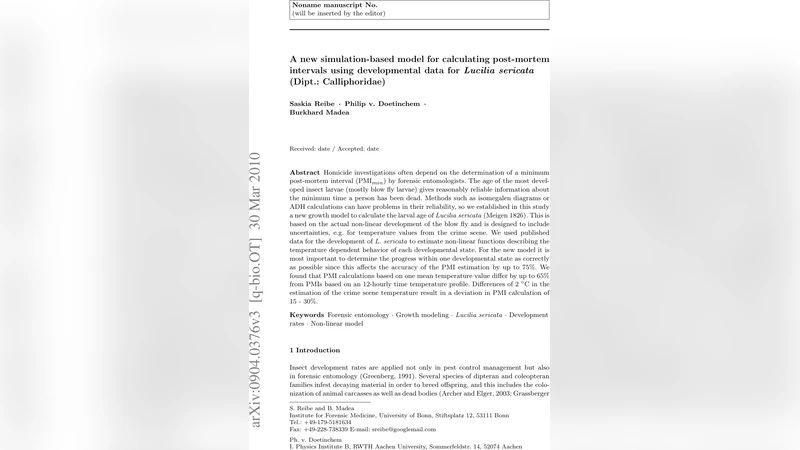
Homicide investigations often depend on the determination of a minimum post-mortem interval (PMI$_{min}$) by forensic entomologists. The age of the most developed insect larvae (mostly blow fly larvae) gives reasonably reliable information about the minimum time a person has been dead. Methods such as isomegalen diagrams or ADH calculations can have problems in their reliability, so we established in this study a new growth model to calculate the larval age of \textit{Lucilia sericata} (Meigen 1826). This is based on the actual non-linear development of the blow fly and is designed to include uncertainties, e.g. for temperature values from the crime scene. We used published data for the development of \textit{L. sericata} to estimate non-linear functions describing the temperature dependent behavior of each developmental state. For the new model it is most important to determine the progress within one developmental state as correctly as possible since this affects the accuracy of the PMI estimation by up to 75%. We found that PMI calculations based on one mean temperature value differ by up to 65% from PMIs based on an 12-hourly time temperature profile. Differences of 2\degree C in the estimation of the crime scene temperature result in a deviation in PMI calculation of 15 - 30%.
💡 Research Summary
Forensic entomology frequently relies on the developmental stage of blow‑fly larvae to estimate the minimum post‑mortem interval (PMIₘᵢₙ). Traditional tools such as isomegalen diagrams and accumulated degree‑hour (ADH) calculations assume a linear relationship between temperature and development or use a single mean temperature value. Both approaches can produce large errors when the ambient temperature fluctuates, when temperature measurements are uncertain, or when the precise progress within a developmental stage is unknown. In this study the authors present a novel, simulation‑based model that explicitly incorporates the non‑linear temperature dependence of Lucilia sericata development and propagates uncertainties through a Monte‑Carlo framework.
Data acquisition and preprocessing
Published laboratory data on the duration of each developmental stage of L. sericata (egg, three larval instars, and puparium) at a range of constant temperatures were compiled. Outliers were removed, and the data were normalized to facilitate model fitting.
Model formulation
For each stage i a temperature‑dependent function tᵢ(T) was derived. The authors tested several functional forms (log‑linear, polynomial, spline interpolation) and selected the one that best captured the rapid acceleration of development at higher temperatures. The fitted functions were then used to generate probability distributions (normally or log‑normally distributed) for the minimum and maximum duration of each stage, reflecting biological variability observed in the source data.
Incorporating intra‑stage progress
A critical innovation of the model is the explicit treatment of the proportion pᵢ of development completed within a given stage. This proportion can be estimated from morphological markers such as head capsule width, mouth‑hook development, and cuticular sclerotization. Sensitivity analysis showed that errors in pᵢ can account for up to 75 % of the total PMI uncertainty, underscoring the importance of accurate intra‑stage assessment.
Monte‑Carlo simulation and uncertainty propagation
The authors performed 10 000 Monte‑Carlo iterations, drawing random values for:
- Ambient temperature – either a single mean value, a 12‑hourly temperature profile, or a profile perturbed by a ±2 °C measurement error;
- Stage‑specific duration distributions;
- Intra‑stage progress pᵢ.
The simulated PMI distributions revealed that using only a mean temperature can lead to PMI estimates that differ by as much as 65 % from those obtained with a realistic 12‑hourly temperature series. Moreover, a modest temperature estimation error of ±2 °C produced a 15‑30 % deviation in the calculated PMI.
Practical implications
The new model provides forensic practitioners with a probabilistic PMI estimate (e.g., a 95 % confidence interval) rather than a single point value. It highlights the necessity of high‑resolution temperature monitoring at the crime scene and of detailed morphological examination of larvae to determine intra‑stage progress. By quantifying the impact of temperature and developmental uncertainties, the model improves the transparency and reliability of entomological evidence presented in court.
Limitations and future directions
The model is based on laboratory data collected under controlled conditions; field validation with varying humidity, carcass type, and micro‑climatic effects is required. Extending the approach to other forensic blow‑fly species (e.g., Calliphora vicina, Chrysomya megacephala) and integrating additional environmental variables such as humidity and substrate temperature would broaden its applicability. Finally, systematic case‑study validation will be essential for establishing standardized reporting guidelines.
Conclusion
By fitting non‑linear temperature‑development functions for Lucilia sericata and embedding them in a Monte‑Carlo simulation that accounts for temperature variability and intra‑stage progress, the authors deliver a robust, uncertainty‑aware method for PMIₘᵢₙ estimation. Compared with traditional mean‑temperature methods, the new approach can reduce errors by up to two‑thirds and provides a clear quantitative framework for expressing the confidence of entomological time‑of‑death estimates. This work represents a significant step toward more scientifically rigorous forensic entomology practice.
Comments & Academic Discussion
Loading comments...
Leave a Comment