By "solving a triangle", one refers to determining the three sidelengths and the three angles, based on given information.Depending on the specific information, one or more triangles may satisfy the requirements of the given information.In the SAS case, two of sidelengths are given, as well as the angle contained by the two sides.According to Euclidean Geometry, such a triangle must be unique. In reference [1], and pretty much in standard trigonometry and precalculus texts,the Law of Cosines is employed in solving a SAS triangle. In this work we use an alternative approach by using the Law of Cosines.In Section 2, we list some basic trigonometric identities and in Section 3 we prove a lemma which is used in Section4. In Section4, we demonstrate the use of the Law of Sines in solving an SAS triangle. In Section 5 we offer three examples in detail; the last one being more general in nature.
Deep Dive into Implementing the Law of Sines to solve SAS triangles.
By “solving a triangle”, one refers to determining the three sidelengths and the three angles, based on given information.Depending on the specific information, one or more triangles may satisfy the requirements of the given information.In the SAS case, two of sidelengths are given, as well as the angle contained by the two sides.According to Euclidean Geometry, such a triangle must be unique. In reference [1], and pretty much in standard trigonometry and precalculus texts,the Law of Cosines is employed in solving a SAS triangle. In this work we use an alternative approach by using the Law of Cosines.In Section 2, we list some basic trigonometric identities and in Section 3 we prove a lemma which is used in Section4. In Section4, we demonstrate the use of the Law of Sines in solving an SAS triangle. In Section 5 we offer three examples in detail; the last one being more general in nature.
Page 1 of 9
Implementing the Law of Sines to
solve SAS triangles
June 8, 2009
Konstantine Zelator
Dept. of Math and Computer Science1
Rhode Island College
600 Mount Pleasant Avenue
Providence, RI 02908
U.S.A.
e-mail : kzelator@ric.edu
konstantine_zelator@yahoo.com
Introduction
Most trigonometry or precalculus texts offer a fairy brief treatment of the subject of solving a triangle; while only
a few contain a more extensive analysis of the subject matter. By “solving a triangle” , we refer to the problem of
determining all three sidelengths and interior triangle angle on given information on some of the triangle’s angles
and/or sidelengths. Depending
1Effective August 1, 2009 and for the academic year 2009-2010:
Konstantine Zelator
Department of Mathematics
301 Thackeray Hall
139 University Place
University of Pittsburgh
Pittsburgh, PA 15260
e-mail: kzet159@pitt.edu
on the specific information, a unique triangle may be formed, more than one triangle, or no triangle at all. Robert
Blitzer’s book, Precalculus, is among those books that contain a typical treatment of this subject (see [1]). Now,
the case SAS refers to the situation wherein two sidelengths are given, as well as the degree measure of the angle
contained between the two sides. As we know from Euclidean geometry, such a triangle is uniquely determined;
meaning that any two triangles constructed with these specifications must be congruent. It appears that not only
Blitzer’s book, but universally, in any book or text with the SAS case, the Law of Cosines is employed. For example,
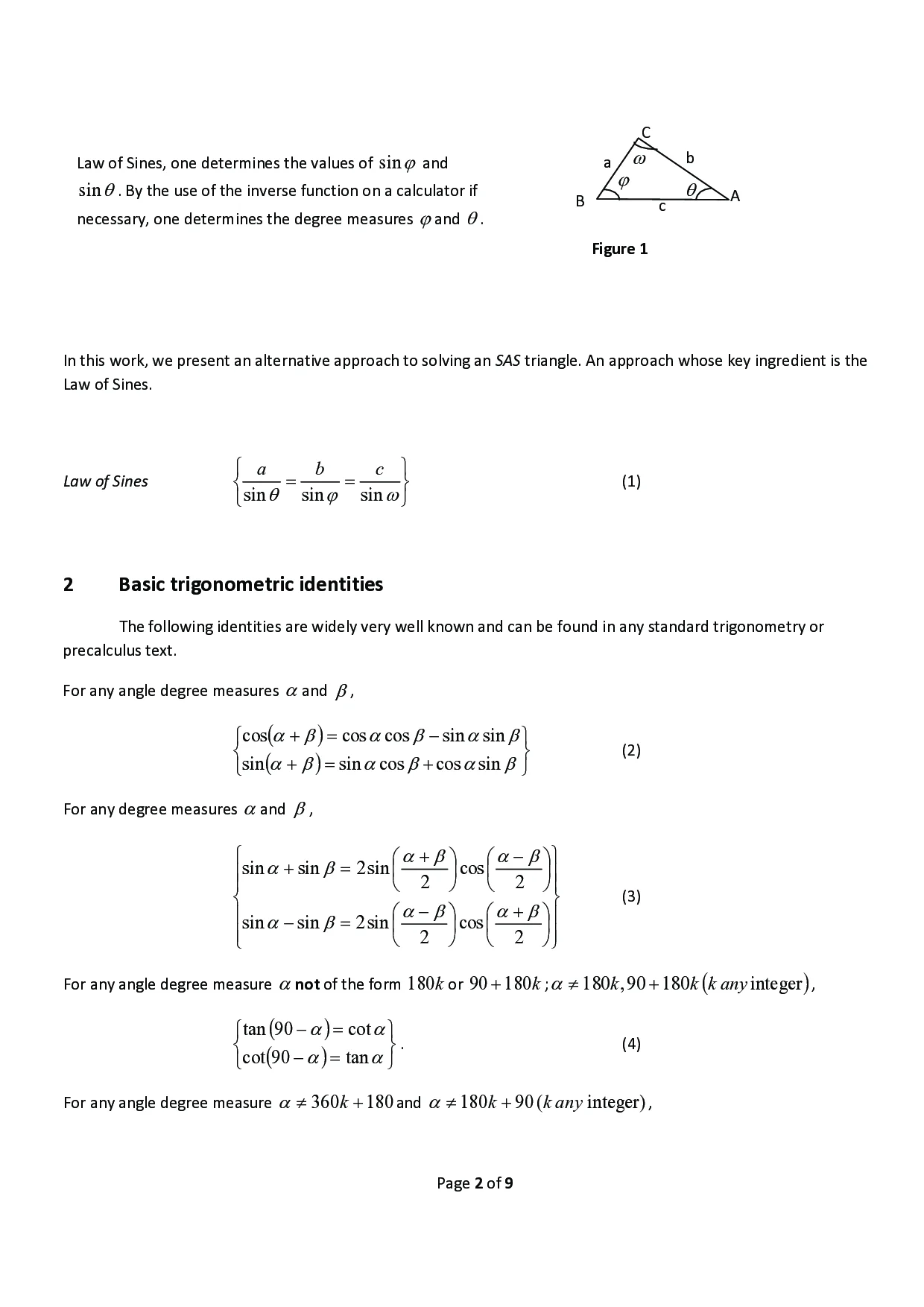
let us say that the lengths a and b are given; as well as the degree measure ω of the angle
BCA
∠
(see Figure 1).
Then, by using the Law of Cosines, one calculates the value of c , the length of BA ; and by using the
Page 2 of 9
Law of Sines, one determines the values of
ϕ
sin
and
θ
sin
. By the use of the inverse function on a calculator if
necessary, one determines the degree measures ϕ and θ .
Figure 1
In this work, we present an alternative approach to solving an SAS triangle. An approach whose key ingredient is the
Law of Sines.
Law of Sines
=
ω
ϕ
θ
sin
sin
sin
c
b
a
(1)
2
Basic trigonometric identities
The following identities are widely very well known and can be found in any standard trigonometry or
precalculus text.
For any angle degree measures α and β ,
(
)
(
)
+
−
β
α
β
α
β
α
β
α
β
α
β
α
sin
cos
cos
sin
sin
sin
sin
cos
cos
cos
(2)
For any degree measures α and β ,
+
−
−
−
+
2
cos
2
sin
2
sin
sin
2
cos
2
sin
2
sin
sin
β
α
β
α
β
α
β
α
β
α
β
α
(3)
For any angle degree measure α not of the form
k
180 or
k
180
90 +
;
(
)
integer
180
90
,
180
any
k
k
k
+
≠
α
,
(
)
(
)
−
−
α
α
α
α
tan
90
cot
cot
90
tan
.
(4)
For any angle degree measure
180
360 +
≠
k
α
and
)
integer
(
90
180
any
k
k +
≠
α
,
C
B
A
a
b
c
ω
ϕ
θ
Page 3 of 9
.
2
tan
1
2
tan
2
tan
2
−
α
α
α
(5)
3
A Lemma and its proof
Lemma 3.1. Suppose that
d
c
b
a
,
,
,
are real numbers such that
0
,
0
≠
+
≠
b
a
bd
, and
0
≠
- d
c
. ( In particular,
this hypothesis is satisfied when
d
c
b
a
,
,
,
are positive.)
Then,
d
c
b
a =
if, and only if,
d
c
d
c
b
a
b
a
−
−
.
Proof. Suppose that
.k
d
c
b
a
=
Then
bk
a =
and
dk
c =
. We have
(
)
1
1
1
(
1
+
−
−
−
−
k
k
k
b
k
b
b
bk
b
bk
b
a
b
a
(6)
and also
(
)
(
)
1
1
1
1
+
−
−
−
k
k
d
d
d
c
d
c
d
c
d
c
.
(7)
From (6) and (7) , it follows that
.
d
c
d
c
b
a
b
a
+
−
−
Conversely, assume that
d
c
d
c
b
a
b
a
+
−
−
, which implies
(
)(
)
(
)(
)
,
bd
bc
ad
ac
bd
bc
ad
ac
d
c
b
a
d
c
b
a
−
+
−
−
−
+
⇔
−
+
−
and thus,
;
2
2
ad
bc =
and since
0
≠
bd
, we obtain
.
;
2
2
d
c
b
a
bd
ad
bd
bc
=
4
Solving an SAS triangle using the Law of Sines
Suppose that the lengths a and b , as well as the degree measure ω , are given in Figure 1. From the Law of Sines
(1) we obtain
Page 4 of 9
ϕ
θ
sin
sin
b
a
(8)
Since θ and ϕ are degree measures of triangle angles, we have
,
180
,
0
<
<
ϕ
θ
and so
0
sin
θ
and
;0
sin
ϕ
and, of course,
.0
,
0
b
a
By Lemma 1, (8) implies
,
sin
sin
sin
sin
b
a
b
a
+
−
−
ϕ
θ
ϕ
θ
and by identities (3),
(
)
(
)
(
)
(
)
b
a
b
a
+
−
−
+
+
−
2
2
2
2
cos
sin
2
cos
sin
2
ϕ
θ
ϕ
θ
ϕ
θ
ϕ
θ
(9)
Since
ω
ϕ
θ
,
,
are triangle angle d
…(Full text truncated)…
This content is AI-processed based on ArXiv data.