Labelled Lambda-calculi with Explicit Copy and Erase
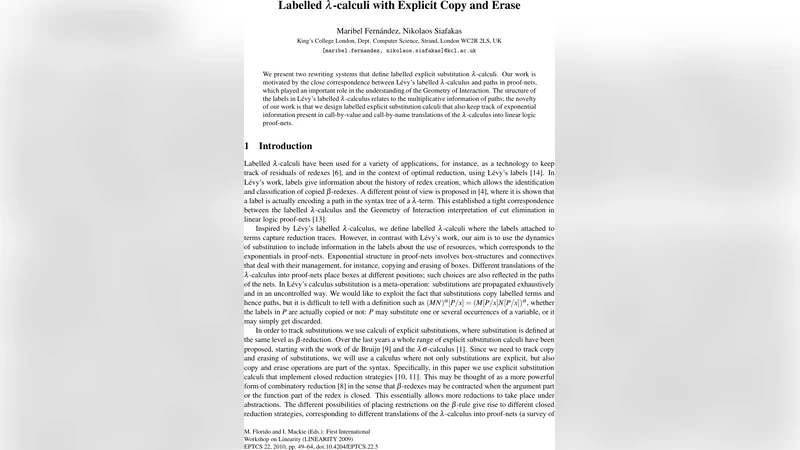
We present two rewriting systems that define labelled explicit substitution lambda-calculi. Our work is motivated by the close correspondence between Levy’s labelled lambda-calculus and paths in proof-nets, which played an important role in the understanding of the Geometry of Interaction. The structure of the labels in Levy’s labelled lambda-calculus relates to the multiplicative information of paths; the novelty of our work is that we design labelled explicit substitution calculi that also keep track of exponential information present in call-by-value and call-by-name translations of the lambda-calculus into linear logic proof-nets.
💡 Research Summary
The paper introduces two rewriting systems that extend Levy’s labelled λ‑calculus with explicit substitution, copy, and erase operators, thereby bridging the gap between λ‑terms and linear‑logic proof‑nets. Levy’s original system attaches a label to each sub‑term, allowing the reconstruction of the multiplicative (tensor/par) structure of paths in the term’s syntax tree. However, because substitution is treated as a meta‑operation that propagates unrestrictedly, the original labels cannot capture the exponential (box) structure that appears in the call‑by‑value (CBV) and call‑by‑name (CBN) translations of λ‑calculus into proof‑nets.
To overcome this limitation, the authors adopt an explicit substitution framework (λc‑terms) where substitution, copying (δ), and erasing (ε) are first‑class syntactic constructs. Two calculi are defined: λlcf (labelled closed‑functions) and λlca (labelled closed‑arguments). In λlcf the β‑rule fires only when the function part of a redex is closed, mirroring the CBV translation where boxes are placed around function components. In λlca the β‑rule requires the argument part to be closed, reflecting the CBN translation where boxes surround arguments. Both calculi thus encode the exponential discipline of linear logic directly into the reduction process.
Labels are generated from a grammar that includes atomic symbols (a, b, …), concatenation (·), choice (|), and a set of exponential markers C, D, ?, !, ←E, →E. The algebra L⋆ supplies constants for multiplicative (p, q) and exponential (r, s, t, d) weights, together with a unary “!” operator. The operator “•” concatenates labels, while the function (·)r reverses a label, allowing the representation of forward and backward traversal of proof‑net edges. When a copy or erase operation is performed, the corresponding exponential markers are inserted into the label of the duplicated or discarded term, e.g. Cpy1 adds −→R·N and −→S·N to the labels of the two copies, which later correspond to contraction and weakening nodes in the net.
The authors define a translation from labelled λc‑terms to weighted proof‑nets: each term’s label becomes a weight on the associated edge, and the structure of the term determines the net’s topology. Paths in the net are constrained to be straight (no twisting or bouncing), and the weight of a path is the product of the weights of its edges, computed using the L⋆ algebra. Because the labels encode both multiplicative (underlining/overlining) and exponential (box entry/exit) information, a single label uniquely identifies a path through the net, including where copies are made and where erasures occur.
Reduction in the labelled calculi proceeds under the usual contextual closure, but the β‑rule is enriched with label manipulation: ((λx.M)α N)β reduces to β−→D α←! • M
Comments & Academic Discussion
Loading comments...
Leave a Comment