The CREAM calorimeter, designed to measure the spectra of cosmic-ray nuclei from under 1 TeV to 1000 TeV, is a 20 radiation length (X0) deep sampling calorimeter. The calorimeter is comprised of 20 layers of tungsten interleaved with 20 layers of scintillating fiber ribbons, and is preceded by a pair of graphite interaction targets providing about 0.42 proton interaction lengths (\lambda int). The calorimeter was placed in one of CERN's SPS accelerator beams for calibration and testing. Beams of 150 GeV electrons were used for calibration, and a variety of electron, proton, and nuclear fragment beams were used to test the simulation model of the detector. In this paper we discuss the performance of the calorimeter in the electron beam and compare electron beam data with simulation results.
Deep Dive into Performance of the CREAM calorimeter in accelerator beam test.
The CREAM calorimeter, designed to measure the spectra of cosmic-ray nuclei from under 1 TeV to 1000 TeV, is a 20 radiation length (X0) deep sampling calorimeter. The calorimeter is comprised of 20 layers of tungsten interleaved with 20 layers of scintillating fiber ribbons, and is preceded by a pair of graphite interaction targets providing about 0.42 proton interaction lengths (\lambda int). The calorimeter was placed in one of CERN’s SPS accelerator beams for calibration and testing. Beams of 150 GeV electrons were used for calibration, and a variety of electron, proton, and nuclear fragment beams were used to test the simulation model of the detector. In this paper we discuss the performance of the calorimeter in the electron beam and compare electron beam data with simulation results.
29th International Cosmic Ray Conference Pune (2005) 8, 371-374
Performance of the CREAM calorimeter in accelerator beam test
Y. S. Yoona, H. S. Ahnb, , M. G. Bagliesic, , G. Bigongiaric, O. Ganelb, J. H. Hand, H. J.
Hyund, J. A. Jeond, T. G. Kangb, H. J. Kime, K. C. Kimb, J. K. Leed, M. H. Leeb, L. Lutzb,
P. Maestroc, A. Malinineb, P. S. Marrocchesic, S. W. Namd, H. Parke, I. H. Parkd, N. H.
Parkd, E. S. Seoa,b, R. Sinab, J. Wub, J. Yangd, R. Zeic and S. Y. Zinnb
(a) Dept. of Physics, University of Maryland, College Park, MD 20742, USA
(b) Inst. For Phys. Sci. and Tech., University of Maryland, College Park, MD 20742, USA
(c) Dept. of Physics, University of Siena and INFN, Via Roma 56, 53100 Siena, Italy
(d) Dept. of Physics, Ewha Womans University, Seoul, 120-750, Republic of Korea
(e) Dept. of Physics, Kyungpook National University, Taegu, 702-701, Republic of Korea
Presenter: Young Soo Yoon (ysy@umd.edu), usa-yoon-Y-abs3-he15-poster
The CREAM calorimeter, designed to measure the spectra of cosmic-ray nuclei from under 1 TeV to 1000
TeV, is a 20 radiation length (X0) deep sampling calorimeter. The calorimeter is comprised of 20 layers of
tungsten interleaved with 20 layers of scintillating fiber ribbons, and is preceded by a pair of graphite
interaction targets providing about 0.42 proton interaction lengths (λint). The calorimeter was placed in one
of CERN’s SPS accelerator beams for calibration and testing. Beams of 150 GeV electrons were used for
calibration, and a variety of electron, proton, and nuclear fragment beams were used to test the simulation
model of the detector. In this paper we discuss the performance of the calorimeter in the electron beam and
compare electron beam data with simulation results.
- Introduction
The cosmic-ray spectrum follows a decreasing power law, with the incident flux dropping by roughly a
factor of 50 for every ten-fold increase in the threshold energy. Thus, of all particles above 1 TeV, only 2%
are above 10 TeV, and only 0.04% above 100 TeV. It is for this reason that the limitation on the energy
reach of flight experiments measuring these particles is mostly statistical. The CREAM instrument was
designed to directly measure the charge and energy of cosmic-ray nuclei, from H to Fe, for energies ranging
from under 1 TeV to 1000 TeV [1]. CREAM incorporates both a calorimeter and a transition radiation
detector (TRD) to measure particle energies (TRD for Z>3), and a timing-based charge detector (TCD) and a
silicon charge detector (SCD) to measure particle charge or ID. The independent measurements allow
verification and cross-calibration for large sub-samples of events collected. The calorimeter uses a sampling
scheme with tungsten absorber to minimize the thickness required for a given depth in X0, allowing a greater
collection power, or geometry factor (GF). The graphite targets, with their relatively low Z number (6 vs. 74
for tungsten), increase the fraction of nuclei interacting early enough to allow a reasonable reconstruction of
their incident energy, while minimizing the weight, and having a minimal impact on the ‘age’ of the shower
development regardless of the depth of graphite the shower secondaries must traverse before reaching the
active scintillating fiber layers. The CREAM payload was flown for about 42 days suspended under a Long
Duration Balloon (LDB) launched from McMurdo Station, Antarctica in December 2004.
- CREAM calorimeter module
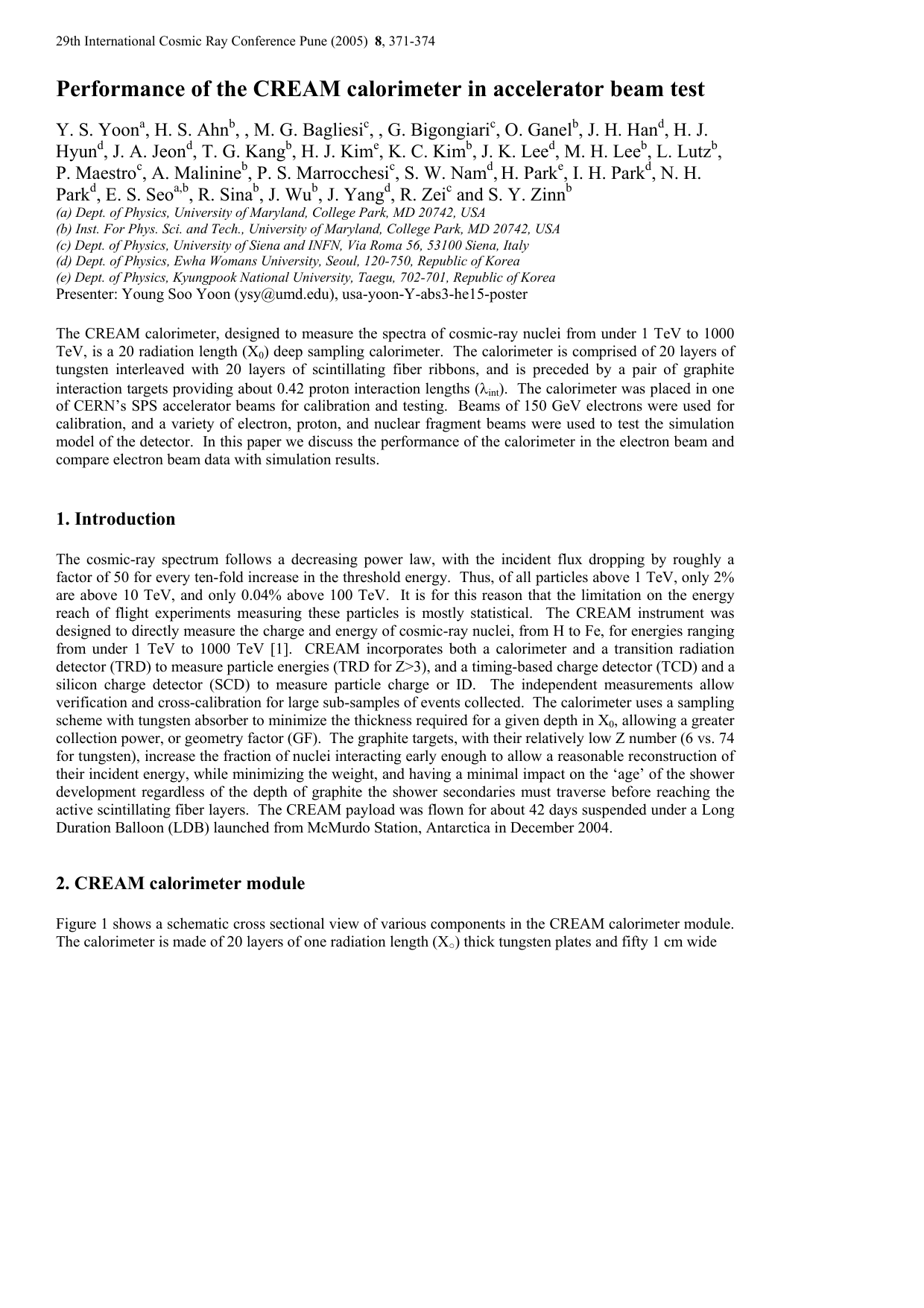
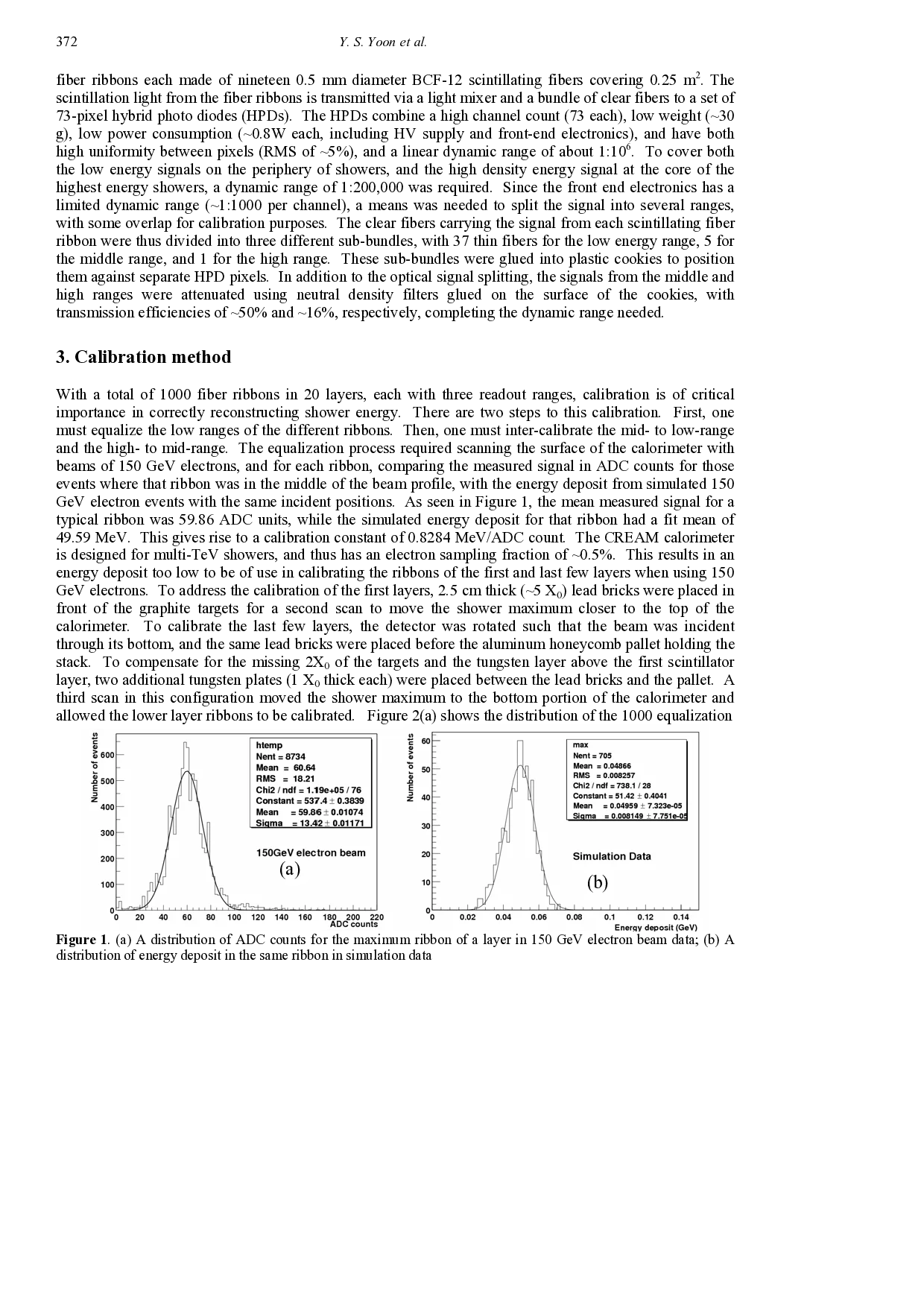
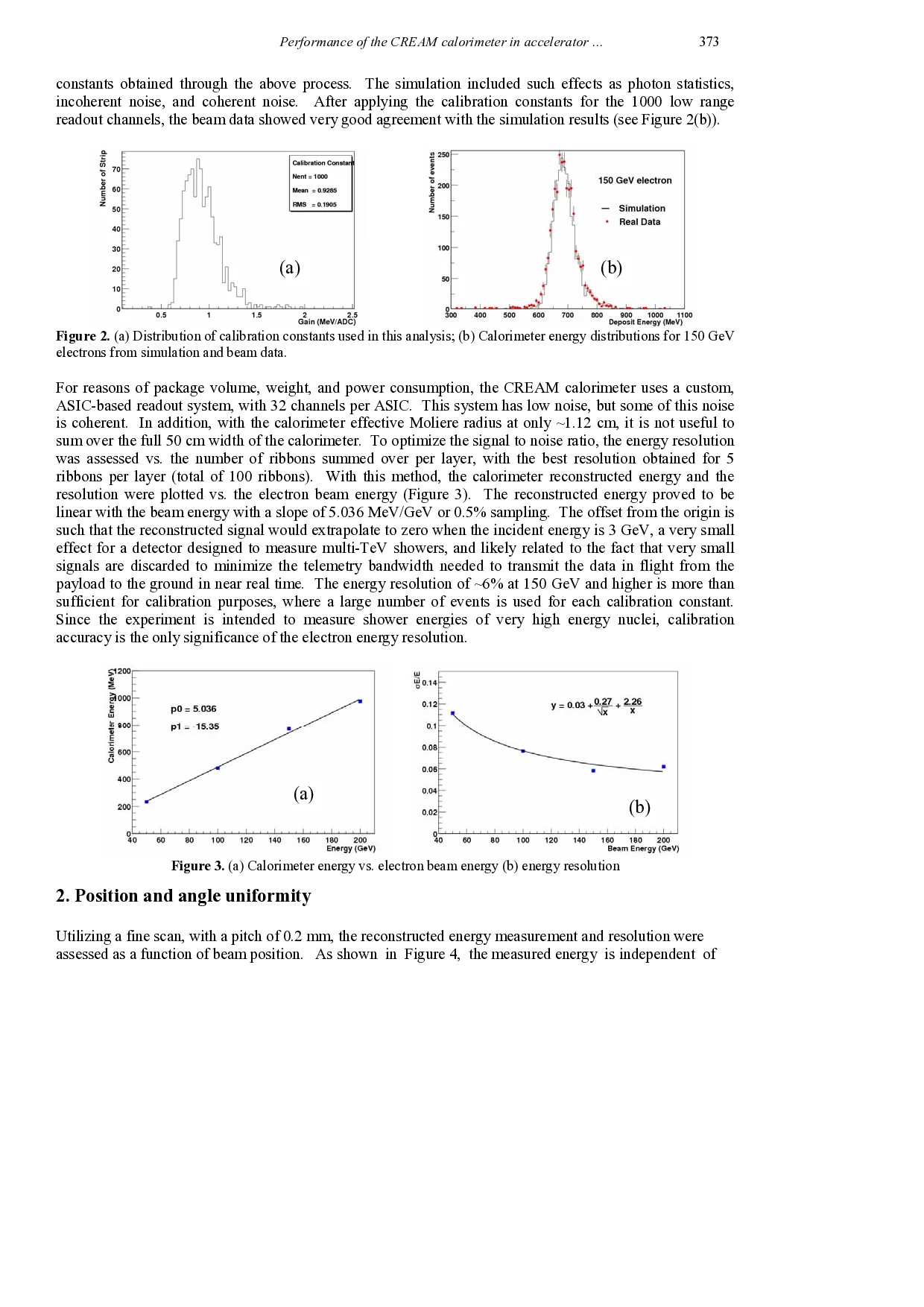
Figure 1 shows a schematic cross sectional view of various components in the CREAM calorimeter module.
The calorimeter is made of 20 layers of one radiation length (X○) thick tungsten plates and fifty 1 cm wide
372
Y. S. Yoon et al.
fiber ribbons each made of nineteen 0.5 mm diameter BCF-12 scintillating fibers covering 0.25 m2. The
scintillation light from the fiber ribbons is transmitted via a light mixer and a bundle of clear fibers to a set of
73-pixel hybrid photo diodes (HPDs). The HPDs combine a high channel count (73 each), low weight (~30
g), low power consumption (~0.8W each, including HV supply and front-end electronics), and have both
high uniformity between pixels (RMS of ~5%), and a linear dynamic range of about 1:106. To cover both
the low energy signals on the periphery of showers, and the high density energy signal at the core of the
highest energy showers, a dynamic range of 1:200,000 was required. Since the front end electronics has a
limited dynamic range (~1:1000 per channel), a means was needed to split the signal into several ranges,
with some overlap for calibration purposes. The clear fibers carrying the signal from each scintillating fiber
ribbon were thus divided into three different sub-bundles, with 37 thin fibers for the low energy range, 5 for
the middle range, and 1 for the high range. These sub-bundles were glued into plastic cookies to position
them against separate HPD pixels. In
…(Full text truncated)…
This content is AI-processed based on ArXiv data.