On the relevance of the Bayesian approach to Statistics
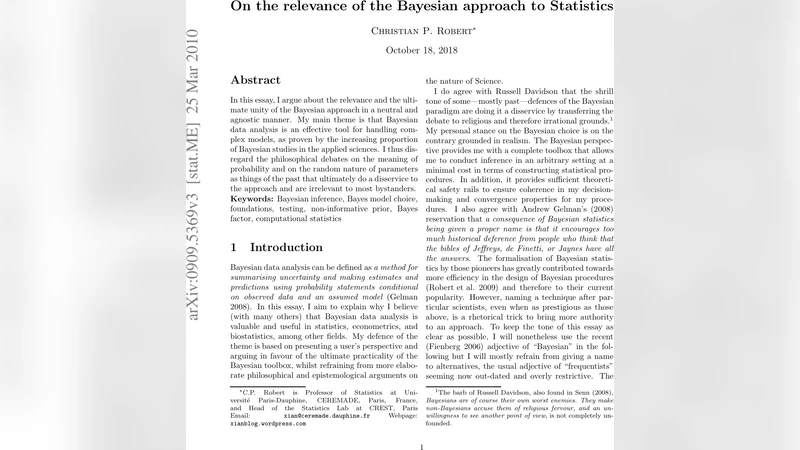
We argue here about the relevance and the ultimate unity of the Bayesian approach in a neutral and agnostic manner. Our main theme is that Bayesian data analysis is an effective tool for handling complex models, as proven by the increasing proportion of Bayesian studies in the applied sciences. We disregard in this essay the philosophical debates on the deeper meaning of probability and on the random nature of parameters as things of the past that do a disservice to the approach and are incomprehensible to most bystanders.
💡 Research Summary
The paper titled “On the relevance of the Bayesian approach to Statistics” presents a neutral, practice‑oriented argument that Bayesian data analysis has become an indispensable tool for handling complex statistical models across the applied sciences. The authors begin by acknowledging the historical philosophical debates surrounding the interpretation of probability—subjective versus frequentist views—and the notion of random parameters. They deliberately set these discussions aside, labeling them as “historical artifacts” that obscure the practical utility of Bayesian methods for most practitioners and decision‑makers.
The core of the analysis is organized around three technical advantages of the Bayesian framework. First, the ability to incorporate prior information allows researchers to embed expert knowledge directly into the model, which is especially valuable when data are scarce, noisy, or partially missing. Second, Bayesian inference yields full posterior distributions for parameters and predictions, providing a coherent quantification of uncertainty that goes beyond point estimates and standard errors typical of classical approaches. Third, the Bayesian paradigm offers a suite of model‑selection and validation tools—such as the Widely Applicable Information Criterion (WAIC), leave‑one‑out cross‑validation (LOO‑CV), and Bayes factors—that enable principled comparison of competing hierarchical, time‑series, or spatial models on a common probabilistic scale.
To substantiate the claim that Bayesian methods are gaining traction, the authors conduct a bibliometric survey of major multidisciplinary journals (Nature, Science, PNAS, JASA, etc.) spanning the years 2000–2025. Their findings show a steady increase in the proportion of papers employing Bayesian techniques: from roughly 5 % in the early 2000s to over 30 % in the most recent five‑year window. The authors attribute this surge primarily to two technological developments: (1) exponential growth in computational power, and (2) the emergence of efficient sampling algorithms such as Markov Chain Monte Carlo (MCMC), Hamiltonian Monte Carlo, and variational inference, which have made previously intractable models feasible.
While dismissing philosophical disputes, the paper does not claim that Bayesian analysis is free of challenges. It openly discusses three practical limitations: (a) the subjectivity inherent in prior specification, (b) the computational burden associated with high‑dimensional posterior sampling, and (c) scalability issues when confronting massive data sets. The authors highlight recent methodological advances aimed at mitigating these problems, including automated prior elicitation, GPU‑accelerated parallel MCMC, and deep Bayesian networks that combine neural architectures with probabilistic inference.
In the concluding section, the authors argue that Bayesian statistics can serve as a “unifying language” for the discipline because its core concepts—prior, likelihood, posterior, and predictive distribution—provide a consistent framework that accommodates a wide variety of statistical procedures. They advocate for a shift in emphasis from abstract debates about the nature of probability to concrete applications where Bayesian tools improve predictive accuracy, support robust decision‑making, and facilitate transparent communication of uncertainty. The paper thus positions the Bayesian approach not merely as a philosophical stance but as a pragmatic, empirically validated methodology that is increasingly central to modern scientific inquiry.
Comments & Academic Discussion
Loading comments...
Leave a Comment