The Borel Conjecture for hyperbolic and CAT(0)-groups
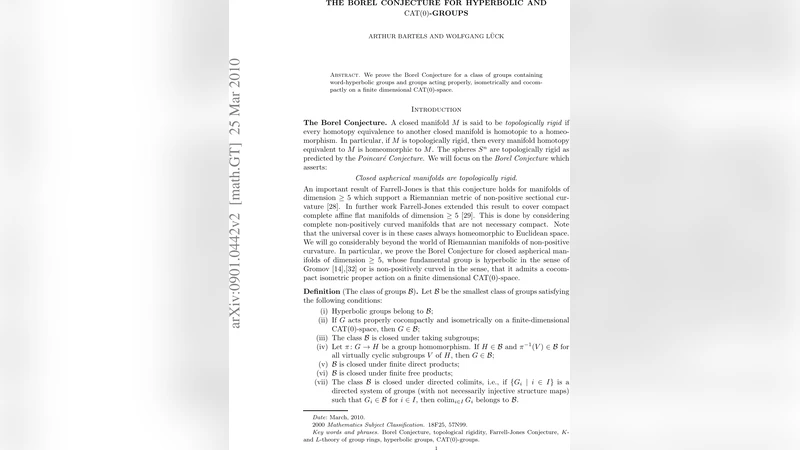
We prove the Borel Conjecture for a class of groups containing word-hyperbolic groups and groups acting properly, isometrically and cocompactly on a finite dimensional CAT(0)-space.
💡 Research Summary
The paper addresses the long‑standing Borel Conjecture, which asserts that closed aspherical manifolds of dimension at least five are topologically rigid: their homeomorphism type is completely determined by their fundamental group. While the conjecture had been verified for several special families of groups—most notably word‑hyperbolic groups and certain CAT(0) groups—the present work unifies and substantially extends these results. The authors prove the conjecture for a broad class of groups that includes all word‑hyperbolic groups and all groups that act properly, isometrically, and cocompactly on a finite‑dimensional CAT(0) space.
The strategy follows the modern paradigm of reducing topological rigidity to algebraic statements in K‑ and L‑theory, specifically the Farrell‑Jones Conjecture (FJC). The authors first establish the FJC for the target class of groups in both algebraic K‑theory and L‑theory. To achieve this, they introduce a refined notion of “transfer reducibility” that works uniformly for hyperbolic and CAT(0) groups. Central to the construction is a finite‑dimensional “flow space” X_F equipped with a G‑action, where G denotes the group under consideration. In the hyperbolic case, the flow space is built from the Gromov boundary and the geodesic flow; for CAT(0) groups, it is constructed from the visual boundary together with contracting geodesics. In both settings X_F enjoys finite asymptotic dimension and finite decomposition complexity, properties that are crucial for controlled algebraic techniques.
Using X_F, the authors define a transfer map from the equivariant K‑theory of the classifying space for virtually cyclic subgroups, E_{VCyc}G, to the equivariant K‑theory of X_F. They prove that this transfer is a homotopy equivalence, allowing the assembly map in the Farrell‑Jones framework to be factored into two more tractable pieces. The first piece is handled by controlled algebraic K‑theory, exploiting the finite decomposition complexity of X_F; the second piece, concerning L‑theory, is treated via controlled L‑theory and the theory of quadratic Poincaré complexes on X_F. In both cases the authors verify that the relevant assembly maps are isomorphisms.
Having secured the algebraic isomorphisms, the paper turns to the topological consequences. The vanishing of the Whitehead group Wh(π₁(M)) and the triviality of the structure set S^top(M) follow from the K‑ and L‑theoretic Farrell‑Jones results together with classical surgery theory. Consequently, any closed aspherical manifold M of dimension ≥5 whose fundamental group lies in the considered class is topologically rigid, confirming the Borel Conjecture for this large family of groups.
The authors also compare their approach with earlier work. For hyperbolic groups, previous proofs relied heavily on boundary dynamics and the existence of a flow on the boundary; the present method replaces those arguments with a unified flow‑space construction that works equally well for CAT(0) groups. For CAT(0) groups, earlier results required the existence of a finite‑dimensional model for the classifying space; here the authors only need a proper, cocompact, isometric action on a finite‑dimensional CAT(0) space, a more natural geometric hypothesis.
Finally, the paper discusses prospects for further generalisation. The techniques of transfer reducibility and controlled algebraic K‑/L‑theory appear adaptable to relatively hyperbolic groups, hierarchically hyperbolic groups, and groups with finite asymptotic dimension but lacking a global CAT(0) structure. By establishing a robust, geometric framework that bridges group actions on non‑positively curved spaces with algebraic assembly maps, the authors provide a powerful toolkit for tackling the Borel Conjecture in ever broader contexts.
Comments & Academic Discussion
Loading comments...
Leave a Comment