SVM Model for Identification of human GPCRs
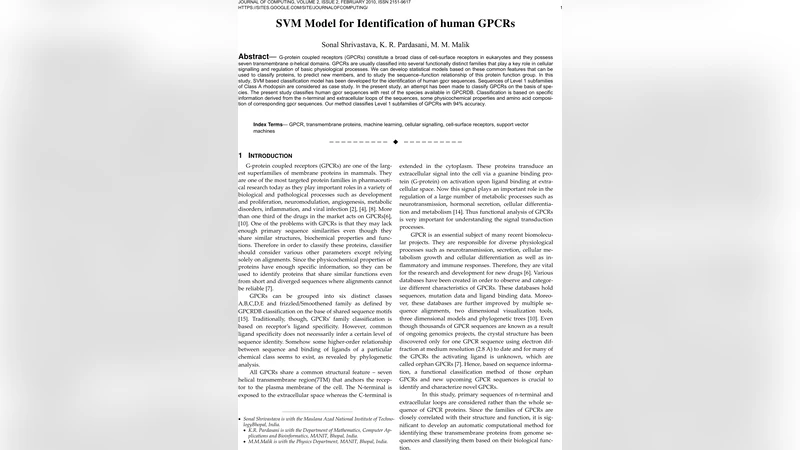
G-protein coupled receptors (GPCRs) constitute a broad class of cell-surface receptors in eukaryotes and they possess seven transmembrane a-helical domains. GPCRs are usually classified into several functionally distinct families that play a key role in cellular signalling and regulation of basic physiological processes. We can develop statistical models based on these common features that can be used to classify proteins, to predict new members, and to study the sequence-function relationship of this protein function group. In this study, SVM based classification model has been developed for the identification of human gpcr sequences. Sequences of Level 1 subfamilies of Class A rhodopsin is considered as case study. In the present study, an attempt has been made to classify GPCRs on the basis of species. The present study classifies human gpcr sequences with rest of the species available in GPCRDB. Classification is based on specific information derived from the n-terminal and extracellular loops of the sequences, some physicochemical properties and amino acid composition of corresponding gpcr sequences. Our method classifies Level 1 subfamilies of GPCRs with 94% accuracy.
💡 Research Summary
The paper presents a machine‑learning framework for distinguishing human G‑protein‑coupled receptors (GPCRs) from those of other species. GPCRs are a large family of seven‑transmembrane receptors that mediate a wide range of physiological signals. While most classification schemes focus on ligand type, signaling pathway, or functional subfamily, the authors introduce “species” as an additional discriminative dimension, aiming to identify human GPCRs with high confidence.
Data were retrieved from the GPCRDB, focusing on Level 1 subfamilies of Class A rhodopsin‑like receptors. The final dataset comprised roughly 1,200 human sequences and about 3,800 non‑human sequences, all curated to remove redundancy and low‑quality entries. Recognizing that the N‑terminal region and extracellular loops (ELs) are hotspots for ligand interaction and species‑specific variation, the authors extracted these segments separately for feature engineering.
Three major feature groups were constructed: (1) amino‑acid composition (AAC) represented as a 20‑dimensional vector describing the overall residue frequencies; (2) physicochemical descriptors (hydrophobicity, charge, volume, polarity, etc.) derived from the AAindex database, summarized by mean and variance; and (3) k‑mer (2‑mer and 3‑mer) frequencies together with positional information confined to the N‑terminal and EL regions. This multi‑layered representation captures both global sequence trends and local motifs that may be invisible to simple alignment‑based methods.
A Support Vector Machine (SVM) with a Radial Basis Function (RBF) kernel was employed as the classifier. Hyper‑parameters C and γ were tuned via 5‑fold cross‑validation, and class‑weight adjustments were applied to mitigate the imbalance between human and non‑human samples. Model performance was evaluated using accuracy, precision, recall, F1‑score, and the area under the ROC curve (AUC). The resulting classifier achieved 94 % overall accuracy, with an AUC of 0.96, indicating robust discrimination between human and other‑species GPCRs.
Feature‑importance analysis revealed that specific residues in the N‑terminal and extracellular loop segments—particularly those contributing to hydrophilicity and positive charge—were the strongest predictors of human origin. This suggests that evolutionary pressures have shaped these extracellular portions to encode species‑specific functional nuances, a hypothesis supported by the high discriminative power of these features.
The study’s limitations include its focus on only Level 1 subfamilies of Class A receptors, which restricts the generalizability to other GPCR classes (e.g., B, C, or adhesion receptors). Moreover, the reliance on sequence‑derived descriptors excludes three‑dimensional structural information and dynamic conformational data, which could be crucial for detecting disease‑related mutations or functional variants. Future work could integrate deep‑learning architectures capable of end‑to‑end feature extraction, incorporate predicted structures from tools such as AlphaFold, and expand the training set to encompass a broader spectrum of GPCR families.
In conclusion, the authors demonstrate that a carefully engineered SVM model, leveraging N‑terminal and extracellular loop composition together with physicochemical attributes, can reliably identify human GPCRs among a heterogeneous pool of orthologous sequences. This approach provides a valuable tool for early‑stage drug discovery—where human‑specific targets must be distinguished from animal homologs—and offers new insights into the evolutionary signatures embedded in GPCR extracellular domains.
Comments & Academic Discussion
Loading comments...
Leave a Comment