The lazy homology of a Hopf algebra
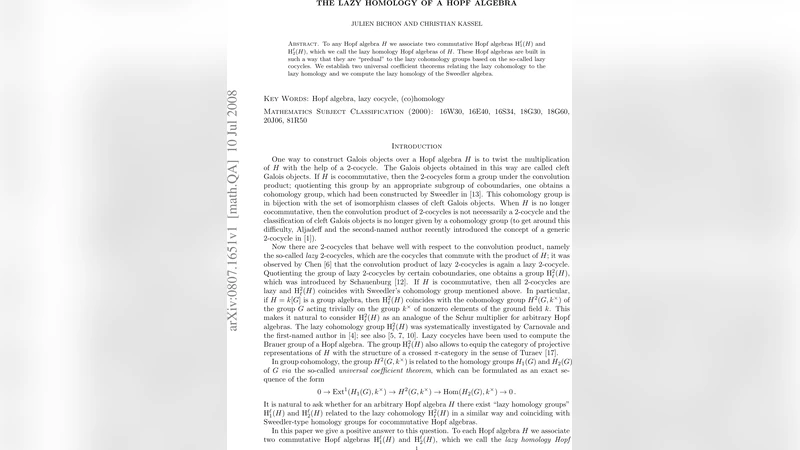
To any Hopf algebra H we associate two commutative Hopf algebras, which we call the first and second lazy homology Hopf algebras of H. These algebras are related to the lazy cohomology groups based on the so-called lazy cocycles of H by universal coefficient theorems. When H is a group algebra, then its lazy homology can be expressed in terms of the 1- and 2-homology of the group. When H is a cosemisimple Hopf algebra over an algebraically closed field of characteristic zero, then its first lazy homology is the Hopf algebra of the universal abelian grading group of the category of corepresentations of H. We also compute the lazy homology of the Sweedler algebra.
💡 Research Summary
The paper introduces a new homology theory for Hopf algebras, called lazy homology, which is designed to be dual to the already existing lazy cohomology based on lazy cocycles. For any Hopf algebra (H) the authors construct two commutative Hopf algebras (H_{\ell}^{1}(H)) and (H_{\ell}^{2}(H)). These objects are “pre‑dual” to the groups of lazy 1‑cocycles and lazy 2‑cocycles, respectively. The construction proceeds by first recalling the convolution monoid (\operatorname{Hom}(C,R)) for a coalgebra (C) and a commutative algebra (R), and then defining the subgroups of lazy elements (\operatorname{Reg}{\ell}^{1}(H,R)) and (\operatorname{Reg}{\ell}^{2}(H,R)). A lazy 1‑cocycle is an algebra map (H\to R) that is also a lazy convolution‑invertible element; a lazy 2‑cocycle is a normalized convolution‑invertible map (\sigma:H\otimes H\to R) satisfying a twisted cocycle identity and a commutation condition with the product of (H).
To obtain the homology objects the authors use Takeuchi’s free commutative Hopf algebra (F(C)) generated by a coalgebra (C). The universal property of (F(C)) yields two key identifications: (\operatorname{Hopf}(F(C),R)\cong\operatorname{Coalg}(C,R)) and (\operatorname{Alg}(F(C),R)\cong\operatorname{Reg}(C,R)). By applying these identifications to the simplicial coalgebra (\Gamma^{}(H)) (the bar construction on (H)), they obtain a simplicial commutative Hopf algebra (F(\Gamma^{}(H))). When (H) is cocommutative, the homology of this simplicial object coincides with Sweedler’s classical Hopf algebra homology (H^{\mathrm{Sw}}_{*}(H)).
The first universal coefficient theorem states that for any commutative algebra (R) there is a natural group isomorphism
\
Comments & Academic Discussion
Loading comments...
Leave a Comment