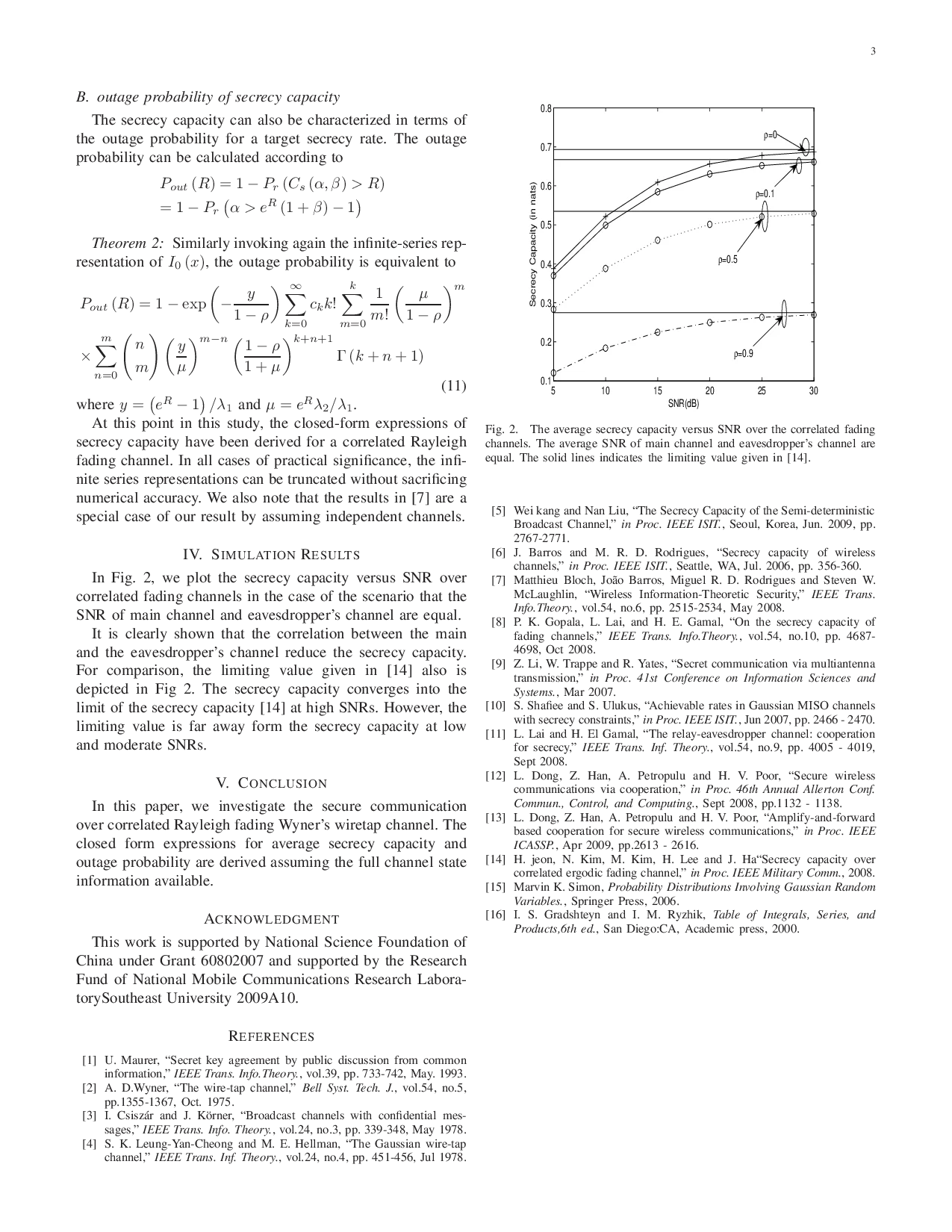
We investigate the secure communications over correlated wiretap Rayleigh fading channels assuming the full channel state information (CSI) available. Based on the information theoretic formulation, we derive closed-form expressions for the average secrecy capacity and the outage probability. Simulation results confirm our analytical expressions.
Deep Dive into Closed-Form Expressions for Secrecy Capacity over Correlated Rayleigh Fading Channels.
We investigate the secure communications over correlated wiretap Rayleigh fading channels assuming the full channel state information (CSI) available. Based on the information theoretic formulation, we derive closed-form expressions for the average secrecy capacity and the outage probability. Simulation results confirm our analytical expressions.
Because wireless communications are susceptible to eavesdropping, traditional security mechanisms mainly rely on cryptographic protocols. Recently, potential benefits of deriving secure information from physical layer have been reported in [1]. In [2], the information-theoretic secrecy capacity was introduced by using the physical properties of channels.
The basic principle of information-theoretic security has been widely accepted as the strictest notion of security, which guarantees that the sent massages can not be decoded by a malicious eavesdropper [1]. Wyner introduced wiretap channel model to evaluate secure transmissions at the physical layer [2], where Alice transmits confidential data to Bob and Eve eavesdrops the data. Csiszar et. al. and Leung-Yan-Cheong et. al. generalized it to broadcast channels and basic Gaussian channels, respectively in [3] and [4]. Wei Kang et. al. studied secure communications over two-user semi-deterministic broadcast channels [5]. The secrecy capacity is defined as the difference between the main channel capacity (Alice to Bob) and the eavesdropping’s channel capacity (Alice to Eve) [4]. Barros et. al. and Gopala et. al. generalized this Gaussian wiretap channel model to wireless quasi-static fading channels [6]- [8]. The secure MIMO systems are studied in [9]- [10]. Motivated by emerging wireless applications, there is a growing interest in exploiting the benefits of relay and cooperative strategies in order to guarantee secure transmissions [11]- [13].
In this paper, we consider the secure communications within Wyner’s correlated wiretap channel by building on the detailed technique in [7]. Similar work studied in [14] gives the limiting value of the average secrecy capacity, which only converges into the secrecy capacity at the high signal-to-noise ratio (SNR). We derive the closed-form expressions of the average secure communication capacity and the outage probability under the assumption of the full channel state information (CSI) available. Simulation results verify our analytical expressions.
National Mobile Communications Research Laboratory, Southeast University, Nanjing 210096, CHINA. E-mail: {sunxiaojun, cmzhao, jiang ming}@seu.edu.cn
where h se and h sd are complex Gaussian random variables (RV) with zero-mean. N d and N e denote zero-mean complex Gaussian noise RVs with unit-variance. The instantaneous SNRs α = |h sd | 2 and β = |h se | 2 are exponentially distributed. The average value is λ 1 and λ 2 , respectively. Since α and β are correlated variables, the joint PDF is expressed as [14][15]
where ρ is the correlation between h se and h sd . I 0 (•) is the zeroth-order modified Bessel function of the first kind. Using the infinite-series representation of I 0 (x) [16]
We can rewrite the joint PDF as
where
. In this study, we assume that Alice has access to CSI on both the main channel and the eavesdropper’s channel. For instance, Eve may be not a covert eavesdropper, but simply another user [6] [7]. Alice wants to transmit some confidential data to Bob which Alice does not wish Eve know. So, Alice can estimate the CSI of the eavesdropper’s channel [6] [7].
Start with the technique detailed in [7], which introduces the secrecy capacity over fading channel. A similar introduction was presented in [8]. Recalling the results of [7] for the Rayleigh fading wiretap channel, the secrecy capacity for one realization can be written as
where ln (1 + α) is the rate of the main channel, and ln (1 + β) denotes the rate of the eavesdropper’s channel.
The average secrecy capacity over correlated channels is derived as follows.
Theorem 1: The average secrecy capacity is averaged over all channel realizations
where function F (λ, k, µ) can be recursively evaluated or computed by using popular symbolic software like MATLAB. After integration by parts, we get
where F k is defined by [16, 3.353.5]
t dt is the exponential-integral function [16]. Γ (•) is the gamma function [16].
Proof: The integral in ( 5) is re-expressed as
The integral R 1 k can be evaluated by [16, 3.381.1]
where γ (•, •) is the incomplete gamma function defined by [16] γ
x m m! Further with some manipulations, R 1 k can be rewritten as
) Using ( 6), we can evaluate the integral m! [16]. It yields
This content is AI-processed based on ArXiv data.