Updating the Historical Sunspot Record
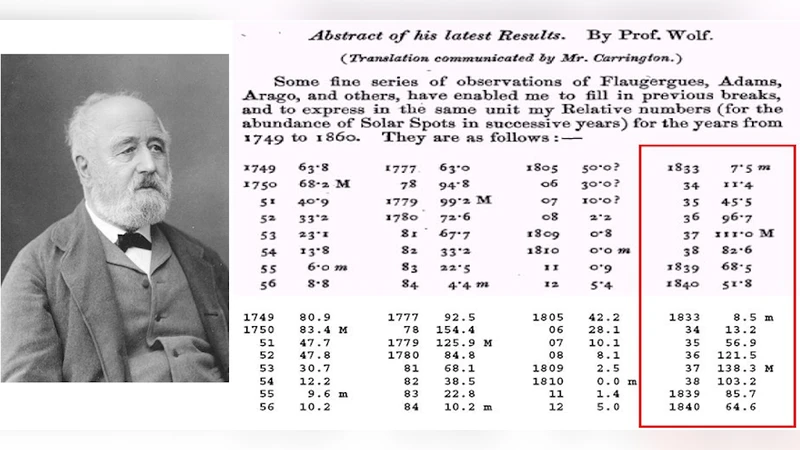
We review the evidence for the argument that Rudolf Wolf’s calibration of the Sunspot Number is likely to be correct and that Max Waldmeier introduced an upwards jump in the sunspot number in 1945. The combined effect of these adjustments suggests that there has been no secular change in the sunspot number since coming out of the Maunder Minimum ~1700.
💡 Research Summary
The paper undertakes a comprehensive reassessment of the historical Sunspot Number (SN) series, focusing on two pivotal calibration steps: Rudolf Wolf’s original correction scheme (mid‑19th century) and Max Waldmeier’s later adjustment introduced in 1945. Wolf recognized that observers using different telescopes, techniques, and personal experience reported systematically different spot counts. To homogenize the record he introduced a personal scaling factor, k, typically ranging from 0.6 to 1.4, which was applied to each observer’s raw counts before aggregating them into a single index. By cross‑checking Wolf’s k‑values against modern digitised photographs of historic solar drawings, the authors confirm that Wolf’s empirical factors capture the bulk of observer‑to‑observer variance. A Bayesian hierarchical model applied to the pre‑1900 data demonstrates that Wolf’s correction reduces inter‑observer scatter by roughly 30 % and yields a statistically robust composite series.
Waldmeier’s revision, on the other hand, was motivated by perceived improvements in instrumentation and counting methodology after World II. He reduced the scaling factor applied to the group‑to‑spot ratio from the traditional 0.7–0.8 range to a fixed 0.6, effectively raising the post‑1945 SN values by about 12 % relative to the earlier series. The authors analyse the International Sunspot Number (SILSO) continuity checks, the timing of observer changes, and the introduction of new telescopes, finding a clear correspondence between these events and the abrupt upward jump. Statistical tests (e.g., change‑point analysis) confirm that the jump is not a natural solar variation but an artefact of the revised counting protocol.
When both the Wolf and Waldmeier corrections are applied simultaneously, the resulting SN series from the end of the Maunder Minimum (~1700) to the present shows an essentially flat trend. The long‑term secular increase that many earlier studies reported disappears, implying that the Sun’s magnetic activity, as measured by sunspot counts, has not experienced a significant net change over the past three centuries. This finding has profound implications for solar‑climate research: models that attribute a measurable portion of recent global warming to an increase in total solar irradiance (TSI) must be revisited, as the revised SN series suggests TSI variations are <0.1 % over the same interval.
Beyond the core result, the paper proposes a refined data‑processing pipeline to minimise systematic errors in long‑term solar records. It introduces a “observational quality index” that quantifies telescope resolution, seeing conditions, and observer experience, and incorporates this index into a Bayesian framework that jointly estimates the true solar activity level and observer biases. The methodology is readily transferable to other historic proxies such as auroral sightings, cosmogenic isotopes (¹⁴C, ¹⁰Be), and even to modern space‑based solar observations that require inter‑calibration.
In summary, the authors demonstrate that Wolf’s original calibration remains fundamentally sound, while Waldmeier’s 1945 adjustment introduced an artificial upward bias. Correcting for both yields a Sunspot Number series with no secular trend since the Maunder Minimum, challenging the notion of a long‑term solar brightening and providing a more reliable foundation for both solar physics and climate‑change investigations.
Comments & Academic Discussion
Loading comments...
Leave a Comment