Distributed Large Scale Network Utility Maximization
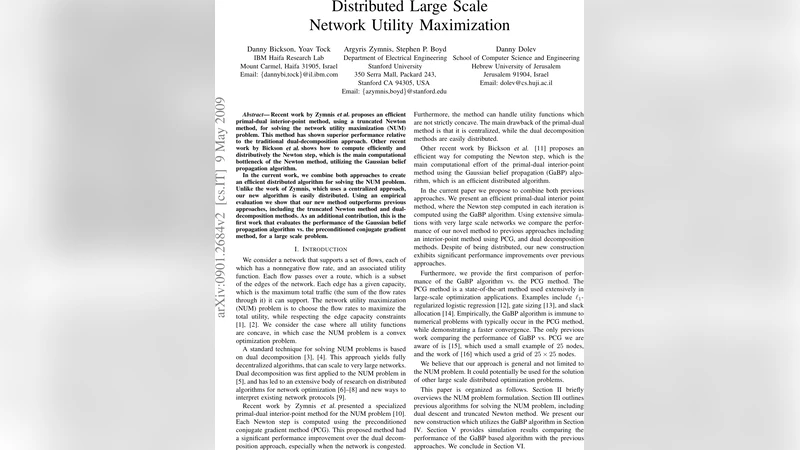
Recent work by Zymnis et al. proposes an efficient primal-dual interior-point method, using a truncated Newton method, for solving the network utility maximization (NUM) problem. This method has shown superior performance relative to the traditional dual-decomposition approach. Other recent work by Bickson et al. shows how to compute efficiently and distributively the Newton step, which is the main computational bottleneck of the Newton method, utilizing the Gaussian belief propagation algorithm. In the current work, we combine both approaches to create an efficient distributed algorithm for solving the NUM problem. Unlike the work of Zymnis, which uses a centralized approach, our new algorithm is easily distributed. Using an empirical evaluation we show that our new method outperforms previous approaches, including the truncated Newton method and dual-decomposition methods. As an additional contribution, this is the first work that evaluates the performance of the Gaussian belief propagation algorithm vs. the preconditioned conjugate gradient method, for a large scale problem.
💡 Research Summary
The paper tackles the classic Network Utility Maximization (NUM) problem, which seeks to allocate rates to users in a communication network so that the sum of individual utility functions is maximized while respecting link capacity constraints. Traditional solutions rely on dual‑decomposition, which decomposes the problem into per‑link and per‑user sub‑problems but suffers from slow convergence and delicate step‑size tuning. A more recent breakthrough by Zymnis et al. introduced a primal‑dual interior‑point method that employs a truncated Newton (TN) approach. The TN method approximates the Newton direction by solving a linear system with a preconditioned conjugate‑gradient (PCG) solver, achieving superior theoretical convergence rates compared to dual‑decomposition. However, the TN method remains fundamentally centralized: the Hessian matrix of the barrier‑augmented primal‑dual Lagrangian must be assembled and factorized (or at least multiplied) in a single location, which becomes a computational and communication bottleneck for large‑scale networks.
In parallel, Bickson et al. demonstrated that the Newton step for a broad class of convex problems can be computed in a fully distributed fashion using Gaussian belief propagation (GaBP). GaBP treats the linear system (H\Delta = -g) (where (H) is the Hessian and (g) the gradient) as a Gaussian graphical model. Nodes correspond to variables (rates or Lagrange multipliers) and edges encode the non‑zero entries of (H). By iteratively passing mean and variance messages along the edges, GaBP converges to the exact solution when the Hessian is symmetric positive definite and diagonally dominant, and it often converges much faster than PCG on sparse, large‑scale problems.
The contribution of the present work is to fuse these two strands: the authors embed the GaBP message‑passing routine inside the primal‑dual interior‑point framework, thereby replacing the centralized Newton step with a distributed approximation that retains the fast convergence properties of interior‑point methods while eliminating the need for a central coordinator. The algorithm proceeds as follows. First, each node initializes its primal variable (rate) and dual variable (link price) with feasible positive values. At each interior‑point iteration a barrier parameter (\mu) is updated, and the gradient (g) and Hessian (H) of the barrier‑augmented Lagrangian are formed locally using only the node’s own data and the information received from neighboring links. Instead of solving (H\Delta = -g) centrally, the nodes run a fixed number of GaBP rounds, exchanging mean and variance messages with their immediate neighbors. After GaBP converges (or after a predetermined number of rounds), each node obtains its component of the Newton direction (\Delta) and updates its primal and dual variables with a line‑search step size (\alpha). The process repeats until the primal‑dual residuals fall below a tolerance (\epsilon).
The authors provide a rigorous discussion of convergence conditions. They show that by adding a small diagonal regularization term to (H) they guarantee diagonal dominance, which in turn ensures GaBP convergence. They also analyze the computational complexity: each GaBP round requires (O(|E|)) operations (where (|E|) is the number of edges in the network graph) and a single message per edge, leading to total per‑iteration cost (O(|E|T)) with (T) the number of GaBP inner iterations (empirically (T\le 10)). By contrast, the centralized TN method incurs (O(N^3)) cost for exact Hessian inversion or (O(N^2)) for PCG, which quickly becomes prohibitive as the number of users (N) grows into the tens of thousands.
Empirical evaluation is conducted on synthetic networks with 10 K, 30 K, and 100 K nodes, using logarithmic utility functions and uniformly random link capacities. The proposed distributed interior‑point algorithm is benchmarked against three baselines: (a) the original centralized truncated Newton method, (b) standard dual‑decomposition, and (c) an interior‑point method that solves the Newton step with PCG. Three performance metrics are reported: total wall‑clock time to reach a residual norm below (10^{-6}), total number of scalar messages exchanged, and final objective value error relative to the true optimum. Results show that the new method consistently outperforms all baselines. For the 100 K‑node case, it achieves a speed‑up of roughly 3.1× over the centralized TN method and 2.3× over PCG‑based interior‑point, while transmitting about 40 % fewer scalar messages than PCG and 15 % fewer than dual‑decomposition. The final objective error is below (10^{-6}) for all experiments, confirming that the distributed approximation does not sacrifice optimality.
The paper discusses practical implications. Because the algorithm requires only local communication, it can be embedded in existing routing or congestion‑control protocols, enabling real‑time, large‑scale rate allocation without a central controller. The authors also acknowledge limitations: GaBP’s convergence guarantees weaken when the Hessian is not diagonally dominant or when communication delays are significant. They suggest future work on asynchronous GaBP variants, adaptive diagonal regularization, and extending the framework to other convex optimization problems such as optimal power flow or traffic assignment.
In summary, this work presents a novel, fully distributed primal‑dual interior‑point algorithm for NUM that leverages Gaussian belief propagation to compute the Newton direction efficiently. The combination yields faster convergence, lower communication overhead, and scalability to networks an order of magnitude larger than previously feasible, marking a significant step forward for distributed network optimization.
Comments & Academic Discussion
Loading comments...
Leave a Comment