The energy spectra of ultra-high energy cosmic rays (CRs) measured with giant extensive air shower (EAS) arrays exhibit discrepancies between the flux intensities and/or estimated CR energies exceeding experimental errors. The well-known intensity correction factor due to the dispersion of the measured quantity in the presence of a rapidly falling energy spectrum is insufficient to explain the divergence. Another source of systematic energy determination error is proposed concerning the charged particle density measured with the surface arrays, which arises due to simplifications (namely, the superposition approximation) in nucleus-nucleus interaction description applied to the shower modeling. Making use of the essential correction factors results in congruous CR energy spectra within experimental errors. Residual differences in the energy scales of giant arrays can be attributed to the actual overall accuracy of the EAS detection technique used. CR acceleration and propagation model simulations using the dip and ankle scenarios of the transition from galactic to extragalactic CR components are in agreement with the combined energy spectrum observed with EAS arrays.
Deep Dive into Comparing the energy spectra of ultra-high energy cosmic rays measured with EAS arrays.
The energy spectra of ultra-high energy cosmic rays (CRs) measured with giant extensive air shower (EAS) arrays exhibit discrepancies between the flux intensities and/or estimated CR energies exceeding experimental errors. The well-known intensity correction factor due to the dispersion of the measured quantity in the presence of a rapidly falling energy spectrum is insufficient to explain the divergence. Another source of systematic energy determination error is proposed concerning the charged particle density measured with the surface arrays, which arises due to simplifications (namely, the superposition approximation) in nucleus-nucleus interaction description applied to the shower modeling. Making use of the essential correction factors results in congruous CR energy spectra within experimental errors. Residual differences in the energy scales of giant arrays can be attributed to the actual overall accuracy of the EAS detection technique used. CR acceleration and propagation model
1. INTRODUCTION Ultra-high energy cosmic rays (UHECRs) are presently measured using a number of giant extensive air shower (EAS) arrays.
The observed energy spectrum exhibits the cutoff predicted by Greisen (1966) and Zatsepin and Kuzmin (1966) (GZK) and ‘Ankle’ features at energies of approximately 4 × 10 19 eV and 5 × 10 18 eV (Fukushima 2009). However, there are essential discrepancies between the flux intensities and/or the estimated energies of the initial cosmic rays (CRs) generating EASs detected by different arrays. These discrepancies exceed instrumental errors and it makes it difficult to decide for the validity of the results obtained.
The current paper presents an analysis of the sources of these discrepancies. It is shown by i) correcting the CR intensity due to instrumental errors and power law spectrum and ii) taking into account model uncertainty in the estimation of EAS initial nucleus energy that the observed UHECR energy spectra appear to be congruent. Residual differences in UHECR energy scales of arrays can be attributed to the actual overall accuracy of the EAS detection technique.
ENERGY SPECTRUM OF UHECRS There are two basic techniques for measuring UHECR parameters with EAS arrays and, in particular, for estimating the energy. The first is the measurement of the electromagnetic component and/or muons reaching the ground; the energy is estimated using a model simulation of the particle density at a particular distance from the shower axis (e.g., S 600 ). The second technique is based on the measurement of the ionization integral of the longitudinal EAS profile with fluorescence or Cherenkov light detectors. In this case the UHECR energy, E 0 , is estimated as a sum of the ionization integral, E i , and the ivanov@ikfia.ysn.ru ‘missing energy’, E m , carried by hadrons, muons, and neutrinos. The ionization integral is given by
where N e (t) is the number of electrons and positrons at depth t; ǫ is the critical energy in air; t 0 is the electron radiation length in air. The missing energy is comparatively small (E m /E 0 < 0.1) at energies above 1 EeV (=10 18 eV), so the method used can be considered to be nearly model-independent.
A typical example of an instrument applying the first technique is the Akeno Giant Air Shower Array (AGASA) (e.g., Takeda et al. (2003)), while the second approach is realized in the High Resolution Fly’s Eye (HiRes) array, consisting of fluorescence light detectors (Abbasi et al. (2008) and references therein). Nextgeneration arrays combine both techniques: The Pierre Auger Observatory (PAO; Schussler et al. (2009)) and the Telescope Array (TA; Bergman et al. (2009)) comprise charged particle detectors and fluorescence telescopes.
In the Yakutsk array experiment these two techniques are also realized: There are scintillators on the ground detecting electrons, positrons, photons, and muons; scintillators beneath the ground detecting muons; and photomultiplier tubes (PMTs) detecting the air Cherenkov light produced by the showers (Egorova et al. 2004). Data from the scintillators and PMTs are used to estimate the energy of the UHECR particles initiating EASs. It has been shown that the two independent estimates diverge significantly, the shift in the lg E between resultant spectra of CRs is approximately 0.12 in the range E 0 > 10 18 eV (Ivanov et al. 2009). A first step in comparing the observed energy spectra is to include a correction to the measured intensity of CRs caused by the instrumental errors and power spectrum.
It was shown by Zatsepin (1959) that there should be a difference between the observed intensity of CRs and the original intensity in the case of a rapidly falling energy spectrum, due to instrumental errors and fluctuations in the shower parameters measured.
Then Murzin (1965) and Kalmykov (1969) calculated the measured intensity in the case of a lognormal distribution of S 600 and the so-called shower size, N e :
where J 0 is the actual intensity; σ N is the RMS deviation of ln N e ; κ is the integral energy spectrum index; and a N = d ln N e /d ln E 0 . In our case, the target values are the parameter Ê = ‘primary particle energy’ estimated after shower detection, and the actual energy of the CR, E 0 , that initiated the EAS. The estimated energy has a distribution around the mean value formed by the instrumental errors and fluctuations with a RMS deviation, σ. The energy fluctuation is small in comparison with instrumental errors and can therefore be neglected.
If we assume the lognormal distribution of y = ln Ê, with an average value equal to ln E 0 , then the observed intensity of CRs is given by the convolution of the primary spectrum, J 0 exp(-κz), and the distribution of instrumental errors:
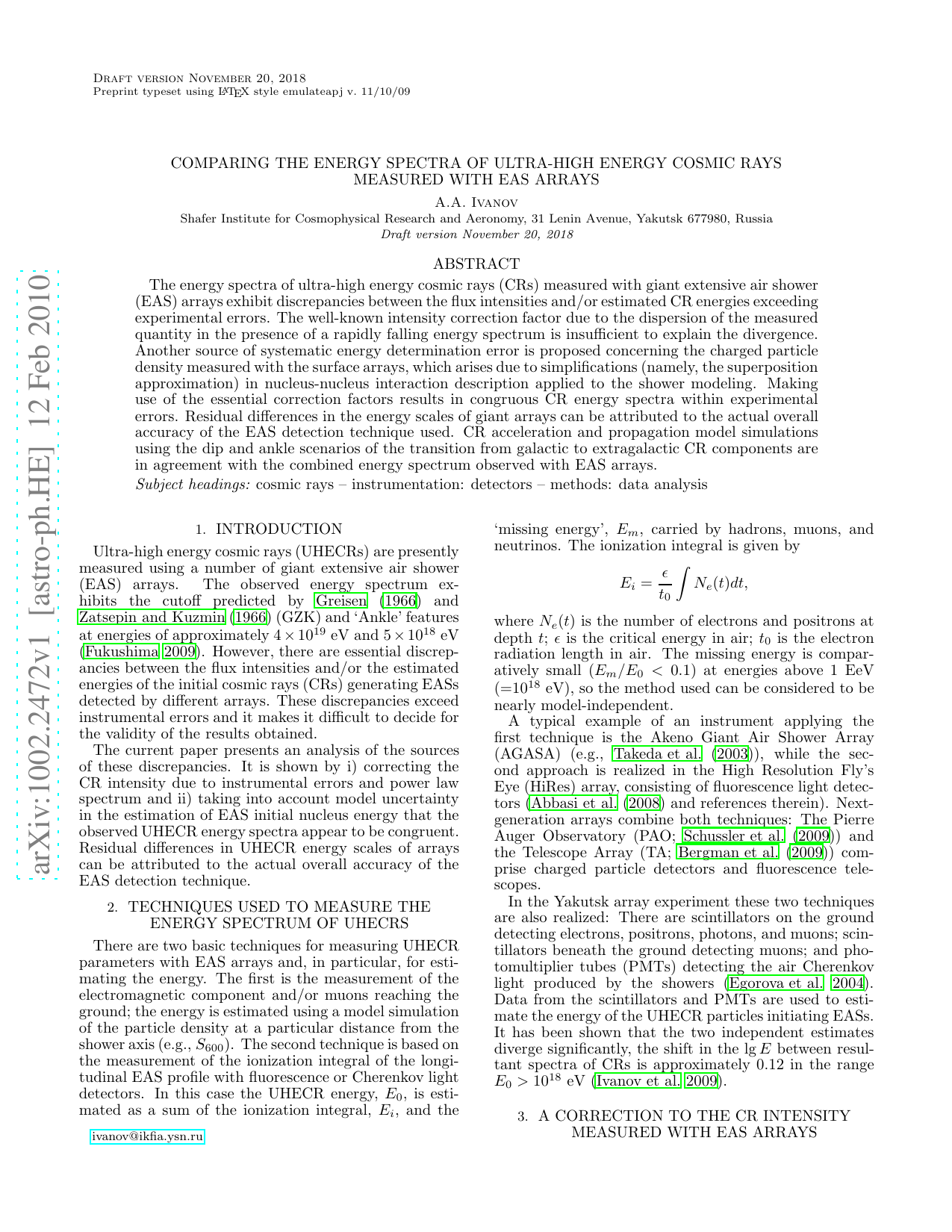
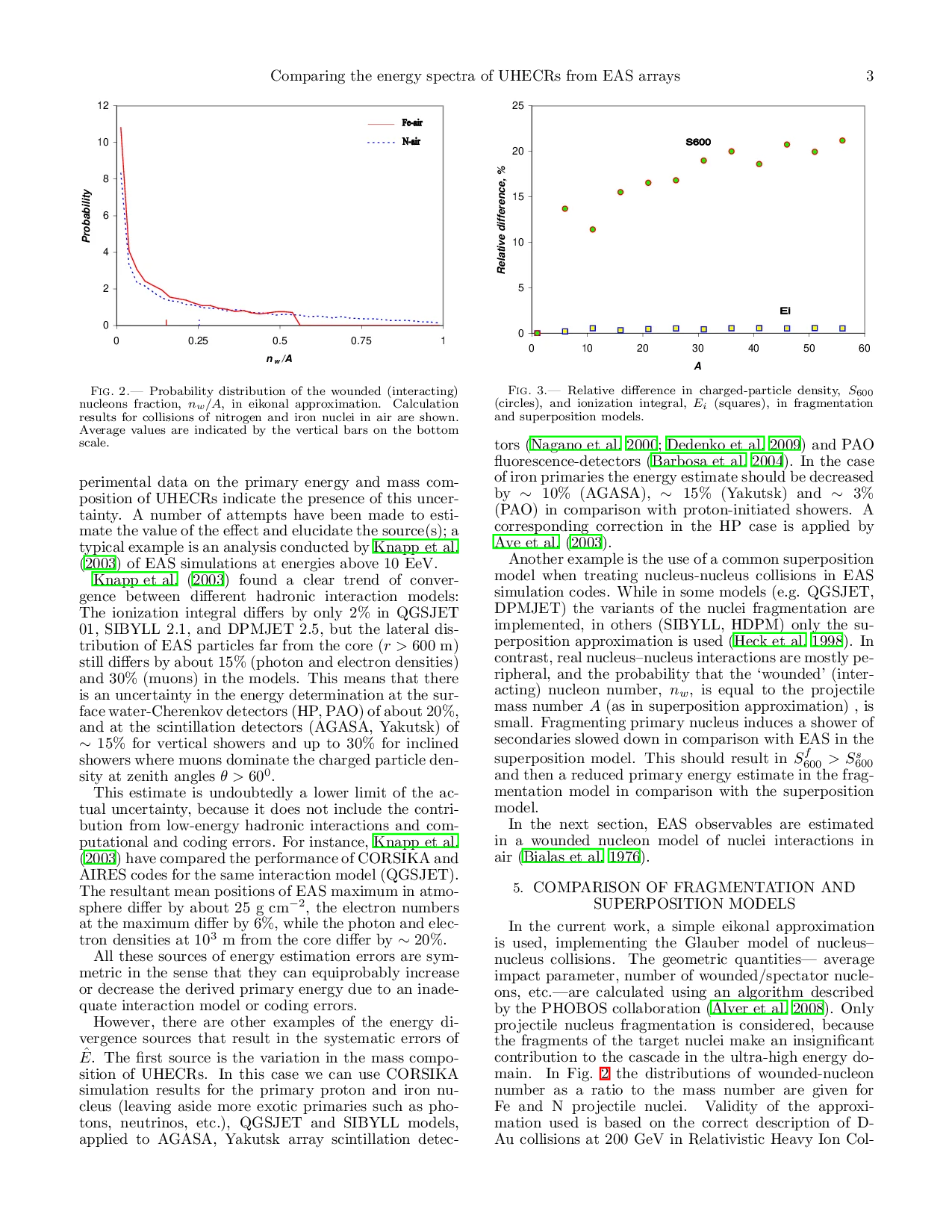
The resultant observed-to-initial intensity conversion factor is (Murzin 1965;Ivanov et al. 2009): The necessary conditions are a constant index and RMS error. As a crude approach, one can use the broken power law approximation of th
…(Full text truncated)…
This content is AI-processed based on ArXiv data.