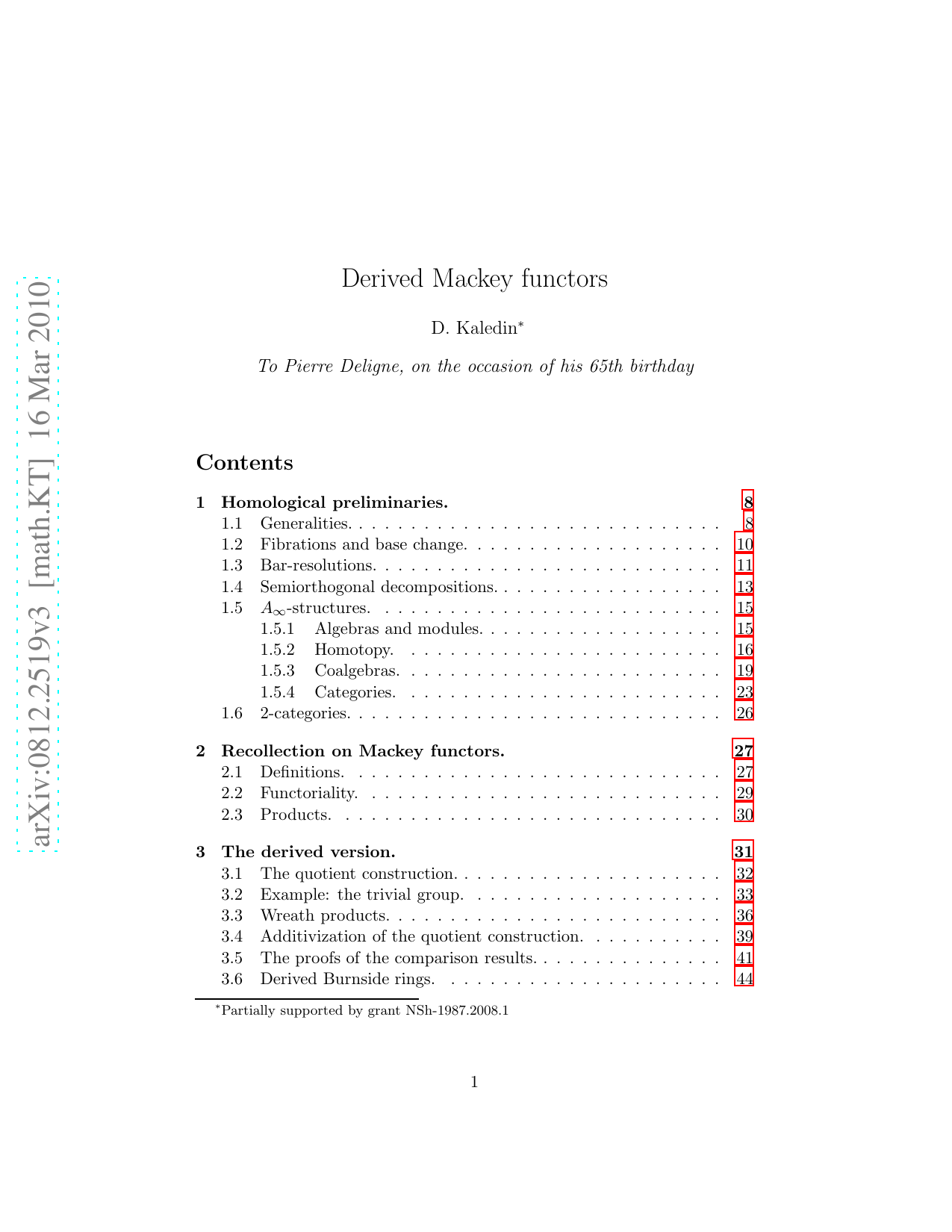
For a finite group $G$, the so-called $G$-Mackey functors form an abelian category $M(G)$ that has many applications in the study of $G$-equivariant stable homotopy. One would expect that the derived category $D(M(G))$ would be similarly important as the "homological" counterpart of the $G$-equivariant stable homotopy category. It turns out that this is not so -- $D(M(G))$ is pathological in many respects. We propose and study a replacement for $D(M(G))$, a certain triangulated category $DM(G)$ of "derived Mackey functors" that contains $M(G)$ but is different from $D(M(G))$. We show that standard features of the $G$-equivariant stable homotopy category such as the fixed points functors of two types have exact analogs for the category $DM(G)$.
Deep Dive into Derived Mackey functors.
For a finite group $G$, the so-called $G$-Mackey functors form an abelian category $M(G)$ that has many applications in the study of $G$-equivariant stable homotopy. One would expect that the derived category $D(M(G))$ would be similarly important as the “homological” counterpart of the $G$-equivariant stable homotopy category. It turns out that this is not so – $D(M(G))$ is pathological in many respects. We propose and study a replacement for $D(M(G))$, a certain triangulated category $DM(G)$ of “derived Mackey functors” that contains $M(G)$ but is different from $D(M(G))$. We show that standard features of the $G$-equivariant stable homotopy category such as the fixed points functors of two types have exact analogs for the category $DM(G)$.
introduced by Dress [Dr] and later clarified by several people, in particular by Lindner [Li]; the reader can find modern expositions in the topological context e.g. in [LMS], [M], [tD], or a more algebraic treatment in [T2].
In this paper, we will be mostly concerned with applications to algebraic topology. Of these, the main one is the following: the category of Mackey functors is the natural target for equivariant homology and cohomology.
Namely, assume given a CW complex X equipped with a continuous action of a finite group G. Then if the action is nice enough, the cellular homology complex C q(X, Z) inherits a G-action, so that we can treat homology as a functor from G-equivariant CW complexes to the derived category D(G, Z) of representations of the group G. However, this loses some essential information. For example, for any subgroup H ⊂ G, the homotopy type of the subspace X H ⊂ X of H-fixed points is a G-homotopy invariant of X in a suitable sense; but once we forget X and remember only the object C q(X, Z) ∈ D(G, Z), there is no way to recover the homology H q(X H , Z).
Thus, the Mackey functors: certain algebraic gadgets designed to remember not only the homology H q(X, Z) as a representation of G, but also all the groups H q(X H , Z), H ⊂ G, with whatever natural group action they possess, and some natural maps between them. We recall the precise definitions in Section 2. For now, it suffices to say that in the standard approach, Mackey functors form a tensor abelian category M(G) such that, among other things, (i) for any G-equivariant CW complex X, we have natural homology objects H G q (X, Z) ∈ M(G), (ii) there is a forgetful exact tensor functor from M(G) to the category Z[G]-mod of representations of G which recovers H q(X, Z) with the natural G-action when applied to H G q (X, Z), (iii) for any subgroup H ⊂ G, the homology H q(X H , Z) can also be recovered from H G q (X, Z) ∈ M(G), (iv) H G q (X, Z) is compatible with stabilization and the tensor product, and extends to the “genuine G-equivariant stable homotopy category” of [LMS], here denoted by StHom(G).
More precisely, for every subgroup H ⊂ G, one has an exact functor from M(G) to the category of abelian groups which associates an abelian group M H to every M ∈ M(G); then in (iii), there is a functorial isomorphism
One can use the correspondence M → M H to visualize the structure of the category M(G) in the following way. For any subgroup H ⊂ G, let M H (G) ⊂ M(G) be the full subcategory spanned by such M ∈ M(G) that
Then this is a Serre abelian subcategory, and the subcategories M H (G), H ⊂ G, form an increasing “filtration by support” of the category M(G).
The top associated graded quotient of this filtration is equivalent to the category Z[G]-modules -that is, we have
where M H (G) {e} =H⊂G ⊂ M(G) is the Serre subcategory generated by M H (G) for all subgroups H ⊂ G except for the trivial subgroup {e} ⊂ G.
One can also compute other quotients; for example, the smallest subcategory M G (G) ⊂ G corresponding to G itself is equivalent to the category Z-mod of abelian groups. More generally, for any normal subgroup N ⊂ G there exists a fully faithful exact inflation functor Infl N G which gives an equivalence
Analogous structures also exist on the category StHom(G). Namely, for any G-spectrum X ∈ StHom(G), one has the so-called Lewis-May fixed points spectrum X H , so that one can define the subcategories StHom H (G) by (•). Then for a normal subgroup N ⊂ G, one has a fully faithful embedding StHom(G/N ) ∼ = StHom N (G) ⊂ StHom(G). In particular, the smallest subcategory StHom G (G) ⊂ StHom(G) is equivalent to the non-equivariant stable homotopy category StHom. Another important feature of the stable category is the geometric fixed points functor Φ H : StHom(G) → StHom; on the level of Mackey functors, this corresponds to the projections onto the associated graded quotients of the filtration by support.
To a person trained in homological algebra, a natural next thing to do is to consider the derived category D(M(G)) of the abelian category M(G), and try to extend all of the above to the “derived level”: one would like to have a natural equivariant homology functor C G q (-, Z) : G -StHom → D(M(G)), and one would expect the category D(M(G)) to imitate the natural structure of the category StHom(G).
Unfortunately, and this came as a nasty surprise to the author, this program does not work: the derived category D(M(G)) is not the right thing to consider. The specific problem is that the inflation functor Infl is not an equivalence. The category D G (M(G)) which ought to be equivalent to the derived category of abelian groups is in fact rather complicated and behaves badly. So, while one might be able to construct a homology functor StHom(G) → D(M(G)), it does not seem to reflect the structure of StHom(G) too closely, and in particular, one cannot expect any reasonable compatibility with the geometric fixed point functors Φ H
…(Full text truncated)…
This content is AI-processed based on ArXiv data.