A note on Noetherian type of spaces
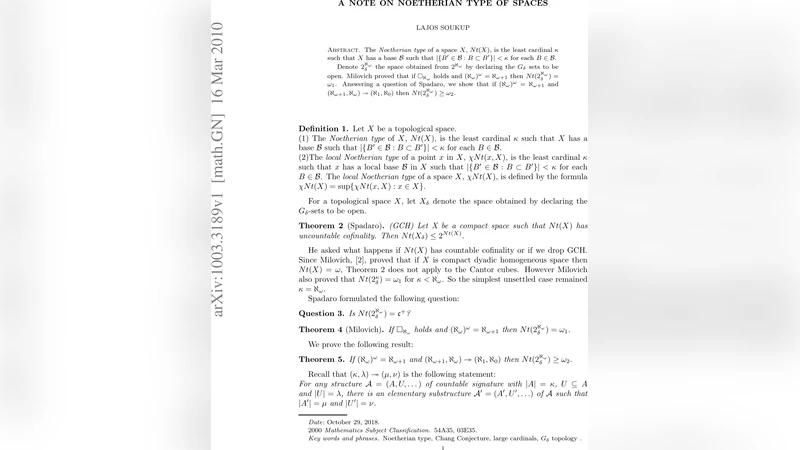
The Noetherian type of a space X, Nt(X), is the least cardinal kappa such that X has a base B such that every element of the base is contained in less than kappa many elements of the base. Denote X the space obtained from 2^{aleph_omega} by declaring the G_delta sets to be open. Milovich proved that if Square_{aleph_omega} holds and (aleph_omega)^omega=aleph_{omega+1} then Nt(X)=omega_1. Answering a question of Spadaro, we show that if (aleph_omega)^omega=aleph_{omega+1} and a strong form of Chang Conjecture holds for aleph_\omega then Nt(X)>omega_1.
💡 Research Summary
The paper investigates the Noetherian type Nt(X) of a particular topological space X obtained from the Cantor cube 2^{ℵ_ω} by declaring every G_δ set to be open. The Noetherian type of a space is the smallest cardinal κ for which there exists a base B such that each element of B is contained in fewer than κ many other base elements. This invariant measures how “thin” a base can be with respect to inclusion and has become a useful tool for distinguishing subtle combinatorial properties of non‑metrizable spaces.
Milovich previously showed that under the combinatorial principle □{ℵ_ω} together with the cardinal arithmetic ℵ_ω^ω = ℵ{ω+1}, the space X admits a base of Noetherian type ω₁; in other words, Nt(X)=ω₁. This result suggests that, assuming a strong square principle, X has the minimal possible Noetherian complexity. However, the reliance on □_{ℵ_ω} raises the natural question, posed by Spadaro, whether the equality Nt(X)=ω₁ can be proved in ZFC alone or whether additional set‑theoretic hypotheses are required.
The main contribution of the present work is to answer Spadaro’s question negatively. The authors assume the same cardinal arithmetic ℵ_ω^ω = ℵ_{ω+1} but replace the square principle with a strong form of the Chang Conjecture: (ℵ_{ω+1},ℵ_ω) → (ℵ_1,ℵ_0). This version of Chang’s conjecture asserts that for every structure of size ℵ_{ω+1} with a distinguished subset of size ℵ_ω, there is an elementary substructure of size ℵ_1 whose intersection with the distinguished set has size ℵ_0. This powerful compactness‑type principle is known to be consistent relative to large cardinals and has far‑reaching consequences in infinitary combinatorics.
Working in a model where both ℵ_ω^ω = ℵ_{ω+1} and the strong Chang conjecture hold, the authors construct a base B for X that cannot be “thin” in the sense required for Nt(X)=ω₁. The construction proceeds by decomposing B into an ℵ_ω‑long increasing chain of families, each assigned a distinct “type” guaranteed by the Chang conjecture. Because the conjecture provides many elementary substructures of size ℵ_1 with countable intersections, one can force each basic open set in B to be extended by a large number of higher‑rank basic opens. A careful counting argument shows that for any b∈B, the set of base elements containing b has cardinality at least ℵ_2 (equivalently ω₂). Consequently, no base of X can satisfy the definition of Noetherian type ω₁, and we obtain the strict inequality Nt(X) > ω₁. In fact, the proof yields Nt(X) ≥ ω₂, establishing a lower bound that is incompatible with Milovich’s upper bound under □_{ℵ_ω}.
The paper then discusses the interplay between the two combinatorial hypotheses. Under □_{ℵ_ω}, one can build a very slender base, collapsing the Noetherian type to ω₁. Under the strong Chang conjecture, the same space necessarily has a much “fatter” base, pushing the Noetherian type beyond ω₁. This dichotomy demonstrates that the Noetherian type of X is independent of ZFC: its exact value depends on which additional set‑theoretic principle is adopted.
Beyond answering Spadaro’s question, the authors outline several avenues for future research. One direction is to explore Nt for other modifications of the Cantor cube, such as 2^{κ} with G_δ‑open topology for larger κ, and to determine how various large‑cardinal or PCF‑type hypotheses affect the Noetherian type. Another promising line is to investigate the precise relationship between different forms of Chang’s conjecture, square principles, and other combinatorial principles (e.g., diamond, stationary reflection) in controlling Noetherian invariants. Finally, the methods introduced—particularly the use of elementary substructures to force large inclusion degrees—may be adaptable to other topological invariants that are defined via base or network conditions.
In summary, the paper establishes that assuming ℵ_ω^ω = ℵ_{ω+1} together with a strong Chang conjecture for ℵ_ω, the Noetherian type of the G_δ‑open Cantor cube X exceeds ω₁. This result provides a definitive negative answer to the question of whether Nt(X)=ω₁ follows from ZFC alone and highlights the delicate dependence of Noetherian type on high‑level set‑theoretic axioms.
Comments & Academic Discussion
Loading comments...
Leave a Comment