Generalized Tambara-Yamagami categories
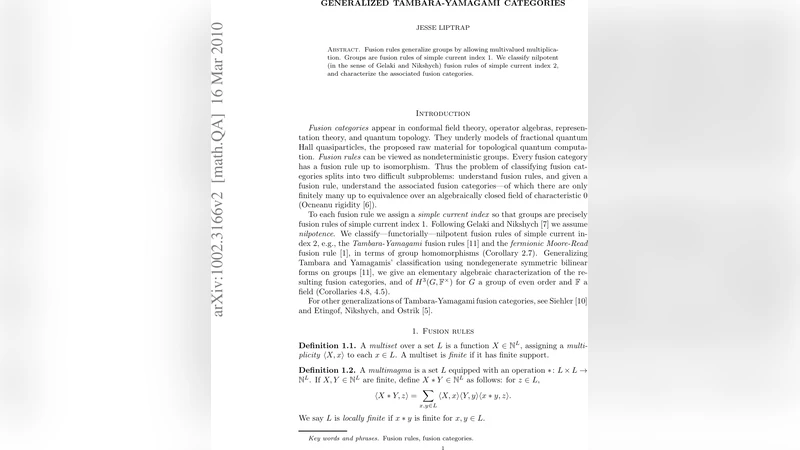
Fusion rules generalize groups by allowing multivalued multiplication. Groups are fusion rules of simple current index 1. We classify nilpotent (in the sense of Gelaki and Nikshych) fusion rules of simple current index 2, and characterize the associated fusion categories.
💡 Research Summary
The paper “Generalized Tambara‑Yamagami categories” tackles the classification problem for fusion rules whose simple‑current index equals two and which are nilpotent in the sense introduced by Gelaki and Nikshych. Fusion rules are a categorical abstraction of groups: while a group’s multiplication is single‑valued, a fusion rule allows the product of two simple objects to be a finite multiset of simples. Simple currents are those objects that fuse with any other simple object to a single simple object; the set of simple currents forms a finite abelian group, and its order is called the simple‑current index. When the index is one the fusion rule reduces to an ordinary group, but the index‑two case already exhibits genuinely new phenomena, such as non‑trivial associators and non‑abelian braiding.
The authors begin by recalling the notion of nilpotent fusion rules: a fusion rule is nilpotent if repeated tensor products eventually land inside the simple‑current subgroup. For index two this means that any product of enough non‑simple‑current objects collapses to the Z₂‑group generated by the unique non‑trivial simple current g. The main goal is to describe all such nilpotent fusion rules and to understand the tensor categories that realize them.
The classification proceeds in two conceptual steps. First, the authors fix the simple‑current subgroup C≅Z₂={1,g}. The remaining simple objects are collected in a set X, on which C acts by an involution: g⊗x = x̄, where x̄ denotes the “dual” of x under the Z₂‑action and satisfies (x̄)̄ = x. The fusion of two objects from X must decompose entirely into objects of C: \
Comments & Academic Discussion
Loading comments...
Leave a Comment