Full centre of an H -module algebra
We apply the full centre construction, defined in arXiv:0908.1250, to algebras in and module categories over categories of representations of Hopf algebras. We obtain a compact formula for the full ce
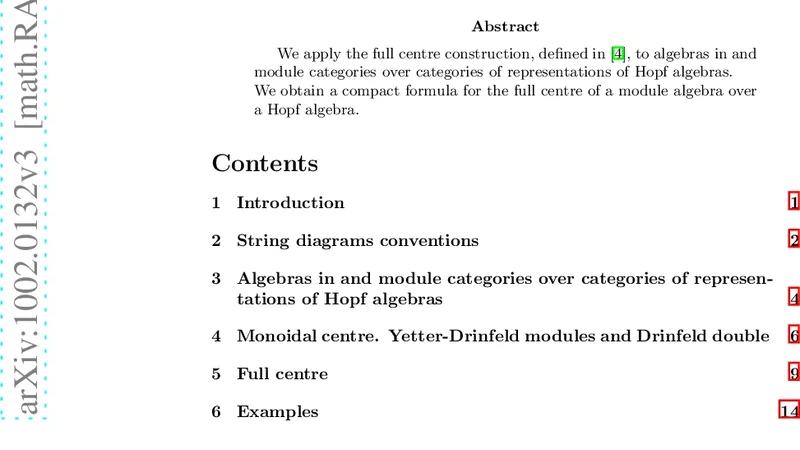
We apply the full centre construction, defined in arXiv:0908.1250, to algebras in and module categories over categories of representations of Hopf algebras. We obtain a compact formula for the full centre of a module algebra over a Hopf algebra.
💡 Research Summary
The paper investigates the full centre construction for algebras that live in module categories over representation categories of Hopf algebras. The notion of a full centre, originally introduced in arXiv:0908.1250, is a categorical refinement of the ordinary centre of an algebra: given a monoidal category 𝒞 and a 𝒞‑module category 𝓜, the full centre Z(A) of an algebra A∈𝓜 is the maximal subobject of the Drinfeld centre 𝒵(𝓜) that commutes with A in the sense of half‑braidings. This construction captures not only internal commutation relations inside A but also how A interacts with the ambient categorical symmetry.
The authors specialise to the case where 𝒞 = Rep(H) is the tensor category of finite‑dimensional representations of a Hopf algebra H over a field k, and 𝓜 is a Rep(H)‑module category. In this setting, algebras in 𝓜 are precisely H‑module algebras (i.e. algebras equipped with an H‑action that respects multiplication). The key observation is that the Drinfeld centre of Rep(H) is equivalent to Rep(D(H)), where D(H) denotes the Drinfeld double of H. Moreover, the centre of the module category 𝓜 can be identified with the centre of Rep(H) via the canonical module‑centre equivalence. Consequently, the full centre Z(A) of an H‑module algebra A can be regarded as an object of Rep(D(H)), i.e. a D(H)‑module algebra.
The main technical achievement is an explicit, compact formula for Z(A). By unraveling the half‑braiding condition in the language of Hopf actions, the authors show that Z(A) consists of those elements of the tensor product D(H)⊗A that satisfy a simple commutation relation: for every b∈A, \
📜 Original Paper Content
🚀 Synchronizing high-quality layout from 1TB storage...