Finite-rate quenches of site bias in the Bose-Hubbard dimer
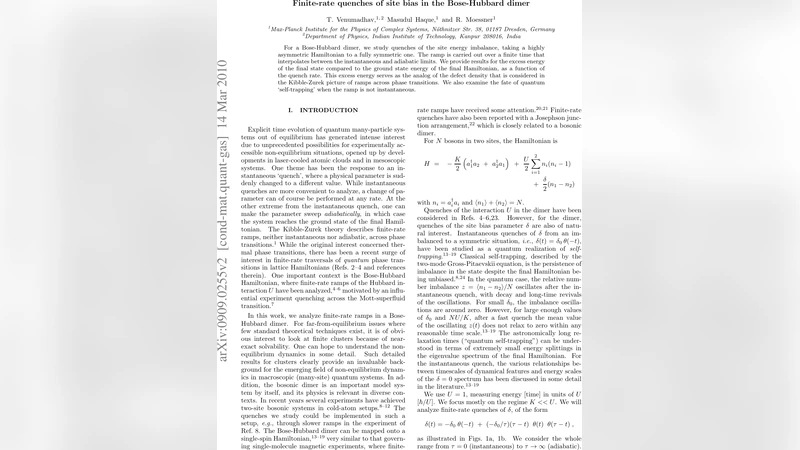
For a Bose-Hubbard dimer, we study quenches of the site energy imbalance, taking a highly asymmetric Hamiltonian to a fully symmetric one. The ramp is carried out over a finite time that interpolates between the instantaneous and adiabatic limits. We provide results for the excess energy of the final state compared to the ground state energy of the final Hamiltonian, as a function of the quench rate. This excess energy serves as the analog of the defect density that is considered in the Kibble-Zurek picture of ramps across phase transitions. We also examine the fate of quantum `self-trapping’ when the ramp is not instantaneous.
💡 Research Summary
The paper investigates non‑equilibrium dynamics in the simplest interacting bosonic lattice system – the Bose‑Hubbard dimer – when the on‑site energy imbalance (site bias) is changed from a large, highly asymmetric value to zero, i.e. from a strongly tilted double‑well to a perfectly symmetric one. The authors consider a linear ramp of the bias Δ(t)=Δ_i(1−t/τ) performed over a finite time τ, thereby interpolating continuously between the sudden‑quench limit (τ→0) and the adiabatic limit (τ→∞). Their central observable is the excess energy ΔE(τ)=⟨ψ(τ)|H_f|ψ(τ)⟩−E_0, where |ψ(τ)⟩ is the state after the ramp, H_f is the final symmetric Hamiltonian, and E_0 is its ground‑state energy. This excess energy plays the role of a “defect density” in the Kibble‑Zurek (KZ) framework, quantifying how far the system is from the instantaneous ground state after a finite‑rate sweep across a dynamical critical point.
Methodologically the work combines exact diagonalisation of the full (N+1)‑dimensional Hilbert space with time‑dependent Schrödinger integration, mean‑field Gross‑Pitaevskii dynamics, and semiclassical phase‑space (truncated Wigner) simulations to access larger particle numbers. By varying τ over several orders of magnitude, three distinct scaling regimes emerge:
-
Sudden‑quench regime (τ≪ℏ/J). The system essentially remains frozen in the initial Fock state with almost all bosons in the lower‑energy well. Consequently ΔE is approximately constant, equal to the energy difference between the initial state and the final ground state. The self‑trapping order parameter z=(N_L−N_R)/N stays close to unity, indicating complete localization.
-
Intermediate KZ‑like regime (ℏ/J≲τ≲ℏ/Δ_i). Here the excess energy decays as a power law ΔE∝τ^{−α}. The exponent α depends on the interaction‑to‑tunnelling ratio u=U/J. For weak interactions (u≪1) the dynamics are well described by a Landau‑Zener picture for a two‑level avoided crossing, giving α≈1. In the strong‑interaction limit (u≫1) the system passes near a quantum critical point associated with the onset of self‑trapping; the scaling follows the KZ prediction α=ν/(1+νz), with ν and z the static and dynamic critical exponents of the underlying mean‑field bifurcation. Numerical data suggest α≈0.5–0.7 in this regime. Importantly, the self‑trapping parameter z begins to drop sharply as τ increases, signalling the breakdown of localization before the system reaches full adiabaticity.
-
Adiabatic regime (τ≫ℏ/Δ_i). The ramp is slow compared to the smallest gap Δ_gap≈U, and adiabatic perturbation theory predicts ΔE∝τ^{−2}. The excess energy thus becomes negligible, and the final state closely follows the symmetric ground state. The population imbalance vanishes (z≈0), confirming complete delocalisation.
The authors also examine the fate of quantum self‑trapping under finite‑rate ramps. While an instantaneous quench preserves the initial imbalance, any finite τ allows for non‑adiabatic transitions that redistribute particles. The transition from a trapped to an untrapped state is not abrupt but follows the same scaling laws that govern ΔE, indicating that self‑trapping loss is a manifestation of the same non‑adiabatic excitations that generate “defects” in the KZ picture.
Experimental relevance is highlighted for superconducting circuit platforms (two coupled nonlinear resonators or transmons) and ultracold atoms in optical double‑well potentials, where the bias can be tuned by external voltages or laser intensity. The excess energy can be inferred from state tomography or from measuring the work done during the ramp, making the predictions directly testable.
In summary, the paper demonstrates that even in a zero‑dimensional system without a thermodynamic phase transition, a finite‑rate sweep across a dynamical critical point exhibits Kibble‑Zurek‑type scaling of excitations. The excess energy serves as a quantitative proxy for defect formation, and the breakdown of quantum self‑trapping provides a concrete physical illustration of how non‑adiabaticity manifests in interacting bosonic systems. The work bridges concepts from quantum critical dynamics, Landau‑Zener theory, and adiabatic perturbation theory, offering a comprehensive benchmark for future studies of non‑equilibrium many‑body physics in minimal lattice models.
Comments & Academic Discussion
Loading comments...
Leave a Comment