Quasiperiodic and Lyndon episturmian words
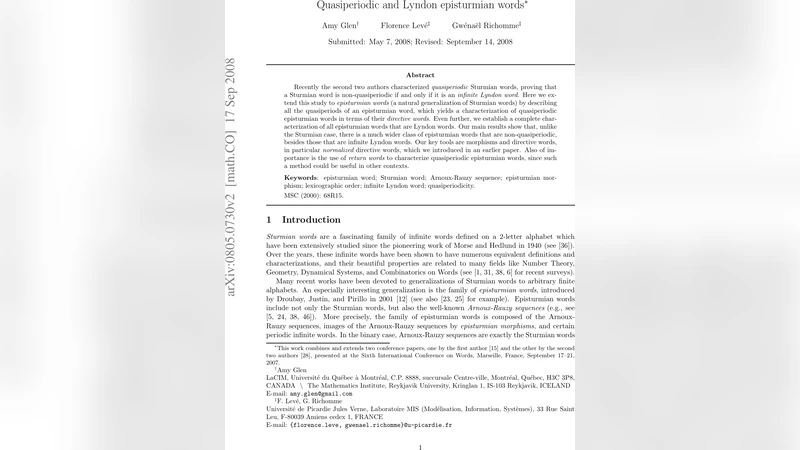
Recently the second two authors characterized quasiperiodic Sturmian words, proving that a Sturmian word is non-quasiperiodic if and only if it is an infinite Lyndon word. Here we extend this study to episturmian words (a natural generalization of Sturmian words) by describing all the quasiperiods of an episturmian word, which yields a characterization of quasiperiodic episturmian words in terms of their “directive words”. Even further, we establish a complete characterization of all episturmian words that are Lyndon words. Our main results show that, unlike the Sturmian case, there is a much wider class of episturmian words that are non-quasiperiodic, besides those that are infinite Lyndon words. Our key tools are morphisms and directive words, in particular “normalized” directive words, which we introduced in an earlier paper. Also of importance is the use of “return words” to characterize quasiperiodic episturmian words, since such a method could be useful in other contexts.
💡 Research Summary
The paper presents a comprehensive study of quasiperiodicity and Lyndon properties for episturmian words, extending earlier results that were known for Sturmian words. After recalling the definition of episturmian words—uniformly recurrent infinite words whose set of factors is closed under reversal and that have at most one right (or left) special factor of each length—the authors introduce the machinery of directive words and their normalization. A directive word is an infinite sequence of “spinned” letters (L‑spin or R‑spin) that encodes the infinite composition of pure episturmian morphisms (the morphisms Lₐ and Rₐ) needed to generate a given episturmian word. Normalized directive words are a canonical form that eliminates redundant spin changes; they were previously shown to be unique for standard episturmian words and to exist for any episturmian word.
The authors then turn to quasiperiodicity. They adopt an equivalent definition based on return words: for a finite prefix p of an infinite word x, a return word is the factor that starts at one occurrence of p and ends just before the next occurrence of p. An infinite word is quasiperiodic if the set of its return words is finite; each return word then serves as a quasiperiod. Using this viewpoint, the paper proves that every standard episturmian word is quasiperiodic. In particular, any sufficiently long palindromic prefix of a standard episturmian word is a quasiperiod, because such prefixes have only finitely many return words.
The main technical contribution is a full description of the quasiperiods of any episturmian word, not only the standard ones. The authors show that the structure of the normalized directive word determines whether the episturmian word is quasiperiodic. Roughly, if the normalized directive word contains a pattern where an L‑spin is eventually followed by an R‑spin of the same letter, then the word is quasiperiodic; otherwise it is non‑quasiperiodic. Theorem 4.19 characterizes the set of all quasiperiods in terms of the return words dictated by the directive word, while Theorem 4.28 gives a clean criterion on the directive word itself. Moreover, Theorem 4.29 provides an effective algorithm: by computing the normalized directive word and checking the presence of the forbidden spin pattern, one can decide quasiperiodicity in linear time with respect to the length of the finite prefix of the directive word examined.
Section 5 investigates how episturmian morphisms interact with quasiperiodicity. It is proved that any pure episturmian morphism maps quasiperiodic words to quasiperiodic words, extending a known result for Sturmian morphisms. Conversely, the authors classify precisely which morphisms can turn a non‑quasiperiodic word into a quasiperiodic one (Section 5.4). This leads to a second, independent proof of the main quasiperiodicity characterization, based on the preservation properties of morphisms.
The final part of the paper deals with infinite Lyndon words. In the Sturmian setting, a word is non‑quasiperiodic if and only if it is an infinite Lyndon word. The authors demonstrate that this equivalence breaks down for episturmian words. They give a complete characterization of episturmian Lyndon words in terms of their (normalized) directive words: an episturmian word is a Lyndon word exactly when its normalized directive word is lexicographically minimal among all its spinned versions. Consequently, there exist many episturmian words that are non‑quasiperiodic yet not Lyndon. The paper provides explicit families of such examples, especially over ternary alphabets, showing that the landscape of non‑quasiperiodic episturmian words is far richer than in the binary case.
Overall, the work blends combinatorial word theory, morphic decompositions, and return‑word analysis to achieve a full taxonomy of quasiperiodic and Lyndon episturmian words. It not only settles open questions about the relationship between quasiperiodicity and Lyndon properties beyond the binary case but also supplies practical algorithms for deciding these properties. The techniques introduced—particularly the use of normalized directive words and return‑word characterizations—are likely to be useful in broader contexts such as symbolic dynamics, coding theory, and the study of low‑complexity infinite sequences.
Comments & Academic Discussion
Loading comments...
Leave a Comment