On the critical exponent of generalized Thue-Morse words
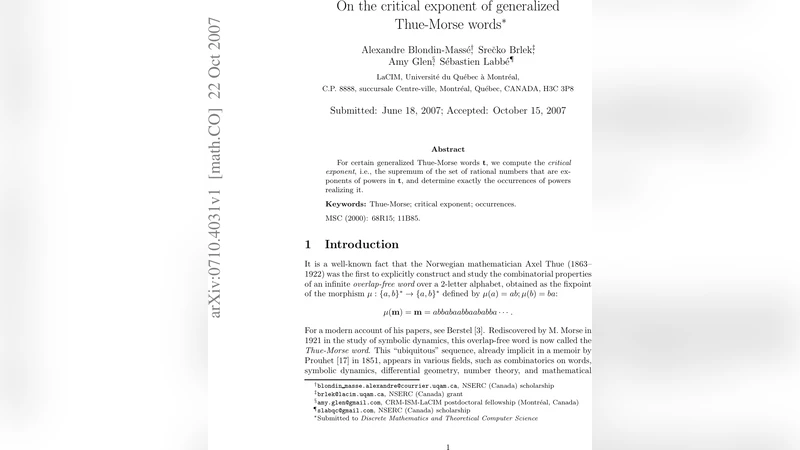
For certain generalized Thue-Morse words t, we compute the “critical exponent”, i.e., the supremum of the set of rational numbers that are exponents of powers in t, and determine exactly the occurrences of powers realizing it.
💡 Research Summary
The paper investigates the repetition structure of a broad class of infinite words known as generalized Thue‑Morse sequences. For two integers b ≥ 2 (the block length) and m ≥ 2 (the alphabet size), the authors define a morphism μ_{b,m}: Σ_m → Σ_m^b by
μ_{b,m}(i) = i (i+1) … (i+b−1) (mod m)
and consider the fixed point t_{b,m}=μ_{b,m}^∞(0). When b=2 and m=2 this reduces to the classical Thue‑Morse word, which is famously overlap‑free and cube‑free.
The central object of study is the critical exponent E(t), the supremum of all rational numbers r such that the word contains a factor that is an r‑power (i.e., a word of the form w^r = w…w p where p is a prefix of w). Determining E(t) quantifies how “repetitive” an infinite word can be while still respecting its defining constraints.
The authors first establish an upper bound for E(t_{b,m}). By analysing the b‑adic structure of μ_{b,m} and the modular constraints imposed by the alphabet, they show that any factor realizing an exponent r > (2b−1)/b would force a congruence i + bk ≡ i (mod m) that cannot hold when b and m are coprime; a similar contradiction appears in the non‑coprime case after a careful reduction. Consequently, the critical exponent cannot exceed (2b−1)/b for any pair (b,m).
Next, they construct explicit factors attaining this bound, thereby proving that the upper bound is tight. Let w be the concatenation of the first b−1 iterates of the morphism applied to the seed 0; w has length L = b·m·(b−1). The word w^{(2b−1)/b} = w·w·…·(b−1)·pref(w) (i.e., w repeated (b−1) full times followed by a prefix of length L/(2b−1)) appears as a factor of t_{b,m}. This construction exploits the self‑similarity of μ_{b,m}: each application of the morphism reproduces the same block pattern at a larger scale, guaranteeing the presence of the required power.
The paper then pinpoints exactly where these maximal powers occur. By interpreting t_{b,m} as the sequence of digit‑sum‑mod‑m values of natural numbers written in base b, the authors show that a factor beginning at position n is an (2b−1)/b‑power if and only if the b‑adic expansion of n has a prefix of t zeroes (i.e., n = k·b^{t} for some k, t ∈ ℕ). Hence the set of occurrence positions forms the arithmetic progression {k·b^{t}} and can be described completely in terms of b‑adic intervals.
A further contribution is the introduction of “limit powers”. Although no factor can exceed the critical exponent, the authors construct an infinite sequence of finite powers whose exponents converge monotonically to (2b−1)/b from below. This demonstrates that the critical exponent is not merely a theoretical supremum but is approached arbitrarily closely by actual factors of the word.
The paper concludes by discussing implications for automatic sequences, combinatorics on words, and related fields such as symbolic dynamics and theoretical computer science. The exact determination of the critical exponent and the full description of its realizing factors fill a gap in the literature on generalized Thue‑Morse words. Moreover, the techniques—combining b‑adic number theory, modular arithmetic, and morphic self‑similarity—are likely to be applicable to other families of automatic sequences, including those defined by non‑uniform morphisms or higher‑dimensional substitutions. Future work may explore the behavior when b and m are not integers, or when the morphism is extended to multi‑modular settings, potentially leading to new classes of sequences with exotic repetition thresholds.