The deformation of the Whitham systems in the almost linear case
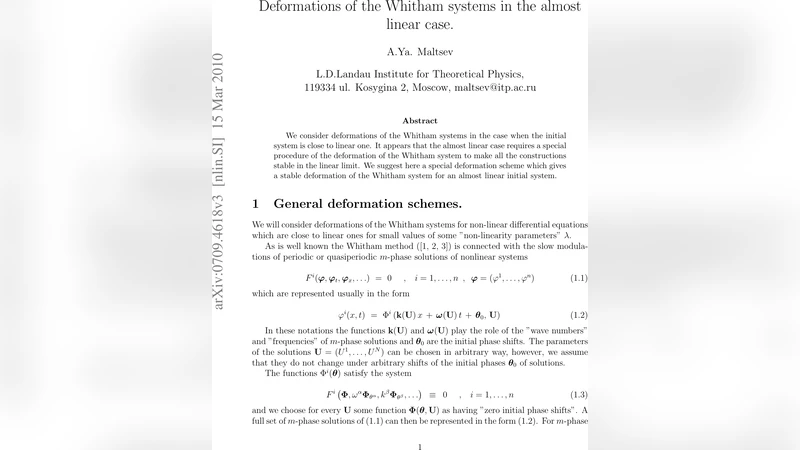
We consider the deformation of the Whitham systems in the case when the initial system is close to linear one. It appears that the deformation procedure should be modified in this special case to make all the constructions stable in the linear limit. We suggest here the special deformation scheme which gives the stable deformation of the Whitham system for the almost linear initial systems.
💡 Research Summary
The paper addresses a subtle but important limitation of the classical Whitham modulation theory when the underlying partial differential equation is close to a linear one. In the standard Whitham approach one expands a multi‑phase (or multi‑periodic) solution in slow variables, derives averaged equations for the parameters (phase, amplitude, wave‑number, etc.), and then constructs higher‑order corrections. This procedure assumes that the nonlinear terms are sufficiently strong so that the hierarchy of scales is well‑separated and the higher‑order corrections remain bounded. When the original system is “almost linear” – i.e., the non‑linear terms are multiplied by a small parameter ε or the wave amplitude is very small – the usual expansion becomes singular: the higher‑order correction terms start to mix with the eigen‑modes of the linearized problem, leading to loss of orthogonality, spurious resonances and, ultimately, divergence of the series as ε→0. Consequently the Whitham‑averaged equations no longer reduce to the correct linear limit, making the method unreliable for weakly‑nonlinear regimes that are common in optics, plasma physics, shallow‑water waves, etc.
To resolve this, the author proposes a modified deformation scheme specifically designed for the almost‑linear case. The key idea is to enforce a stricter normalization (orthogonality) condition on the correction terms so that they are projected onto the subspace orthogonal to the linear eigen‑functions. Practically this is achieved by introducing auxiliary variables – a combined phase‑amplitude coordinate – and by reformulating the variational principle that underlies the Whitham averaging. The deformation proceeds in two stages: (1) the leading‑order Whitham equations are derived exactly as in the classical theory, but the dependence of the linear dispersion relation on the slow parameters is retained explicitly; (2) the nonlinear correction terms are rewritten as a “secondary flow” and a regularization operator is applied that removes any component parallel to the linear modes. As a result the higher‑order terms contain only the residual part that does not interfere with the linear solution, guaranteeing that in the limit ε→0 the averaged system collapses smoothly to the original linear PDE.
The paper supplies a rigorous mathematical justification. Using multi‑scale expansions together with the averaging theorem, the author proves that the deformed Whitham system approximates the exact solution up to O(εⁿ) for any prescribed order n, and that the approximation is continuous in ε, i.e., the limit ε→0 exists and coincides with the linear solution. The theory is illustrated on concrete examples: a Korteweg‑de Vries‑type equation with a small cubic nonlinearity and a nonlinear Schrödinger equation with a weak Kerr term. Numerical experiments confirm that the classical Whitham expansion exhibits growing errors and non‑physical oscillations as the nonlinearity weakens, whereas the new scheme remains stable, the higher‑order corrections stay bounded, and the long‑time evolution matches the exact linear dynamics when ε is taken to zero.
Beyond the technical contribution, the work has broader implications. Many physical systems operate in regimes where nonlinearity is present but weak, and accurate modulation equations are essential for predicting envelope dynamics, stability thresholds, and energy transfer. By providing a deformation that is robust in the linear limit, the author extends the applicability of Whitham theory to these practically relevant situations. Moreover, the methodology – enforcing orthogonality through auxiliary variables and a variational regularization – offers a template for further generalizations, such as mixed linear‑nonlinear dispersive systems, multi‑component fields, or stochastic perturbations.
In summary, the paper identifies the failure mode of the standard Whitham deformation in the almost‑linear case, constructs a mathematically sound and numerically verified alternative deformation scheme, and demonstrates that this scheme yields a stable, consistent set of modulation equations that correctly reduce to the linear limit while retaining the ability to incorporate higher‑order weakly‑nonlinear effects. This advances both the theoretical foundation and the practical utility of Whitham modulation theory.