A characterization of fine words over a finite alphabet
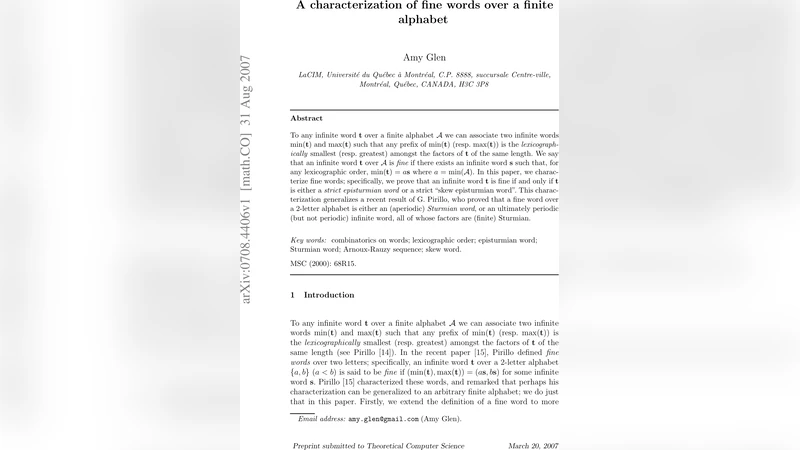
To any infinite word w over a finite alphabet A we can associate two infinite words min(w) and max(w) such that any prefix of min(w) (resp. max(w)) is the lexicographically smallest (resp. greatest) amongst the factors of w of the same length. We say that an infinite word w over A is “fine” if there exists an infinite word u such that, for any lexicographic order, min(w) = au where a = min(A). In this paper, we characterize fine words; specifically, we prove that an infinite word w is fine if and only if w is either a “strict episturmian word” or a strict “skew episturmian word’’. This characterization generalizes a recent result of G. Pirillo, who proved that a fine word over a 2-letter alphabet is either an (aperiodic) Sturmian word, or an ultimately periodic (but not periodic) infinite word, all of whose factors are (finite) Sturmian.
💡 Research Summary
The paper studies infinite words over a finite alphabet A through the lens of lexicographic extremal factors. For any infinite word w, the authors define two auxiliary infinite words min(w) and max(w) by taking, for each length k, the lexicographically smallest and largest factors of w of that length, and then concatenating these extremal factors as k grows. By construction, every prefix of min(w) (resp. max(w)) is the smallest (resp. greatest) factor of w of the same length.
A word w is called “fine” if there exists an infinite word s such that, for every possible lexicographic order on A, the equality min(w)=a s holds, where a is the smallest letter of A under that order. In the binary case {a,b} (a<b) this reduces to the condition (min(w),max(w))=(a s,b s), which is exactly the definition used by Pirillo in his study of fine words over two letters.
The main contribution is a complete characterization of fine words for arbitrary finite alphabets. The authors prove that an infinite word w is fine iff it belongs to one of two well‑studied families:
-
Strict episturmian words – these are infinite words whose set of factors is closed under reversal and which have at most one right (or left) special factor of each length. “Strict’’ means that the directive word Δ(w)=x₁x₂… contains every letter of A infinitely often. Strict episturmian words coincide with the Arnoux‑Rauzy sequences; they have minimal factor complexity (|A|−1)n+1 and generalize Sturmian words to larger alphabets.
-
Strict skew‑episturmian words – these are non‑recurrent infinite words whose every finite factor is also a factor of some strict episturmian word. In other words, they are “skew’’ analogues of episturmian words: all finite blocks look episturmian, but the infinite word itself does not satisfy the recurrence property required of genuine episturmian words.
To reach this result the paper first reviews the necessary combinatorial background: words, factors, prefixes, the lexicographic order, morphisms, and the free group F(A). A central tool is the family of epistandard morphisms Ψₐ (a∈A), defined by Ψₐ(a)=a and Ψₐ(x)=ax for x≠a. These morphisms are non‑erasing, invertible in F(A), and generate the monoid of epistandard morphisms. The authors show that applying Ψₐ preserves the “minimal‑factor’’ property in a precise way (Lemma 4.4), which is crucial for inductive arguments.
Propositions 4.2 and 4.3 connect the extremal‑factor condition to episturmian structure: a standard Arnoux‑Rauzy sequence satisfies a s = min(s) for any smallest letter a, while a standard episturmian word satisfies a s ≤ min(s). Lemma 4.4 (and its extension in Remark 4.5) demonstrates that if t = Ψ_z(t¹) and s = Ψ_z(s¹) for some letter z, then min(t)=a s ⇔ min(t¹)=a s¹, provided z belongs to the alphabet of t¹. This lemma enables the authors to peel off successive epistandard morphisms from a fine word while preserving the fine property.
The main theorem (Theorem 4.6) states: An infinite word w is fine if and only if w is either a strict episturmian word or a strict skew‑episturmian word. The proof proceeds in two directions.
-
(⇒) Assuming w is fine, the authors iteratively factor w as Ψ_{x₁}(w¹), Ψ_{x₂}(w²), … using the smallest letter a at each step. The process either continues indefinitely, yielding a strict episturmian word (the directive word contains every alphabet letter infinitely often), or it terminates after finitely many steps, after which the remaining suffix is periodic. In the latter case the whole word is shown to be a strict skew‑episturmian word.
-
(⇐) For a strict episturmian word the equality min(w)=a s follows directly from its definition and the properties of its directive word. For a strict skew‑episturmian word, the authors construct a suitable s by concatenating the appropriate epistandard morphism images of a strict episturmian word, again using Lemma 4.4 to guarantee the minimal‑factor condition.
Thus the binary result of Pirillo (fine words are either Sturmian or skew‑Sturmian) emerges as the special case |A|=2, because strict episturmian words become aperiodic Sturmian words and strict skew‑episturmian words become skew‑Sturmian words.
In summary, the paper introduces the notion of fine words, links it to the well‑developed theory of episturmian sequences, and provides a clean, exhaustive classification valid for any finite alphabet. The work highlights the interplay between lexicographic extremal factors, epistandard morphisms, and the structural dichotomy between recurrent (episturmian) and non‑recurrent (skew) infinite words. This not only generalizes known binary results but also deepens our understanding of combinatorial properties of infinite words in the broader context of symbolic dynamics and theoretical computer science.
Comments & Academic Discussion
Loading comments...
Leave a Comment